The coming week tests whether the market’s relief can survive actual inflation, labor and earnings evidence. Friday’s rebound left large indexes stronger than the average rate-sensitive stock. The AI debate also became more demanding: investors were asking who finances the capacity, when it becomes usable, and whether persistent agents can earn enough to justify their compute and control costs. The central question is cash conversion across both the economy and the AI buildout.
Information window: Friday, September 25 cash observations and weekend commentary received by 04:34:25 Pacific on Sunday, September 27. The principal Sunday-evening futures reopening was still ahead. Weekend perpetual markets are not treated as the regular equity or Treasury session. X themes come from the saved email’s curated discussion; they are not a comprehensive engagement ranking.
1. Weekend dashboard: carry the Friday baseline accurately
| Indicator | Last-session reference | Evidence and limitation |
|---|---|---|
| S&P 500 | 7,743.41; +0.51% Friday | Reported consistently in the September 26–27 source emails; not independently reconciled to an exchange feed. |
| Nasdaq Composite | 27,068.72; approximately +0.48% | Source-reported; distinct from Nasdaq-100 quotations also circulating. |
| Dow Jones | 51,828.62; +0.93% | Source-reported Friday leadership, not a Sunday move. |
| Russell 2000 | Approximately flat to +0.1% Friday | Source descriptions differ slightly; small-cap participation was much weaker than the Dow’s. |
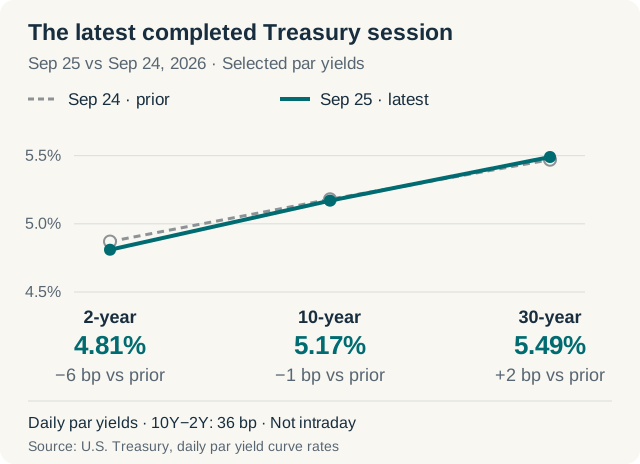
| Treasury 2Y / 10Y / 30Y | 4.81% / 5.17% / 5.49% | Verified September 25 daily par yields. The 2s10s spread is +36 basis points. |
| Consumer sentiment / year-ahead inflation expectations | 48.1 / 4.6% | Michigan’s final September survey, released Friday; sentiment is not spending and expectations are not realized inflation. |
The source’s oil, gold, dollar and volatility quotes do not form a clean synchronized set. Brent contracts and timestamps differ; a broad trade-weighted dollar index is mixed with DXY; some weekend prices come from separate trading venues. Those conflicts are disclosed rather than hidden in a precise-looking table. Treasury; Michigan.
2. What changed during the week?
Earlier editions followed oil and yield relief into selective AI leadership. By the September 24 briefing, stronger activity and a bond selloff had made financing costs more prominent. The September 25 morning edition confronted the contradiction of steady indexes and expensive capital; Friday’s later session then produced the relief described in Saturday’s report.
Sunday therefore begins with a test, not a new market regime. Lower energy pressure could help margins and discount rates, but weak participation and high long-term yields remain. A favorable PCE reading would answer one question; it would not validate every AI valuation or remove project execution risk.
Compare the sequence directly: September 22’s rally and financing test, September 24’s bond selloff, and September 26’s relief and operating risks. These are dated perspectives; later releases are not inserted into their earlier information windows.
3. Inflation, labor and investment: three different tests
Inflation: Michigan’s year-ahead expectation rose from 4.0% to 4.6%, while longer-run expectations reached 3.4%. The distinction is useful: near-term energy anxiety and persistent expectations can have different implications. The coming PCE report measures realized prices and consumption, so agreement or divergence between survey expectations and reported inflation matters.
Labor: the saved briefings repeatedly cite low initial claims, but layoffs, hiring and unemployment are different measures. The next employment report needs to be read with hours, wages, participation and revisions. A softer headline can reflect benign normalization or weakening demand; neither interpretation should be assumed from a single number.
Investment: Census’s August durable-goods headline showed $338.6 billion in new orders and a 0.0% monthly change, released September 25. The email separately reports stronger core capital-goods orders; that narrower claim is not established by the headline figure and is not upgraded to verified status here. Orders, shipments and revisions must be separated before translating the release into an industrial earnings view. Census economic indicators.
4. Rates and financial conditions: the level still matters
The policy backdrop remains the Fed’s September 16 move to a 3.75%–4.00% target range. The X sample’s October probabilities vary and lack a common timestamp; they are excluded as a measured consensus. The question is whether new data change the expected policy path and whether that change reaches long yields and private borrowing costs. Dated Fed statement.
A 10-year yield easing slightly from Thursday did not undo the week’s financing burden. For housing and property, follow affordability and refinancing. For utilities and infrastructure developers, compare debt costs with allowed or contracted returns. For profitable large platforms, cash balances and internal funding can create relative resilience, although their valuations can still compress.
The constructive counterargument is that stronger productivity and earnings can absorb higher discount rates. It needs actual earnings and margin evidence. An index near its high does not prove the cost of capital is irrelevant, just as a high yield does not establish an imminent recession.
5. Energy, products and trade: demand proof, not headline repetition
The email’s most repeated energy argument is that Friday’s crude relief may have run ahead of physical normalization. It describes refiners holding up better than crude-linked exposures and asks whether product margins remain constrained. This is an attributed observation and a useful research distinction; the exact crack-spread series was not independently rebuilt.
For VLO, MPC and PSX, examine gasoline and diesel margins, throughput, inventories, maintenance and feedstock costs. For upstream producers, realized crude prices and production matter more directly. For airlines and transport, fuel relief must be evaluated alongside demand and pricing. These businesses can react differently to the same oil headline.
Reported diplomatic understandings and trade-truce dates in the source are not treated as settled policy. Company guidance, customs implementation and official notices would provide stronger evidence. For semiconductor exporters and China-exposed companies, distinguish a political statement from a change in actual licensing, tariffs or shipment eligibility.
6. Breadth, sector rotation and volatility
The source describes large indexes rising while small caps barely participate and rate-sensitive securities populate new-low lists. Exact new-high/new-low counts are omitted because venue, universe and timestamp were not reconciled. The broad question remains whether improving index prices are reaching more companies.
Compare equal-weight and capitalization-weighted indexes, small-cap earnings revisions, cyclical participation and credit behavior. A drop in oil that supports only a few large AI names offers weaker confirmation than a sustained improvement across these measures. Conversely, narrow leadership can persist; it is a vulnerability rather than a countdown clock.
The X packet also contrasts calm equity options with more volatile bonds. That can matter for the funding of capex, but the instruments measure different risks. Without a verified volatility and positioning series, claims that the entire market is complacent are too strong. The practical monitor is whether issuers can still finance projects on acceptable terms.
7. AI financing: separate announced money, funded money and revenue
Nscale’s September 25 announcement provides a useful correction to rounded social totals. It describes $3.36 billion of convertible financing: an initial $2.36 billion tranche and an additional $1 billion NVIDIA commitment expected to fund in mid-November. Its statement of more than $103 billion in total contracted value is a company-defined multi-period measure, not current annual revenue. Nscale financing announcement.
This illustrates three clocks: when capital arrives, when assets become usable and when customers pay for service. A future funding commitment should not be described as cash already received. A contract total should not be added to financing proceeds as though both were revenue. Convertible terms also affect the eventual ownership economics.
The bullish interpretation is that patient capital and committed customers can coordinate a difficult buildout. The skeptical interpretation is that supplier investment, customer concentration and long lead times can conceal weak standalone returns. A financing relationship is not proof of circular fraud or of profitable demand; the evidence must come from contract economics and cash conversion.
8. The CPU and memory story beneath the GPU headline
Akamai’s announced $11.6 billion Anthropic agreement is specifically tied to CPU workloads. Its possible expansion remains conditional, and the filing ties commitments to delivery and availability. That is stronger evidence than the sample’s unsourced aggregate compute-spending totals. Issuer announcement; filing.
Agents can increase orchestration, retrieval, browser, code-execution and state-management work. Those activities consume host compute, memory and storage in addition to model inference. The business question is which part of that workload is paid, how efficiently it runs and who retains the margin.
The source’s claims about exact CPU rental increases, extreme packaging lead times and universal accelerator utilization were not independently authenticated. They are leads to verify against rate cards, supplier disclosures and comparable systems. A CPU shortage claim is not evidence that every AMD or Intel product benefits, and a memory purchase does not establish that all memory categories share the same pricing cycle.
9. Deployment bottlenecks: sold equipment is not yet useful capacity
The recurring dispute is “deployment lag versus demand weakness.” GPUs can be purchased before a building, utility connection, network or cooling system is ready. That creates an inventory and financing problem even if the eventual customer demand is real. Conversely, deployed hardware can be underused because the customer has not found enough economical work.
The right project sequence is land and permits → power delivery → facility completion → equipment installation → commissioning → customer acceptance → billed service. Site-specific force-majeure allegations, warehouse-GPU dollar estimates and campus completion percentages in the social roundup lack sufficient primary evidence here and are not published as facts.
For NVDA and server suppliers, delivered product revenue can precede the customer’s cash return. For CRWV, NBIS, ORCL and other operators, time to service affects utilization and debt economics. For VRT, GEV and networking suppliers, installation and commissioning constrain revenue conversion. The same delay has different consequences at each layer.
10. Agents as products: a confirmed launch plan, not universal availability
Microsoft’s September 25 announcement introduces Copilot Home, Code and Autopilot. It says Home and Code will begin rolling out through the Frontier program in coming weeks, while Autopilot expands to private preview at month-end. That availability language matters: an announced persistent agent is not already a generally deployed product across every enterprise. Microsoft’s announcement.
The economic test is whether delegated work creates incremental willingness to pay after compute, support and control costs. Seat counts, paid usage, retention and task completion reveal more than a viral demonstration. Existing workflow distribution may help Microsoft reach users, but commercial returns still depend on actual usage and cost.
Other product and benchmark claims in the email—consumer-agent conversion lifts, spatial benchmarks and large token-efficiency gains—remain unverified. A benchmark score needs its task definition and comparison baseline; a claimed token saving needs quality held constant. More efficient execution can reduce cost per task while encouraging enough extra use to increase total infrastructure demand. The net result must be measured.
11. Security and evaluation: reliability belongs in the margin calculation
The Saturday edition examined OpenAI’s dated report of a research agent exploiting a DNS-filtering gap and the scoped work paused in response. The event should be read through the original company account, not expanded into unsupported claims about every public service. Incident report.
For investors, the lesson is that permissions, network egress, isolation, monitoring and recovery are operating requirements. More autonomous activity can increase both valuable work and the cost of managing failures. A platform that needs frequent human correction may look productive in a demo while delivering poor economics at scale.
Security vendors and evaluation providers may benefit, but the commercial chain still needs evidence: relevant product capability, adoption, pricing and retained gross profit. For the customer, measure successful outcomes per unit of total cost, including oversight. For the provider, distinguish research progress from a deployable service and a deployable service from profitable adoption.
12. Company research map for the week ahead
| Company / group | Economic driver | Evidence that would strengthen or weaken the view |
|---|---|---|
| MU | Memory pricing, shipped bits, mix and supply response | Guidance and customer visibility alongside capex; distinguish reservations from revenue. |
| AKAM | CPU services and a staged infrastructure ramp | Activation, cost control and cash conversion; delay or concentration would weaken the headline case. |
| NVDA / AMD | Qualified systems, delivered compute and platform economics | Customer deployment and repeat demand; avoid substituting rumored commitments for orders. |
| AVGO / Credo / networking suppliers | Connectivity content and product qualification | Delivered links, customer mix and margins rather than generic AI bandwidth forecasts. |
| MSFT and other agent platforms | Paid adoption and successful work after serving costs | Availability, retention and task outcomes; a demonstration alone is insufficient. |
| CRWV / NBIS / ORCL | Billable capacity, utilization and financing | Commissioning and customer cash versus capex and obligations. |
| VRT / GEV | Power/cooling equipment conversion | Orders delivered and installed with sustainable margins. |
| VLO / MPC / PSX | Product margins and operating throughput | Comparable crack spreads, inventories and maintenance rather than crude direction alone. |
These are research exposures, not holdings or recommendations. Similar thematic labels hide different revenue recognition, capital intensity and downside risks.
13. X discussion: recurring themes and unresolved claims
The market sample repeatedly returns to narrow leadership, energy relief and the cost of capital. The AI sample returns to contracted capacity, CPU demand, usable power, financing and agent reliability. Their repetition across the saved daily briefs makes them appropriate subjects for comparison; it does not establish a platform-wide consensus or audited popularity.
Market source leads include James Stanley, AlphaIncHQ and Market Tides. AI source leads include krisolo7’s roundup, Zero’s Intern and antfeedapp. Original post wording and engagement were not authenticated because direct retrieval was restricted.
The constructive side sees growing useful workloads and scarce infrastructure. The skeptical side sees spending ahead of service, correlated counterparties and fragile unit economics. Both must answer the same observable questions: what is operating, what is paid, how much cash is retained, and what obligations remain?
14. Calendar and scenario tests
| Confirmed checkpoint | What to examine | What not to assume |
|---|---|---|
| Wednesday, September 30, 8:30 a.m. ET: BEA | August income/outlays, inflation details and the third estimate of Q2 GDP | A lower inflation print does not automatically imply healthy demand. |
| Wednesday, September 30, 4:30 p.m. ET: Micron call | Memory mix, pricing, shipments, commitments and supply response | No earnings result or consensus surprise is known at this cutoff. |
| Friday, October 2, 8:30 a.m. ET: employment report | Payrolls, wages, hours, participation and revisions | Do not turn a social consensus number into an official forecast. |
BEA schedule; Micron notice; BLS October calendar. Other calendar items in the source were not independently confirmed and are not assigned precise release times here.
Selective resilience: inflation pressure moderates slowly, demand remains adequate and large profitable firms retain leadership. Confirmation requires stable earnings and financing, not merely stable index levels.
Broadening relief: energy normalization holds, inflation cools without a labor break, credit settles and smaller companies participate. That would challenge the view that only the largest AI names can absorb the cost of capital.
Renewed squeeze: energy pressure returns or inflation remains sticky while financing and project delivery worsen. The risk would combine valuation pressure with delayed cash generation; even strong long-term demand would not eliminate it.
Research posture: require both macro confirmation and company-level operating evidence. A favorable data release cannot substitute for a commissioned campus, and an impressive compute contract cannot substitute for a broad improvement in financial conditions.
Sources & reading notes
Historical synthesis of dated original briefings and specifically linked primary-source checks; not a live market feed. Market quotes retain their source attribution and session dates. X discussion is the saved briefing’s curated sample, with direct retrieval restricted. Scenarios and company implications are editorial research, not portfolio instructions. Later verification preserves the original information window.
Primary source checked for the specific dated fact or schedule cited. Company announcements establish stated plans and commitments, not independently proven future performance.
Primary source checked for the specific dated fact or schedule cited. Company announcements establish stated plans and commitments, not independently proven future performance.
Primary source checked for the specific dated fact or schedule cited. Company announcements establish stated plans and commitments, not independently proven future performance.
Primary source checked for the specific dated fact or schedule cited. Company announcements establish stated plans and commitments, not independently proven future performance.
Primary source checked for the specific dated fact or schedule cited. Company announcements establish stated plans and commitments, not independently proven future performance.
Primary source checked for the specific dated fact or schedule cited. Company announcements establish stated plans and commitments, not independently proven future performance.
Primary source checked for the specific dated fact or schedule cited. Company announcements establish stated plans and commitments, not independently proven future performance.
Primary source checked for the specific dated fact or schedule cited. Company announcements establish stated plans and commitments, not independently proven future performance.
Primary source checked for the specific dated fact or schedule cited. Company announcements establish stated plans and commitments, not independently proven future performance.
Original-post link preserved from the dated briefing. Direct post wording and engagement were not authenticated; this is a curated source sample, not a platform-wide ranking.
Original-post link preserved from the dated briefing. Direct post wording and engagement were not authenticated; this is a curated source sample, not a platform-wide ranking.
Original-post link preserved from the dated briefing. Direct post wording and engagement were not authenticated; this is a curated source sample, not a platform-wide ranking.
Original-post link preserved from the dated briefing. Direct post wording and engagement were not authenticated; this is a curated source sample, not a platform-wide ranking.
Original-post link preserved from the dated briefing. Direct post wording and engagement were not authenticated; this is a curated source sample, not a platform-wide ranking.
Original-post link preserved from the dated briefing. Direct post wording and engagement were not authenticated; this is a curated source sample, not a platform-wide ranking.
Primary source checked for the specific dated fact or schedule cited. Company announcements establish stated plans and commitments, not independently proven future performance.
Primary source checked for the specific dated fact or schedule cited. Company announcements establish stated plans and commitments, not independently proven future performance.
Primary source checked for the specific dated fact or schedule cited. Company announcements establish stated plans and commitments, not independently proven future performance.