Tuesday’s briefing describes Monday’s strong rally, led by AI-related chips and large platforms as oil and longer-term yields eased. The advance changes the near-term market tone without settling two deeper questions: how widely the gains are shared, and whether the infrastructure behind AI demand can deliver acceptable returns. New primary announcements about power, cooling and subsea bandwidth give that second question more substance.
Information window: Tuesday, September 22, 2026, before the U.S. cash open. The complete dated source was received at 05:51 a.m. Pacific. Monday, September 21 is the completed cash session; early Tuesday commentary is a separate layer. Tuesday’s closing prices, later speeches and subsequent data releases are excluded.
1. Monday’s rally, with the quote windows separated
The source reports the S&P 500 near 7,764.70, up approximately 1.49% Monday, and the Nasdaq Composite up about 2.26% to a record close. These are attributed observations. Its Nasdaq point levels mix opening and intraday references, so those levels are not combined into a closing snapshot. The same discipline applies to sector ETFs, oil contracts and premarket futures.
| Measure | Monday reference | Evidence |
|---|---|---|
| S&P 500 | About 7,764.70; +1.49% | R: original market account |
| Nasdaq Composite | Approximately +2.26% | R: reported close-to-close move |
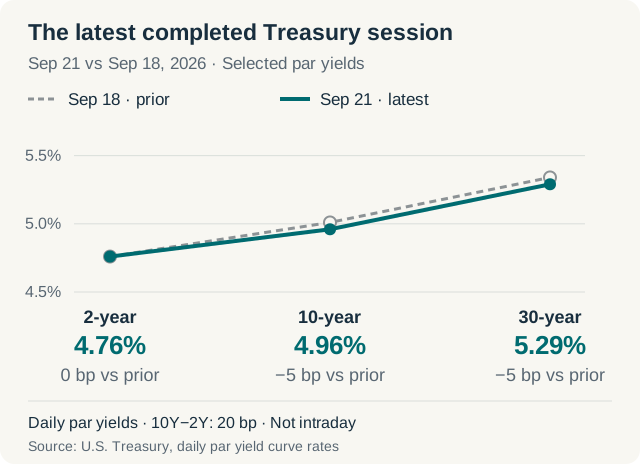
| Two / ten / thirty-year Treasury | 4.76% / 4.96% / 5.29% | V: September 21 daily par observations |
| Ten-year less two-year | +20 basis points | A: official-series calculation |
The official ten-year observation fell five basis points from Friday’s 5.01%; the two-year was unchanged. That is a small bull flattening in these daily observations, with a positive two-to-ten-year slope, not an inverted curve. Treasury series.
2. The size of the index move overstates the participation signal
The original reports advancers ahead of decliners by about 1.4 to one, an approximately 90-basis-point lag in equal-weight S&P performance, and more new lows than new highs among the constituents it tracks. These breadth figures are retained as source-reported diagnostics, not independently rebuilt statistics. Its sector account puts technology and communication services ahead of energy and utilities.
That pattern is compatible with a strong cap-weighted rally and a much less decisive experience for the typical stock. It does not invalidate the rally, but it makes the source of earnings leadership unusually important. A few very large companies can carry an index while smaller borrowers still struggle with capital costs.
The next test is whether participation improves without the leaders breaking down. A broader advance would reinforce the idea that energy relief helps the economy. Continued dependence on chips and one or two platforms would leave the index more sensitive to an industry-specific disappointment in spending, margins or monetization.
3. The policy baseline has not become easy
The Fed’s September 16 hike set the funds range at 3.75%–4.00%. The median year-end projection of 4.1% is a conditional view, not a decision about October. The source’s precise next-meeting probability is excluded because it was not independently reproduced. FOMC statement; projections.
August CPI was 3.4% above a year earlier, with core at 2.4%. August payrolls rose 162,000 and unemployment was 4.1%. These releases were already known and provide context rather than new Tuesday surprises. CPI; employment.
The morning source anticipates a day of Fed commentary. This edition does not know what those later remarks will say. The useful distinction is between a market finding the recent hike digestible and policymakers concluding inflation is resolved. Monday’s rise establishes the former market behavior; it cannot establish the latter policy judgment.
4. Oil relief remains exposed to headline reversal
The source attributes part of Monday’s relief to reports about potential easing of Hormuz disruption, then records contradictory statements and further geopolitical headlines. Those competing reports are not resolved into a confirmed reopening here. The commodity quotes also cover different contracts and times, so a single exact Brent or WTI closing value would be misleading.
The transmission is straightforward: lower sustained fuel costs would ease pressure on some businesses and inflation expectations. A brief headline-driven futures decline may not change delivered diesel prices, freight costs or refinery constraints. That difference matters for consumer margins and transport businesses as much as for upstream producers.
The original describes a relatively flat dollar, softer gold and a firm but volatile crypto market. These are source observations, not one synchronized cross-asset signal. In particular, Bitcoin prints from different hours should not be used to manufacture a clean correlation with the S&P close. Policy, leverage and continuous trading can drive a different intraday path.
5. The chip rally is a research queue, not a completed earnings argument
Intel, AMD, Qualcomm and Meta are prominent in the source’s Monday leadership account. The quoted individual-stock moves include early and intraday observations; this edition does not relabel them as verified closing returns. More significant than their precise rank is the concentration of the narrative around AI compute, platforms and supporting infrastructure.
For NVIDIA, the durable questions remain system performance, customer demand and the funding supporting deployments. AMD needs evidence that competitive deployments produce attractive economics; Intel’s reported partnership and capacity discussions require definitive company confirmation; Qualcomm’s AI opportunities need to be tied to actual products, customers and revenue periods.
The companies are not interchangeable exposures. A GPU supplier, a foundry, a processor designer and a platform owner occupy different parts of the spending chain. A common equity rally does not prove they capture the same amount of value, on the same schedule or with the same capital burden.
6. DSX Ready turns the power-and-cooling theme into a qualification process
NVIDIA’s September 21 announcement introduces DSX Ready for partner products meeting applicable AI-factory design requirements. Its initial categories are battery energy storage systems and cooling distribution units. The release lists Hitachi Energy, LG Energy Solution and Tesla in the battery category, and LG Electronics, LiquidStack and Vertiv in cooling. DSX Ready announcement.
The company explicitly distinguishes product qualification from site-level engineering and stability. That is the economic point: a qualified component can reduce selection and integration uncertainty, but it cannot by itself establish a functioning campus. These are supplier and program statements, not verified incremental orders or a revenue forecast.
For Vertiv and other equipment suppliers, the next evidence is delivery, installation and customer acceptance. For developers, it is how the chosen equipment fits the actual electrical and thermal design. Standardization can reduce friction while leaving utility work, construction execution and operating reliability as separate constraints.
7. Meta’s Petal expands the bandwidth discussion beyond the campus
Meta’s September 21 release announces Petal, an approximately 7,000-kilometer U.S.–France subsea cable intended to enter service in 2029, developed with NEC and Sumitomo Electric Industries and support from Orange on the French landing. Meta describes petabit capacity and a doubling of capacity versus its best-in-class transoceanic comparison. These are announced project goals, not bandwidth already in service. Meta’s primary announcement.
This adds a concrete long-distance infrastructure commitment to the platform story. It should not be confused with low-latency communication inside a tightly coupled training cluster. Undersea transport, links between data centers and rack-level fabrics solve different problems with different distance, latency and reliability constraints.
The same week’s Marvell optical demonstrations provide context closer to the data center. Marvell’s release. The common question is where capacity is actually scarce and which supplier’s product addresses that bottleneck profitably; the word “networking” alone is too broad to answer it.
8. Time to power includes permits, flexible demand and customer obligations
The original’s developer discussion centers on Cipher, IREN, TeraWulf, Applied Digital, Core Scientific, Nebius and CoreWeave. It also cites a reported Texas permitting pause and large analyst estimates of a national power shortfall. This edition has not established an authoritative statewide order or reconciled those forecast assumptions, so it does not present either as a verified restriction or measured shortage.
A firmer anchor is the September 16 AEMA announcement on grid-responsive demand. Its existence is verified; estimates of the total capacity it might unlock remain hypotheses. Alliance announcement.
Company analysis needs the local sequence: utility agreement, permits, electrical equipment, cooling, commissioning and tenant acceptance. Interruptible service may accelerate one project but conflict with another customer’s uptime promise. An already energized site can be valuable, while still requiring investment to support different rack densities or workloads. The timeline to revenue follows the slowest unresolved dependency.
9. Memory and agents complicate the “power, not chips” slogan
The day’s source puts power at the center of the bottleneck discussion, but power availability does not erase the need for memory, networking and orchestration. An agent can use a long context, call tools, retrieve documents and run several attempts before producing a useful answer. These steps consume different system resources and can reduce the utilization of expensive accelerators if poorly coordinated.
The research implication is to measure complete workload performance: successful tasks per unit of time and total cost, with the promised service level maintained. More raw tokens are not necessarily better output. Similarly, a memory-capacity solution is not automatically a memory-bandwidth solution, and conventional DRAM availability does not settle advanced accelerator-memory supply.
For memory and server-component suppliers, the opportunity depends on architecture and content per system. For operators, the goal is balanced utilization. A facility can possess adequate power and still fail to achieve the economics advertised in a GPU-only comparison.
10. The model debate is increasingly about the cost of getting work done
The original records practitioner criticism of recent Grok updates and speculation about another OpenAI model release. No rumored launch is treated as confirmed. Its useful debate is whether speed, token usage and reliability improve together, or whether a nominally similar price conceals a higher bill per successful task.
The preserved overnight Theo post is cited by the source in that discussion. The post could not be read independently here, so specific performance percentages and comparative rankings are not presented as measured facts. The broader source also describes developers splitting tasks among tools rather than treating one model as universally best.
For enterprise software, that makes retention, paid usage and gross profit after inference expense more meaningful than launch attention. Agents also need scoped permissions, audit trails and reliable stopping conditions. Those controls affect deployability and human review costs. Security is therefore part of the economic evaluation, without requiring an unverified breach allegation to make the point.
11. Funding and company implications: separate strategic interest from cash earned
The source discusses strategic investments, neocloud financing and expanding hyperscaler commitments. Its numerical claims about funding conversion and private-company revenue were not reconciled to filings, so they are not promoted to audited facts. A funding announcement, a cash payment, a purchase commitment and revenue recognition describe different events.
For Meta, the cable announcement indicates infrastructure commitment, while monetization still depends on product demand and operating economics. For NVIDIA and AMD, attractive customer workloads matter alongside customer access to capital. For Vertiv, qualification and equipment demand need to become deliveries and cash. For developers, contracted capacity must become a commissioned service with dependable receipts.
This is why the macro and AI stories meet. A near-5% ten-year yield changes the hurdle rate for projects whose benefits arrive years ahead. Longer-lived infrastructure and faster-obsolescing equipment need different financing assumptions. Strong demand can justify investment, but it does not make every capital structure or asset life equally sound.
12. Three debates in the source-curated X sample
Rally versus participation: the source links Brad Horn and BarkStreetGirl to the morning market discussion. Its central disagreement is whether Monday starts a broader advance or extends concentrated leadership.
Infrastructure demand versus returns: a ZeroHedge link is associated with the argument that an AI earnings disappointment could matter more to the index than another modest policy adjustment. This is a hypothesis about market dependence, not an established causal estimate.
Physical capacity versus useful output: the source links Tory Green’s September 21 discussion with flexible power and Shay Boloor’s September 22 discussion with connectivity. The earlier post is carry-forward context. These links document the curated research trail; they do not establish platform-wide popularity, verified replies or independently reproduced product performance.
13. Catalysts and the conditions for confirmation
The immediate source agenda is Fed commentary, the coming growth and labor data, petroleum conditions and policy headlines. BEA’s calendar lists GDP and August personal income and outlays for September 30; Micron has also scheduled results for September 30. BEA calendar; Micron notice. These are future checkpoints from this edition’s perspective, with no later outcomes imported.
Confirmation: fuel pressure eases durably, financing conditions stabilize and participation broadens while company demand remains strong. Partial confirmation: leaders retain gains, but equal-weight performance and project economics lag. Invalidation: energy and yields rise together, or the leading AI businesses show weaker utilization, margins or customer funding. A product demonstration alone cannot overturn that stress case; dependable delivery and cash generation can.
14. Sources and evidence boundary
V means specifically checked primary-source facts, including the existence and stated terms of company announcements. R means attributed market or reported observations in the dated source. X means source-curated social discussion whose post content and engagement were not independently authenticated. A means analysis and conditional scenarios. This historical edition preserves Monday’s session and Tuesday’s pre-open perspective. Source receipt establishes availability, not a single timestamp for all prices; forecasts and project plans remain distinct from operating results.
Sources & reading notes
Dated research with V primary-source checks, R attributed market/reporting observations, X source-curated social discussion and A editorial analysis. Company announcements establish statements and plans, not independently proven performance or future results. Cash-session dates, source availability and quote windows remain separate. No platform-wide sentiment inference or live quote feed is claimed. This is not a live market feed.
Specifically cited facts were checked against this primary release. Company statements and future plans are not independently audited outcomes.
Specifically cited facts were checked against this primary release. Company statements and future plans are not independently audited outcomes.
Specifically cited facts were checked against this primary release. Company statements and future plans are not independently audited outcomes.
Specifically cited facts were checked against this primary release. Company statements and future plans are not independently audited outcomes.
Specifically cited facts were checked against this primary release. Company statements and future plans are not independently audited outcomes.
Specifically cited facts were checked against this primary release. Company statements and future plans are not independently audited outcomes.
Specifically cited facts were checked against this primary release. Company statements and future plans are not independently audited outcomes.
Specifically cited facts were checked against this primary release. Company statements and future plans are not independently audited outcomes.
Specifically cited facts were checked against this primary release. Company statements and future plans are not independently audited outcomes.
Original link preserved from dated source research. Direct X retrieval was blocked in this review; post content, replies and engagement were not independently authenticated. Older posts are labeled as carry-forward context.
Original link preserved from dated source research. Direct X retrieval was blocked in this review; post content, replies and engagement were not independently authenticated. Older posts are labeled as carry-forward context.
Original link preserved from dated source research. Direct X retrieval was blocked in this review; post content, replies and engagement were not independently authenticated. Older posts are labeled as carry-forward context.
Original link preserved from dated source research. Direct X retrieval was blocked in this review; post content, replies and engagement were not independently authenticated. Older posts are labeled as carry-forward context.
Original link preserved from dated source research. Direct X retrieval was blocked in this review; post content, replies and engagement were not independently authenticated. Older posts are labeled as carry-forward context.
Original link preserved from dated source research. Direct X retrieval was blocked in this review; post content, replies and engagement were not independently authenticated. Older posts are labeled as carry-forward context.
Specifically cited facts were checked against this primary release. Company statements and future plans are not independently audited outcomes.
Specifically cited facts were checked against this primary release. Company statements and future plans are not independently audited outcomes.