Information window: Wednesday, September 23 cash trading and early Thursday commentary available in the source received September 24 at 06:18:09 Pacific. This edition precedes Thursday’s cash session and uses Wednesday’s daily Treasury observations. Evidence key: V = checked primary disclosure; R = source-reported market observation; X = attributed social commentary; A = analysis. Same-day closing figures and later announcements are excluded.
A broader decline changes the question
R. Wednesday’s reported losses reached beyond the technology leaders: the S&P 500 fell 0.75%, the Nasdaq Composite 1.13%, the Dow 0.68% and the Russell 2000 roughly 1.8%. The source closes are shown below as reported observations, not independently reconciled exchange data. The distinction from Tuesday is breadth: a narrow advance became a decline affecting large technology companies and smaller businesses alike.
| Wednesday, September 23 | Reported close | Reported daily change |
|---|---|---|
| S&P 500 | 7,706.03 | −0.75% |
| Nasdaq Composite | 26,936.04 | −1.13% |
| Dow | 51,511.59 | −0.68% |
| Russell 2000 | 2,838.66 | About −1.8% |
A. The relevant issue is whether stronger demand raises future cash flows enough to offset a higher required return. AI demand can remain strong while financing terms, valuation multiples and project returns deteriorate.
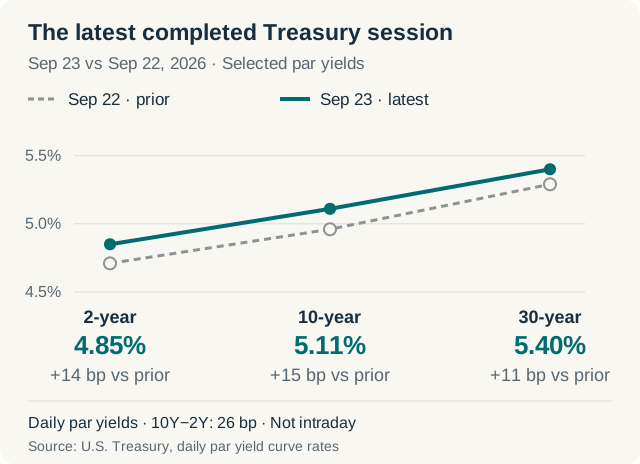
The curve supplies a firmer anchor than intraday chatter
V. Treasury’s daily par series shows a broad September 23 yield rise. These observations share a methodology and date; they should not be mixed with Thursday’s early traded-note quotes. Treasury table.
| Maturity | September 22 | September 23 | Change |
|---|---|---|---|
| 2-year | 4.71% | 4.85% | +14 basis points |
| 5-year | 4.83% | 4.99% | +16 basis points |
| 10-year | 4.96% | 5.11% | +15 basis points |
| 30-year | 5.29% | 5.40% | +11 basis points |
A. The two-to-ten-year spread moved only from 25 to 26 basis points. This looks more like a broad increase in required yields than a dramatic steepening. The source also attributes pressure to a weak five-year auction, but the auction’s claimed size, tail and buyer allocation were not verified here. The curve itself does not establish auction causation.
Strong activity brings an inflation complication
V. S&P Global’s September 23 flash composite PMI rose to 58.4 from August’s 56.0. Its release describes faster activity and hiring alongside higher input costs and capacity constraints. The survey’s growth estimates are signals, not official GDP results. S&P Global release.
A. This creates two competing channels. Better demand supports orders, utilization and revenue. Greater cost and wage pressure can squeeze margins or encourage price increases, complicating disinflation. The outcome depends on pricing power: a supplier with scarce qualified capacity differs from a consumer business whose customers can postpone purchases.
V/A. The Fed’s September 16 hike to 3.75–4.00% was already in place. The PMI does not dictate the next decision, and market-implied hike probabilities require their own timestamped pricing evidence. Firm activity weakens a simple imminent-recession narrative without resolving the inflation problem. Fed statement.
Energy, the dollar and gold transmit different risks
R. The source describes renewed oil pressure, a firmer dollar and softer gold alongside higher yields. Its exact commodity and currency quotations are drawn from different times, so they are not presented as a single comparable closing panel.
A. Oil can lift producers’ revenue while raising freight, travel, manufacturing and household costs. Refining constraints can keep diesel expensive even when crude eases. A stronger dollar can damp some imported prices but pressure translated foreign earnings and dollar borrowers. Gold can fall as yields rise despite unresolved geopolitical risk; its direction does not provide an all-purpose safety signal.
The August CPI release had already shown 0.4% monthly headline inflation and 0.3% core inflation. The next question is whether fresh fuel pressure feeds into broader prices or is absorbed in margins. BLS release.
Sector performance is a clue, not a causal verdict
R/A. The source reports energy resilience, pressure on utilities and small companies, and selected security/software names holding up better. Higher rates offer a plausible common mechanism: utilities finance long-lived assets, smaller companies may face refinancing exposure, and technology valuations can rely heavily on distant profits. Those are exposures to examine, not proof of why every stock moved.
Palo Alto Networks, CrowdStrike, Fortinet and Palantir appear in the source’s relative-strength discussion. Resilience during one session is not evidence of a new contract or earnings upgrade. The next checks are breadth within each group, sustained relative performance and actual customer or financial disclosures. A contained volatility reading also cannot establish that credit or funding conditions are benign.
AI projects face both a timing problem and a funding problem
A. A project can have a credible customer and still earn a disappointing return if it takes longer to energize or costs more to finance. Spending on equipment and construction may precede revenue; delays extend that cash gap. Contract protections matter: who bears power costs, when billing begins, whether a customer can terminate, and how much funding is fixed rather than floating.
For scale, a one-percentage-point increase applied to a hypothetical $1 billion fully floating debt balance adds $10 million of annual interest before taxes. This is arithmetic, not an estimate for any named issuer. Actual sensitivity depends on hedges, maturities, utilization and available cash.
V. Oracle’s September 10 disclosure reported negative $5.396 billion free cash flow for Q1 FY2027 alone. That historical figure illustrates why revenue growth and funding needs must be examined together; it is not a trailing-year figure or evidence of a newly disclosed September 24 problem. Oracle results.
Power scarcity creates several different business models
X. The source links Vikas Malpani’s power-constraint discussion to long interconnection waits. Exact wait-time and future-shortage estimates remain unverified. The useful question is which projects have executable delivery milestones.
A. GE Vernova’s equipment opportunity is different from Constellation or Vistra selling power, a regulated utility recovering investment through approved rates, or Vertiv supplying thermal infrastructure. Equipment orders depend on manufacturing capacity and project schedules. Merchant-power economics depend on realized prices and contract terms. Regulated returns depend on approvals and cost recovery. Cooling revenue depends on actual deployments and service execution.
V/A. NVIDIA’s September 21 DSX Ready program formalizes battery and cooling-product qualification. It helps structure supplier selection but does not itself award revenue or eliminate site engineering. Smaller powered sites could reach customers sooner, while large campuses may offer operational advantages once completed. NVIDIA announcement.
Compute and networking must be measured as a working system
A. The source’s GPU/ASIC scarcity forecasts are long-range scenarios, not current orders. NVIDIA’s system approach, AMD’s accelerator opportunity and custom-chip programs should be compared using qualified workloads, software support, memory, networking and useful throughput. Peak arithmetic performance alone says little about the customer’s delivered cost.
Broadcom and Marvell also face design-cycle and customer-concentration questions: a successful design must reach volume, and its economics depend on more than the total AI spending forecast. Optical interconnect may reduce data-movement constraints, but deployment timing, manufacturing yield and serviceability still matter.
The common checkpoint is completed work per unit of capital and energy. Hardware delivered to a warehouse, equipment installed at an unpowered site and a cluster serving paying customers are distinct states. Counting them together can overstate near-term earning capacity.
Memory strength can raise another company’s costs
A. HBM demand is only one part of the memory story. Conventional DRAM supports CPUs and servers; NAND supports storage; packaging and qualification can limit how quickly supply reaches customers. A richer product mix or stronger pricing could support Micron while raising capital costs for infrastructure buyers.
V/A. Microsoft’s January FY2026 Q2 call explained that memory-price increases affect capex before the full cloud-margin effect flows through six-year depreciation. That timing distinction remains useful: stable near-term margins do not prove that replacement equipment has become cheaper. Cash spending, depreciation and economic obsolescence should be examined separately. Microsoft transcript.
Micron’s September 30 results call is therefore a test of qualified supply, pricing, costs and expansion discipline. No Q4 result is assumed here. Company calendar announcement.
Agents could change distribution before they change revenue
X/A. The source raises agent-led booking as a challenge for Expedia, Airbnb and Booking Holdings. The thesis is that an assistant could become the discovery interface. The opposing view is that inventory access, payments, loyalty, customer service and supplier relationships remain valuable even if discovery changes.
The measurable tests are referral mix, customer-acquisition cost, direct bookings, conversion and take rate—not the number of agent demos. A platform could lose interface visibility yet retain transaction economics; another could gain traffic while paying more for it.
Agents also expand CPU work, retrieval, tool execution and permission management. For software and security vendors, the opportunity depends on paid deployment and trusted operation. Error recovery, unauthorized actions and human review can erase nominal inference savings. Palo Alto Networks, CrowdStrike and Microsoft should be examined through product adoption and incremental economics, without treating the source’s one-day stock resilience as proof.
Model evaluation provides a concrete development beyond infrastructure
V. OpenAI published MentalHealthBench on September 23, describing an open evaluation developed with more than 80 licensed mental-health experts. It evaluates model responses in realistic scenarios. This verified publication belongs in Thursday’s window; its precise release time is not established for Wednesday morning. OpenAI announcement.
A. For AI businesses, the relevant implication is that buyers need domain-specific evaluations in addition to general capability scores. Benchmark performance does not establish clinical effectiveness, deployment safety or commercial demand. Evaluation cost, monitoring and human escalation can become part of delivering a usable service.
X. The source also cites The Information’s lead about a proposed frontier-AI standards body. Its formation and authority are not verified here. A reported industry proposal must not be described as enacted regulation. Whether voluntary standards improve procurement confidence or primarily add cost remains an open question.
What the competing X arguments actually imply
X/A. The curated market stream, including ZeroHedge and Deltaone, focuses attention on higher yields. The macro disagreement is whether strong activity ultimately supports earnings, or whether inflation and policy restraint overwhelm that benefit. The first view needs durable revenue and margins; the second needs evidence that financing or costs are eroding results.
The AI disagreement is scarcity versus returns. Power advocates emphasize a physical bottleneck; skeptics ask whether customers can earn enough from the eventual capacity. These are compatible risks: supply can be scarce while an individual project is overpriced. A third debate concerns speed: smaller deployments can arrive sooner, but fragmented capacity may not satisfy every workload. The appropriate resolution is project and customer evidence, not a claim that one camp represents all of X.
A company map for the next evidence
| Company group | First economic test | Counter-evidence |
|---|---|---|
| NVIDIA, AMD, Broadcom, Marvell | Qualified systems or designs reach paid volume. | Customer delays, mix pressure or weaker realized economics. |
| Micron | Memory supply and pricing convert into cash returns. | Cost escalation or capacity spending outrunning demand. |
| Vertiv, GE Vernova, Constellation, Vistra | Orders or power contracts have deliverable schedules and margins. | Construction slippage, execution costs or unfavorable contract terms. |
| CoreWeave, Nebius, IREN, Oracle | Customer acceptance and collections cover the investment path. | Funding gaps, concentration or delayed utilization. |
| Travel, application and security platforms | Agents improve conversion, retention or paid usage. | Distribution loss, high serving costs or weak trust. |
Catalysts and conditions that would change the view
A. The next macro checks are labor resilience, the persistence of Wednesday’s yield move, energy costs and whether market participation stabilizes. The BEA calendar lists September 30 at 8:30 a.m. Eastern for the Q2 GDP third estimate and August personal income/outlays; Micron’s call follows at 4:30 p.m. No future results are incorporated. BEA schedule.
A constructive outcome would pair strong activity with easing cost pressure, steadier yields and wider earnings support. Persistent high yields with weaker margins would favor the financing-stress interpretation. Falling yields caused by deteriorating demand would require a different analysis from falling yields caused by better inflation. For AI, delivered revenue and cash collection are the checkpoints across all three scenarios.
Source limits. Original X URLs are dated, source-curated leads; direct reads were unavailable, so content, authorship and engagement remain unauthenticated. Exact auction statistics, power-shortage forecasts and several market quotes remain unverified and are omitted or attributed. Primary links establish only the facts specifically cited. This is historical research, not a live market feed.
Sources & reading notes
Historical synthesis of complete dated source packets and linked primary disclosures; not a live market feed. V denotes a specifically verified primary fact; R a source-reported market observation; X a source-curated social lead whose content was not independently authenticated; A editorial analysis. Receipt time establishes source availability, not a synchronized quotation cutoff. No later market outcomes are introduced.
Only prior-session daily par observations used; intraday quotes are separate.
Available only in the September 24 edition; survey activity is not official GDP.
Verified target range after the September 16 decision, before either edition.
September 11 release; historical background within both information windows.
Negative $5.396 billion free cash flow is Q1 FY2027 alone, not trailing-year FCF.
Direct post access was unavailable. Content, authorship and engagement are not independently authenticated; snowflake time alone is not authentication.
Verified announcement and named qualification categories; not orders or site certification.
Historical management explanation of memory-capex and six-year depreciation timing.
September 30, 2026 results call at 2:30 p.m. Mountain / 4:30 p.m. Eastern remained future.
Dated announcement used only in September 24 because the September 23 posting hour is unknown.
Direct post access was unavailable. Content, authorship and engagement are not independently authenticated; snowflake time alone is not authentication.
Direct post access was unavailable. Content, authorship and engagement are not independently authenticated; snowflake time alone is not authentication.
Direct post access was unavailable. Content, authorship and engagement are not independently authenticated; snowflake time alone is not authentication.
September 30 schedule checked during reconstruction; not an archived historical calendar capture.