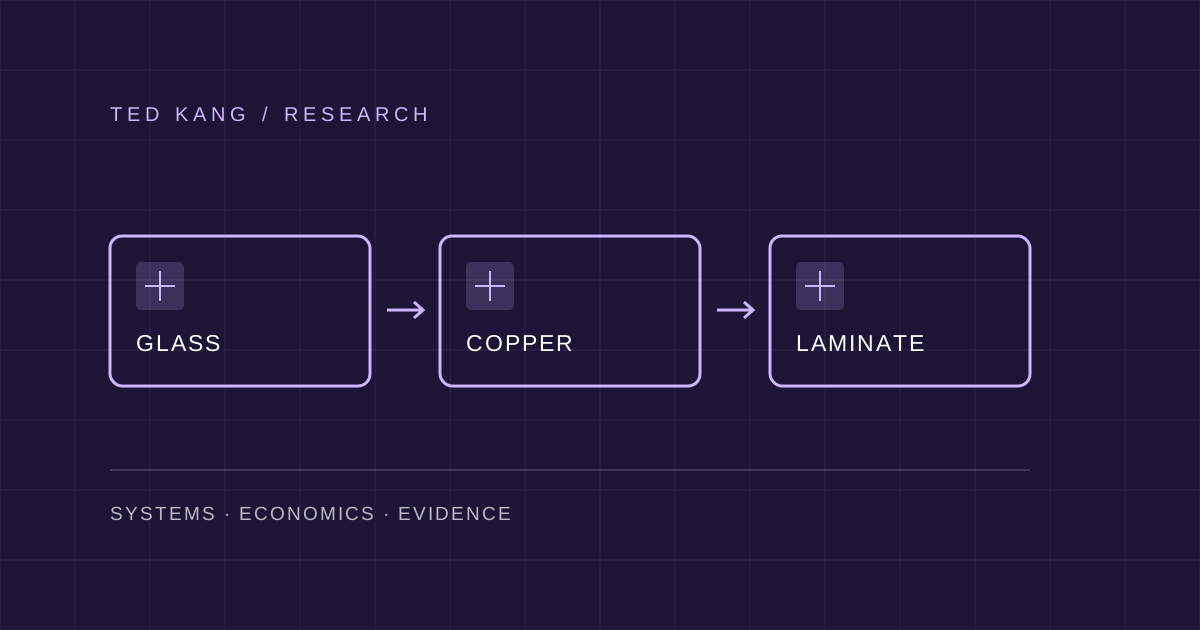
Faster AI systems demand more sophisticated materials. The central hypothesis is that content per system and slow supplier qualification can matter as much as the number of systems shipped.
This September 14 research framework follows AI infrastructure upstream into materials. The question is which specialized products can translate rising content per system into durable earnings. The September 27 source review preserves that question while separating supplier disclosures from unauthenticated market-wide forecasts.
The hypothesis is that faster, denser AI systems need more sophisticated materials to maintain signal integrity and mechanical stability. If material content rises faster than system shipments, demand can increase even without an equivalent increase in unit volumes. Scarcity and pricing power remain separate claims that require evidence about qualified supply, actual orders and competing capacity.
The core thesis
The trade is not really:
AI needs more PCBs → buy PCB suppliers.
It is:
higher bandwidth + larger boards/packages + tighter electrical tolerances → increasingly exotic materials → qualified capacity becomes the bottleneck.
That distinction is important because ordinary fiberglass, commodity copper foil and generic PCB manufacturing don't necessarily capture the economics.
The value appears concentrated in products such as:
low-Dk / low-loss glass fabric → HVLP4+ copper foil → very high-spec CCL → dense optical fiber/connectivity.
As signaling rates move from 400G toward 800G, 1.6T and eventually 3.2T, signal loss, thermal expansion, flatness and dimensional stability become increasingly difficult engineering problems. The amount and grade of materials therefore matter more than simply the number of boards being produced.
Why advanced AI boards can take longer to produce
More demanding boards can add processing steps, tighter tolerances, additional layers and inspection requirements. The effect on output depends on where those steps use constrained equipment and how much rework or yield loss they create.
| Stage | Potential constraint to investigate |
|---|---|
| Glass fabric | Yarn properties, weaving quality and customer qualification |
| Copper foil | Surface profile, treatment consistency and qualified production |
| Laminate | Resin system, dimensional stability and lamination yield |
| Board fabrication | Layer alignment, drilling, plating, testing and rework |
These are process questions, not measured cycle times for a named factory. The original secondary-source comparison had inconsistent stage totals and did not establish whether work occurred sequentially or in parallel. It is therefore unsuitable for estimating a capacity deficit.
Longer elapsed lead time does not automatically mean lower annual throughput. Work may queue, overlap or move through different machines. A credible capacity model needs the occupied time at the constrained process, good-unit yield and the rate at which new equipment can qualify.
Under those conditions, greater complexity can reduce effective capacity and support pricing. Capacity expansion, yield improvement or a redesign can reverse that result.
High-end glass fabric and qualified supply
Of the materials mentioned, high-end glass fabric provides a specific qualified-supply question.
Glass cloth provides mechanical reinforcement and electrical properties inside copper-clad laminate.
Normal glass isn't good enough for the most demanding AI designs.
Nittobo, for example, markets proprietary NE-glass with materially lower dielectric constant/loss than conventional E-glass and T-glass with low thermal expansion. Those characteristics become especially important as packages grow larger, traces become denser and signaling speeds increase. Nittobo electronic materials
Nittobo identifies T-glass with low thermal expansion for high-density package substrates, while NE-glass provides low dielectric constant and loss. Those properties address different design needs; one material should not be treated as universally superior.
Larger substrates can make warpage and dimensional stability more demanding. Qualification and the yield of the customer's final product determine whether additional supplier capacity is usable.
For capacity announcements, distinguish construction, equipment installation, customer qualification and actual shipments. Those milestones have different revenue implications.
Why this can remain constrained
Adding high-spec glass-cloth capacity isn't simply installing a generic manufacturing line.
The reported bottlenecks include:
- specialized yarn
- weaving capacity
- qualification
- manufacturing equipment
- technical know-how
- long customer validation cycles
The exact market-wide shortage percentages circulated in the original discussion were not authenticated from the underlying research. The more defensible test is whether named suppliers disclose full utilization, longer lead times, binding customer commitments or expansion schedules.
Investment implication
This is where Nittobo becomes interesting.
The key thesis isn't merely that Nittobo sells fiberglass.
It's:
Nvidia / ASIC substrate complexity pushes customers toward the highest-spec low-CTE and low-loss materials, and qualified supply cannot ramp nearly as quickly as demand.
That can generate both volume growth and ASP/mix expansion.
That is a more specific economic hypothesis than commodity material exposure; customer pricing and the cost of expansion determine whether it produces better returns.
HVLP copper foil and grade migration
Copper foil sounds mundane until signal speeds get sufficiently high.
At very high frequencies, current increasingly travels near the conductor surface. A rougher copper surface therefore creates more signal loss.
So as networking speeds rise, customers need increasingly smooth copper:
standard foil → VLP → HVLP → HVLP4+
The result is a grade migration story, not simply a copper-volume story.
Volume growth and a shift to higher-specification foil are separate drivers. Confirm the relevant grade, customer qualification and actual order mix before applying a market-wide demand estimate to one company.
Mitsui Kinzoku's June 11, 2026 statement describes continued growth potential for its VSP high-frequency copper foil and MicroThin products and consideration of further capacity investment. That supports a company-specific product and investment discussion, not the unverified global capacity share attributed to it in the source post. Mitsui copper-foil statement
Why the mechanism matters
There are two simultaneous earnings drivers:
AI PCB square meters increase and each generation migrates to more expensive foil grades.
That is usually an attractive materials setup.
The main question becomes how durable pricing power is once competing capacity eventually qualifies.
Optical fiber is real, but it's a different trade
Fiber intensity has direct company evidence, although the comparison depends on the network design.
Corning itself says an AI data center can require more than 10× the fiber of a traditional data center. Corning on AI fiber demand
And current commercial behavior supports the scarcity thesis.
On September 8, 2026, Verizon announced a multi-billion-dollar Corning agreement for more than 80 million miles of optical fiber and connectivity solutions from 2027 through 2032. It covers consumer broadband as well as long-haul connectivity serving AI demand. Fiber miles are not route miles, and the whole agreement should not be labeled AI data-center revenue. Verizon announcement
Long-term supply commitments can help suppliers plan capacity, but they do not reveal margins, immediate revenue or every condition on delivery. Read the contractual time horizon alongside the physical deployment plan.
Capacity must become qualified output before it resolves a customer's shortage. A supplier's expansion plan is therefore evidence of an intended response, not proof that the constraint has already disappeared.
The Verizon agreement supports a narrow conclusion: one large customer has secured a future supply arrangement. It does not measure the size of an industry-wide fiber shortage.
But GLW is not a pure AI-fiber stock
This matters.
Corning has:
- optical communications
- display glass
- specialty materials
- automotive/environmental technologies
- life sciences
So AI connectivity can become an important earnings driver without dominating consolidated earnings immediately.
For someone looking specifically for bottleneck torque, the Asian suppliers may offer more concentrated exposure, albeit with additional governance, currency and market-access considerations.
CCL is the broadest second-order beneficiary
Copper-clad laminate is basically the material sandwich from which PCBs are fabricated:
copper foil + resin + glass fabric → CCL
→ PCB fabrication.
This is the physical relationship shown in the source material.
No market-size forecast is needed to understand the mechanism. The relevant company evidence is shipment mix, selling prices, margins, customer qualification and the cost of adding the required grade of capacity.
The AI-specific driver isn't just more board area.
It's higher-value CCL grades.
As:
- data rates rise
- layer counts increase
- boards get larger
- thermal tolerances tighten
the laminate needs increasingly sophisticated dielectric properties.
So the dollar content per AI system can rise substantially even without proportional unit growth.
The connection to AI connectivity
The same signal-integrity problem appears at several levels of an AI system. The Credo research follows it through cables and semiconductor links.
Credo is solving signal integrity at the cable/link level.
This materials thesis is solving signal integrity inside boards, packages and optical infrastructure.
They're manifestations of exactly the same physical problem:
AI compute is scaling faster than our ability to move data reliably.
At lower bandwidth:
ordinary materials + passive copper work.
At higher bandwidth:
better glass + smoother copper + better resin + retimers/AECs + eventually more optics become necessary.
So the broader secular thesis isn't simply "AI needs GPUs."
It's:
AI is turning connectivity and signal integrity into increasingly valuable scarce resources.
That's a much more powerful organizing framework.
Why the bottleneck moves every generation
A bottleneck can move as one part of the system improves.
AI infrastructure has gone through successive bottlenecks:
Accelerator availability, memory bandwidth, advanced packaging, power delivery, cooling and connectivity can constrain the same project at different times. Their order varies by operator and design; it is not a universal calendar of investment opportunities.
None of these disappears.
Instead, solving one bottleneck exposes the next one.
That makes the installed system and the customer's next deployment more useful units of analysis than a fixed list of fashionable components.
The adjacent issue: AI package substrates
The material chain also extends into the package beneath an accelerator.
The same phenomenon is occurring in ABF substrates, which sit underneath advanced chips.
Claims about a particular supplier's utilization or price increase require dated disclosures and a clear product boundary. The unverified Ajinomoto price and capacity figures from the source discussion are excluded here.
So the materials map is increasingly:
GPU/ASIC ↓ advanced package ↓ ABF substrate ↓ PCB ↓ CCL ↓ glass fabric + resin + copper foil ↓ cables / AEC / optical ↓ fiber.
The investment question becomes:
Where is demand growing faster than qualified capacity, and where is incremental capacity hardest to create?
That's the right bottleneck screen.
Compare the constraints before ranking companies
The following questions organize further research. They are not a ranking of investment merit or a measured forecast of shortages.
| Segment | Evidence that would strengthen the case | What could weaken it |
|---|---|---|
| Specialty glass fabric | Customer-qualified capacity and durable mix improvement | New qualified suppliers or weaker demand |
| High-spec copper foil | Higher-grade shipments and sustained margins | Competing capacity and price concessions |
| Optical fiber | Contracted deliveries becoming cash-generating sales | Buildout delays or unfavorable contract economics |
| Package substrates | Yield, utilization and repeat customer programs | Redesigns or a change in packaging architecture |
| Advanced laminate | More valuable mix after input and expansion costs | Supplier price pressure or customer bargaining |
| Specialty resin | Qualified formulations with limited substitutes | Material substitution and rapid qualification of rivals |
Concentration can make a business more sensitive to a theme, but it can also concentrate customer, product and execution risk. It is not automatically a better investment.
What could break the thesis
There are several things I'd be careful about.
First, shortage forecasts are not guaranteed. A modeled gap can disappear faster than expected if capacity comes online, yields improve, customers redesign products or AI capex slows.
Second, high ASP isn't automatically high incremental profit. Suppliers may face substantial expansion capex and customer pricing negotiations.
Third, qualification creates a moat but also delays revenue. A company announcing new capacity does not mean Nvidia, Google or hyperscaler supply chains immediately adopt it.
Fourth, architecture changes matter. Greater use of optical interconnects could reduce some PCB/copper requirements while increasing completely different material categories.
Fifth, valuation can already anticipate the operating improvement. A compelling material constraint is not enough if the price assumes growth or margins that the company cannot sustain. This article does not assert a current return for an unauthenticated supplier basket.
The question is whether earnings revisions still exceed what valuation embeds.
The stock-selection framework I'd use
I would score each company across five dimensions:
Scarcity How large is the actual supply deficit?
Qualification moat How difficult is it for a new supplier to get approved?
AI revenue sensitivity Does an additional $1B of AI infrastructure demand actually move company EPS?
Pricing power Can scarcity translate into ASP increases?
Capacity response How quickly can competitors erase the shortage?
Under that framework, something like Nittobo may be more attractive conceptually than a diversified supplier where AI is only a small part of revenue.
The materials-intensity thesis
The organizing idea is AI materials intensity.
The hypothesis to test is:
AI system material demand can grow materially faster than AI-system unit volumes.
Depending on the architecture, a newer system can require:
more layers + larger substrates + lower-loss materials + smoother copper + better thermal stability + much more fiber.
That gives upstream specialty-material producers a form of content-per-system growth similar to what semiconductor investors normally look for in chips.
And when that content growth meets slow, qualification-constrained capacity, you get exactly the type of setup that produced earlier HBM and CoWoS bottleneck trades.
Examples for further company-specific research are Nittobo, Mitsui Kinzoku and Corning, with a specific objective: build their AI exposure, capacity additions, competitive positioning, earnings sensitivity and current valuation side by side. That comparison should separate a compelling industry mechanism from a company whose earnings and valuation actually support the thesis.
Sources and assumptions
The source discussion supplied a hypothesis about rising material content in AI systems. Its underlying sell-side report was not authenticated. Market-size, growth, shortage, cycle-time, capacity-share, price-change and stock-basket estimates from that discussion are excluded from this analysis. The inconsistent production-time table has been replaced with process questions.
Primary references support narrower points: Nittobo's glass properties, Mitsui's June 11 copper-foil statement, Corning's fiber-intensity comparison, and Verizon's September 8 supply announcement. Company descriptions are attributed; none alone establishes an industry-wide shortage. The proposed company comparisons are research questions, not completed valuations.