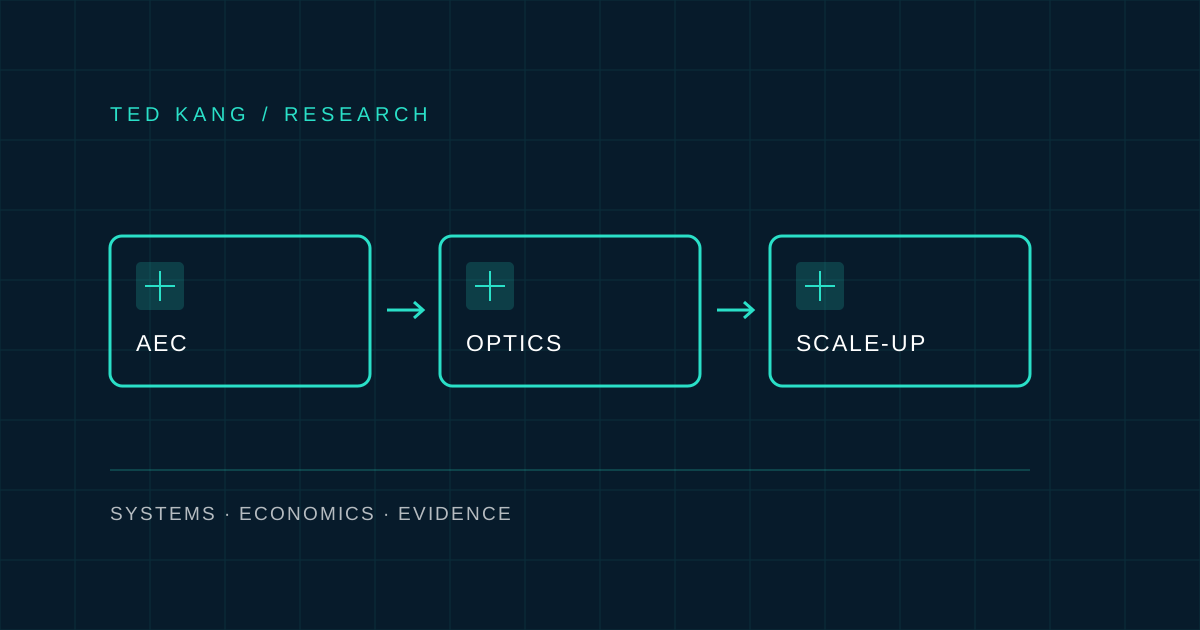
Credo's opportunity is to use its established cable business to enter adjacent connectivity markets. The investment case depends on translating the broader product map into profitable customer deployments.
This research follows Credo from its active electrical cable business into a broader connectivity portfolio. The company observations retain the September 14, 2026 information window; the September 27 source review separates reported results, company guidance and longer-term possibilities.
The important way to think about Credo is no longer simply:
AI GPUs → more networking → more AEC copper cables → CRDO wins.
It's becoming:
larger AI clusters → connectivity/reliability becomes a larger bottleneck → more connectivity content per accelerator → Credo attempts to own several layers of that connectivity stack.
That distinction is important. AECs created Credo's extraordinary FY26 growth, but optics, retimers, silicon photonics and eventually scale-up connectivity/OmniConnect determine whether Credo can compound after the original AEC ramp.
The September 1 Q1 FY27 release reported $479.0 million revenue, up 114.7% year over year and 9.6% sequentially. Management guided the following quarter to $525–535 million of revenue. The reported quarter and the subsequent outlook are different kinds of evidence. Q1 FY27 results and Q2 outlook
The next test is whether the wider product portfolio changes the mix and durability of that revenue.
What Credo actually does
Start with the distinction between performing a calculation and moving its inputs and results.
Imagine an AI cluster with tens or hundreds of thousands of accelerators. The GPUs/ASICs perform the computation, but they constantly need to exchange data.
There are therefore two separate problems:
Compute
Nvidia GPU / Google TPU / Amazon Trainium / other ASIC ↓ Connectivity
Move enormous quantities of data among those accelerators quickly, reliably and without consuming excessive electricity.
Credo primarily attacks the second problem.
Its portfolio now includes AECs, optical transceivers, optical DSPs, SerDes, retimers, silicon photonics, microLED technology and software/telemetry. Credo describes the objective as connectivity across scale-out and scale-up networks using both electrical and optical interconnects. FY26 Form 10-K · DustPhotonics acquisition
Why this matters economically
Suppose you have billions of dollars of accelerators sitting inside a cluster.
The value of the network isn't simply:
How much does this cable cost?
It's closer to:
How much expensive compute becomes unusable or inefficient when communication breaks down?
That's why Credo keeps talking about GPU utilization, cluster stability and link reliability.
This is one of the strongest parts of the investment thesis.
AEC is the business that created CRDO
AEC remains the starting point for understanding the reported growth.
Traditional short-distance connectivity broadly gives customers choices between passive copper and optical connections.
Credo inserted active electronics into copper cables, allowing the signal to travel farther while retaining attractive copper economics.
Conceptually:
DAC
Cheap + low power ↓ Limited reach
Credo AEC
Copper + signal-processing electronics ↓ Longer reach + low power + reliability
Optical
Much longer reach ↓ Historically higher power/cost/complexity
This became extraordinarily valuable as AI racks became denser.
And we now know just how important AEC was financially.
Credo disclosed that FY26 revenue increased:
$437M → $1.335B
or +206%.
More importantly, the 10-K says increased AEC shipments contributed more than 99% of the absolute increase in revenue. FY26 Form 10-K
That is an extraordinary statistic.
Growth also reveals a concentration risk
FY26 wasn't yet a diversified connectivity story.
It was overwhelmingly:
AEC adoption → enormous revenue growth.
So the future thesis requires Credo to successfully transition from:
spectacular AEC company → diversified AI-connectivity platform.
That's exactly why FY27 optics is so important.
The optical pivot is the biggest thing to watch
A transition toward optics creates both a competitive risk and an adjacent market.
The natural bear argument against Credo historically was:
Copper works today, but eventually AI clusters require more optics. Won't that cannibalize Credo?
Management's answer is effectively:
Fine. We'll sell the optics too.
Credo completed its acquisition of DustPhotonics on May 28, 2026, adding silicon-photonics PIC technology and allowing it to integrate:
SerDes → DSP → silicon photonics → system integration → telemetry
Credo explicitly says the acquisition gives it a vertically integrated stack across electrical and optical connectivity. Q1 FY27 results · DustPhotonics acquisition
That substantially changes the thesis.
The optical revenue ramp is the test
Credo's published portfolio includes ZeroFlap optical transceivers, optical DSPs and, after the DustPhotonics acquisition, silicon-photonics components. These are distinct products with different qualification and manufacturing requirements. September 1 portfolio description · DustPhotonics completion announcement
The business question is how much of the optical opportunity becomes recurring sales, at what margin, and with which customers. A design win is an intermediate milestone: qualification, customer deployment and revenue recognition still need to follow.
This analysis does not use the full-year optical targets or design-win schedules circulated in the originating discussion. The linked quarterly release supports reported financial results and next-quarter guidance; it does not, by itself, substantiate those more detailed forecasts.
Compare future optical disclosures with AEC performance. Optical growth alongside resilient AEC demand would support a broader connectivity business. An optical delay combined with slowing AEC growth would leave more of the valuation dependent on an uncompleted transition.
What vertical integration does—and does not—mean
Owning more of a physical link can allow a supplier to optimize components together. Credo's acquisition announcement describes a more integrated electrical and optical portfolio. That is different from supplying every part of an AI network. Company acquisition description
Switching silicon, network interface cards, operating software, optical components and packaging still involve other suppliers. NVIDIA, Broadcom, Marvell and optical vendors can be partners, customers or competitors in different parts of that system.
The strategic possibility is coordinated design across several connectivity components. The commercial evidence would be higher attachment, better reliability or customer retention that competitors cannot easily reproduce.
PILOT may be more strategically interesting than it appears
Reliability software can connect individual components to the performance of the wider system.
PILOT monitors signal integrity and helps identify degrading links before they disrupt workloads. Credo made it available across SerDes, retimers and AECs during FY26. FY26 Form 10-K
Don't think of this as:
hardware + random monitoring software.
The potential flywheel is:
More Credo hardware deployed ↓ more link telemetry ↓ better understanding of failures ↓ better hardware/firmware optimization ↓ greater reliability ↓ customer prefers additional Credo components ↓ more Credo hardware deployed.
If this actually develops, Credo's moat isn't merely a better cable.
It's system-level knowledge of link behavior at enormous scale.
That's considerably harder to commoditize.
But we don't yet have enough disclosure to prove that PILOT itself drives material customer wins. I would treat this as potential moat formation, not an established software moat.
The mature-node or “n-1” strategy
Manufacturing cost and availability are part of the competitive comparison.
Credo says its SerDes/DSP architecture allows it to achieve competitive performance while manufacturing on older, more available process nodes.
That potentially gives Credo:
lower wafer cost + better availability + less leading-edge capacity competition.
Credo explicitly calls this its n-1 advantage. FY26 Form 10-K
This is a company-described design strategy, not a statement that every product uses an older node. For example, Credo’s Blue Heron product page specifies a 3 nm process. The relevant advantage has to be assessed product by product.
It is one possible contributor to the reported economics:
68% gross margins for connectivity hardware.
The company isn't operating like a commodity cable manufacturer.
It owns substantial semiconductor/IP value embedded inside the connectivity product while outsourcing manufacturing under a fabless model. FY26 Form 10-K
The reported financial model
FY26:
| Metric | FY26 |
|---|---|
| Revenue | $1.335B |
| YoY growth | +206% |
| GAAP net income | $472M |
| Non-GAAP net income | $662M |
| Non-GAAP GM | ~68% |
FY26 results and GAAP/non-GAAP reconciliation. Q1 FY27 subsequently delivered:
$479M revenue
+115% YoY
68% non-GAAP gross margin
~49% non-GAAP net margin
while management guided Q2 to $525–535M. Q1 FY27 results
Annualizing reported Q1 revenue of $479M gives approximately $1.92B. Annualizing the $530M midpoint of Q2 guidance gives approximately $2.12B, but that second calculation assumes a forecast is achieved; neither calculation is a full-year revenue prediction.
Credo is already producing substantial profits. The GAAP/adjusted distinction still matters: Q1 FY27 GAAP net income was $129.4M, versus $236.3M non-GAAP. Stock-based compensation and acquisition-related adjustments are economic considerations, not amounts to ignore when valuing the business.
But I would change the valuation analysis
A valuation needs a sustainable earnings case, not just a high current growth rate.
The historical valuation illustration below uses the following assumptions, not a current stock quote or a verified forecast:
FY27 revenue = $2.4B × 50% net margin = $1.2B net income
÷ 199M shares
= $6.03 EPS
Then:
$234 / $6.03 ≈ 39× P/E
The arithmetic is fine.
But I wouldn't put much weight on:
P/E ÷ EPS growth = PEG
and conclude that 0.5× PEG means cheap.
PEG ratios become misleading when earnings are exploding from an unusually depressed base.
A business growing EPS:
$1 → $2
can produce fantastic PEG mathematics.
That doesn't mean investors should automatically capitalize $2 at an enormous multiple.
Better framework
I'd value CRDO around three questions:
1. What is normalized FY28/FY29 earnings power?
2. How long can revenue compound above ~30–40% after the current hyperscaler ramps?
3. What multiple should an AI-connectivity company deserve once growth normalizes?
The stock can simultaneously be:
an exceptional company and a poor investment at the wrong price.
Customer concentration is the biggest near-term risk
Revenue concentration can make a strong product business sensitive to a small number of deployment decisions.
Credo's FY26 end-customer concentration was approximately:
Customer D: 33%
Customer B: 32%
Customer E: 19%
And the top ten customers represented approximately 90% of revenue. FY26 Form 10-K
So roughly 84% of FY26 revenue was attributable to three end customers.
That's enormous.
It creates a plausible source of earnings volatility, without explaining every share-price move.
One hyperscaler changing:
architecture,
supplier allocation,
deployment schedule,
capex,
or qualification strategy
could materially move Credo's earnings.
Diversification across additional customers and products is therefore not merely incremental upside.
It is essential to de-risking the company.
Weaver and the scale-up option
OmniConnect extends Credo's product map toward memory and chip-to-chip connectivity. The September 1 company release includes it in the portfolio, but a portfolio description does not establish a standard revenue amount per accelerator. Company portfolio description
Weaver is a research lead within that wider opportunity. Its commercial importance depends on the exact system configuration, quantities of Credo components, customer qualification and deployments that become sales. The per-GPU dollar ranges and timing circulated in the originating discussion are excluded here because this review did not authenticate their original management context.
If customers adopt more Credo components per system, revenue could grow faster than accelerator units. It could also face redesign, alternative architectures or a small number of customer programs. Treat that as potential future value until commercial evidence supports an earnings model.
Hyperlume and MicroLED optionality
Credo paid roughly $92M for Hyperlume in September 2025.
Hyperlume develops microLED optical interconnect technology. FY26 Form 10-K
The strategic idea is interesting because there's currently a rough progression:
short distance → copper
longer distance → optics
MicroLED potentially attacks an intermediate distance while retaining attractive power/reliability characteristics.
If successful, Credo could eventually offer:
AEC → MicroLED → traditional optical
across increasing distances.
Commercial contribution and timing require customer and revenue evidence. A technology acquisition alone does not establish a production schedule.
The four stages of the thesis
I would condense the investment case into this:
Stage 1 — proven
AEC adoption
Credo found a superior solution for short-distance AI connectivity and captured enormous hyperscaler deployments.
Assessment: supported by reported AEC growth.
Stage 2 — happening now
Optical expansion
ZeroFlap optics + optical DSP + DustPhotonics silicon photonics.
Test: disclosed optical revenue, customer deployments and margins.
Assessment: the product portfolio is established; the forecast ramp remains to be delivered.
Stage 3 — emerging
Scale-up / retimers
Blue Heron and related products move Credo deeper into accelerator-to-accelerator networking.
Assessment: an emerging product opportunity whose revenue contribution still needs validation.
Stage 4 — optionality
Weaver + MicroLED + NPO/CPO
Potentially dramatically expands content per accelerator and addressable connectivity distances.
Assessment: optionality, with limited evidence for base-case valuation.
The platform thesis
AEC established customer relationships, engineering experience and cash generation that Credo can use to address adjacent connectivity problems. The thesis does not require every roadmap product to succeed, but it does require repeated commercial execution beyond one successful cable product.
AEC can mature. Optical components, retimers and memory connectivity may expand the amount of Credo technology in a system, while also increasing competition and execution demands.
The opportunity is a broader AI-connectivity business whose content can rise with system complexity. The evidence should be revenue mix, repeat deployments and cash returns—not the size of a product diagram alone.
What I would watch each quarter
| Measure | Research question |
|---|---|
| Reported revenue | Does customer deployment turn into recognized sales? |
| Optical mix | Does the newer portfolio add revenue while AEC remains healthy? |
| Margins | Do GAAP and adjusted profitability remain strong after acquisition and compensation costs? |
| Customer concentration | Does revenue become less dependent on a few end customers? |
| Design wins | Which programs progress from qualification to production? |
| Inventory and receivables | Does growth convert into cash at acceptable working-capital cost? |
| PILOT | Is there evidence of better attachment or retention? |
A durable optical ramp would strengthen the diversification case. A delay would matter most if the original AEC growth engine weakened at the same time. Neither outcome can be settled by a product announcement alone.
Sources and assumptions
The dated financial foundation is Credo's FY26 Form 10-K, FY26 earnings release and September 1 Q1 FY27 release. Issuer materials establish what the company reported; product descriptions remain company claims. GAAP and non-GAAP measures are kept separate.
The originating Credo discussion supplied the research question. Unauthenticated full-year targets, optical category forecasts, Weaver dollar-content ranges and roadmap dates are excluded from the conclusions. The valuation calculation is a dated illustration with assumed inputs, not a current quote, price target or verified earnings forecast.