
Compute demand creates opportunity across the semiconductor stack. The strongest economics belong to businesses that remain difficult to replace after capacity expands and the next architecture arrives.
The semiconductor discussion often begins with a chip designer and ends with a performance benchmark. That leaves out the system needed to turn a design into useful compute: manufacturing, memory, packaging, networking and software.
My starting point is the bottleneck. What prevents the customer from obtaining another unit of useful output, who controls that constraint, and how long will that position last? Those questions help separate an important technology from an attractive business, and an attractive business from an attractive investment.
Underwrite the whole stack
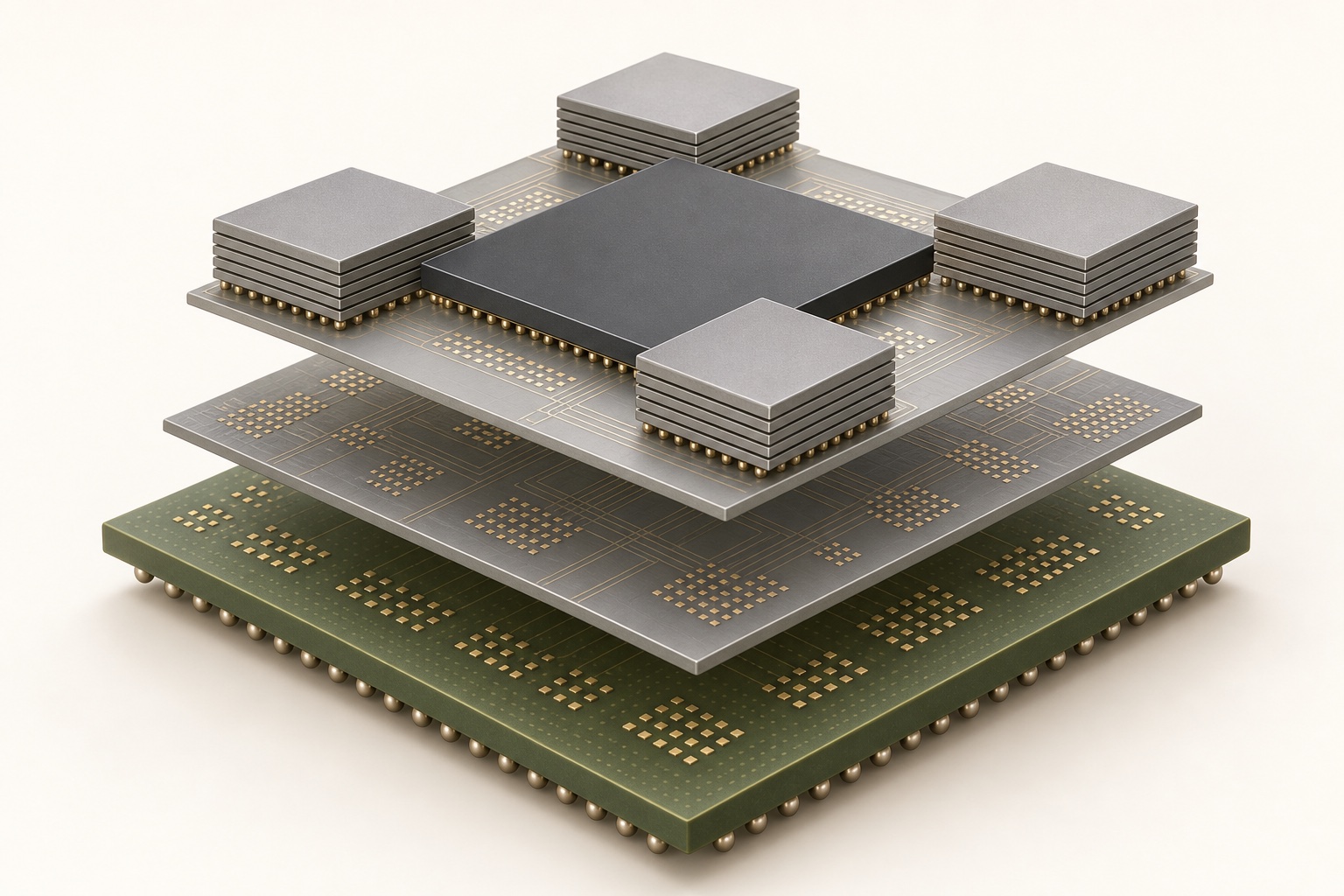
The logic chip performs calculations. Memory holds the information it needs. The package connects these components and carries signals and power between them. Software organizes the work. An improvement in one layer creates value only to the extent that the rest of the system can use it.
High-bandwidth memory, or HBM, places stacks of memory dies close to an accelerator and connects them through a wide interface. Two measurements matter. Capacity, usually stated in gigabytes, determines how much information fits. Bandwidth, often stated in terabytes per second, describes how quickly information can move. More capacity does not automatically mean proportionately more bandwidth. Micron’s HBM product documentation treats them as separate design dimensions. Micron HBM overview.
For AI inference, memory may need to hold model weights, temporary working data and the cached information used while generating responses. Research on PagedAttention demonstrates why managing that growing cache matters. A model that does not fit may need to be divided across accelerators or served using another memory arrangement. That introduces additional communication and software choices. A model that fits can still spend much of its time moving data rather than calculating.
Hypothetical example: if a simplified task must read 2 terabytes from memory and the available bandwidth is 1 terabyte per second, data movement alone imposes a two-second lower bound. Doubling arithmetic capability cannot remove that bound. Actual execution can be slower and can overlap some work; the point is to identify the limit before paying for more of something else. NVIDIA’s performance guide distinguishes memory bandwidth, calculation throughput and latency as separate constraints. NVIDIA GPU performance background.
Packaging makes these relationships physically possible. It is more than a protective shell: advanced packages can connect multiple logic dies and memory stacks through dense interconnects. TSMC’s 2024 annual report describes investment in CoWoS, other packaging technologies and three-dimensional integration. That establishes packaging’s role in its technology offering; it does not establish that every packaging process has the same scarcity or economics. TSMC 2024 Annual Report.
Logic and memory have to work as one system
Scarcity moves
A supply chain can be constrained by logic fabrication in one period, qualified HBM in another, and packaging or testing in the next. These are linked production stages. Extra wafer capacity cannot deliver a finished accelerator if a required memory stack or packaging step is unavailable.
Even the word “capacity” needs unpacking. A factory announcement, installed equipment, a functioning process and customer-qualified output are different milestones. Yield is the share of production that meets the relevant requirements. Throughput is how much the process can handle in a given time. A line can have plenty of nominal throughput and still produce too few saleable units if yield is poor.
Qualification is the customer’s process of establishing that a component or manufacturing process meets its requirements. In an integrated system, substituting a supplier may require redesign, validation and reliability testing. Intel’s packaging and test description spans wafer, die and final-system checks. That complexity can protect an incumbent, but a difficult qualification today does not guarantee permanent exclusivity.
I would ask whether the shortage reflects a hard technical problem or a temporary mismatch between orders and available production. The first may support a lasting advantage. The second may disappear when equipment arrives and production stabilizes. A backlog shows demand under particular ordering conditions; it does not, by itself, resolve cancellation risk, duplicate ordering or future pricing.
The system can also change around the constraint. A customer might use a smaller model, different precision, another accelerator or a different package design. Those choices have performance and development costs. They nevertheless belong in the analysis because a customer’s ability to adapt limits what a scarce supplier can charge.
A chip is one part of the delivery system
Architecture, usable tools, and workload compatibility determine what customers can do.
Qualified processes and memory supply turn specifications into usable components.
Integration and data movement determine how components work together.
Power, cooling, operations, and paying demand turn hardware into a service.
The arms race is also a capital cycle
Each business model carries a different reinvestment burden. A designer that outsources manufacturing still funds engineering, software, inventory and supply commitments. A foundry commits capital to manufacturing before the final demand outcome is known. Memory producers must manage both new generations and the possibility that industry capacity arrives together.
Capital expenditure is cash spent on long-lived assets. Depreciation allocates that investment as an expense over an estimated useful life. Because the cash leaves and the expense appears on different schedules, rapid growth can look very different in earnings and cash flow. I would connect the two before assuming that strong revenue translates into cash available to shareholders.
A capacity expansion can create value if its output remains differentiated and customers pay enough to cover operating costs, development and the capital required. The same expansion can weaken returns if competing supply arrives faster than demand. High spending is evidence of commitment and future supply; it is not proof of durable scarcity.
Utilization of the factory matters as well. Fixed costs are spread across fewer units when a line runs below plan. Conversely, a well-utilized line may report excellent margins during a shortage that are difficult to sustain in a more balanced market. I would compare a range of demand and pricing conditions rather than extend the strongest quarter indefinitely.
Geographic diversification adds another layer. A second manufacturing location can improve resilience while increasing cost or complicating a production ramp. The commercial question is who funds that resilience and whether the customer values it enough to support the required return. TSMC’s 2024 report explicitly links overseas expansion to customer needs and government support; that is a dated company strategy, not a guarantee about the economics of every new site.
What would earn a stronger view
I would look for evidence that customers keep choosing a supplier across product generations, that yields and delivery performance are improving, and that cash generation survives a less favorable pricing environment. Design wins, shipments, revenue and cash collection answer different questions and should be tracked separately.
Software compatibility can reinforce a hardware position by reducing the work needed to deploy a system. It can also be challenged as tools improve on competing platforms. The relevant evidence is the customer’s cost and time to switch for a real workload, not an assumption that an ecosystem is either permanently locked or instantly portable.
The main countercase is substitution combined with abundant supply. Customers redesign around a bottleneck, a competing platform becomes practical, or new capacity erodes pricing before the original investment has earned its return. A supplier can remain strategically important throughout that process.
That is why I keep the operating thesis and the valuation thesis separate. Excellent execution can still produce disappointing equity returns if the price already assumes years of exceptional growth and margins. I want a business the next generation needs, purchased with room for an outcome that is good rather than perfect.
The best position in the stack is one the next generation still needs.
Sources and review. Reviewed September 13, 2026. Primary sources are linked alongside the relevant claims. Company examples and forecasts are identified by date; technical descriptions do not establish future investment returns. Numerical examples are hypothetical.