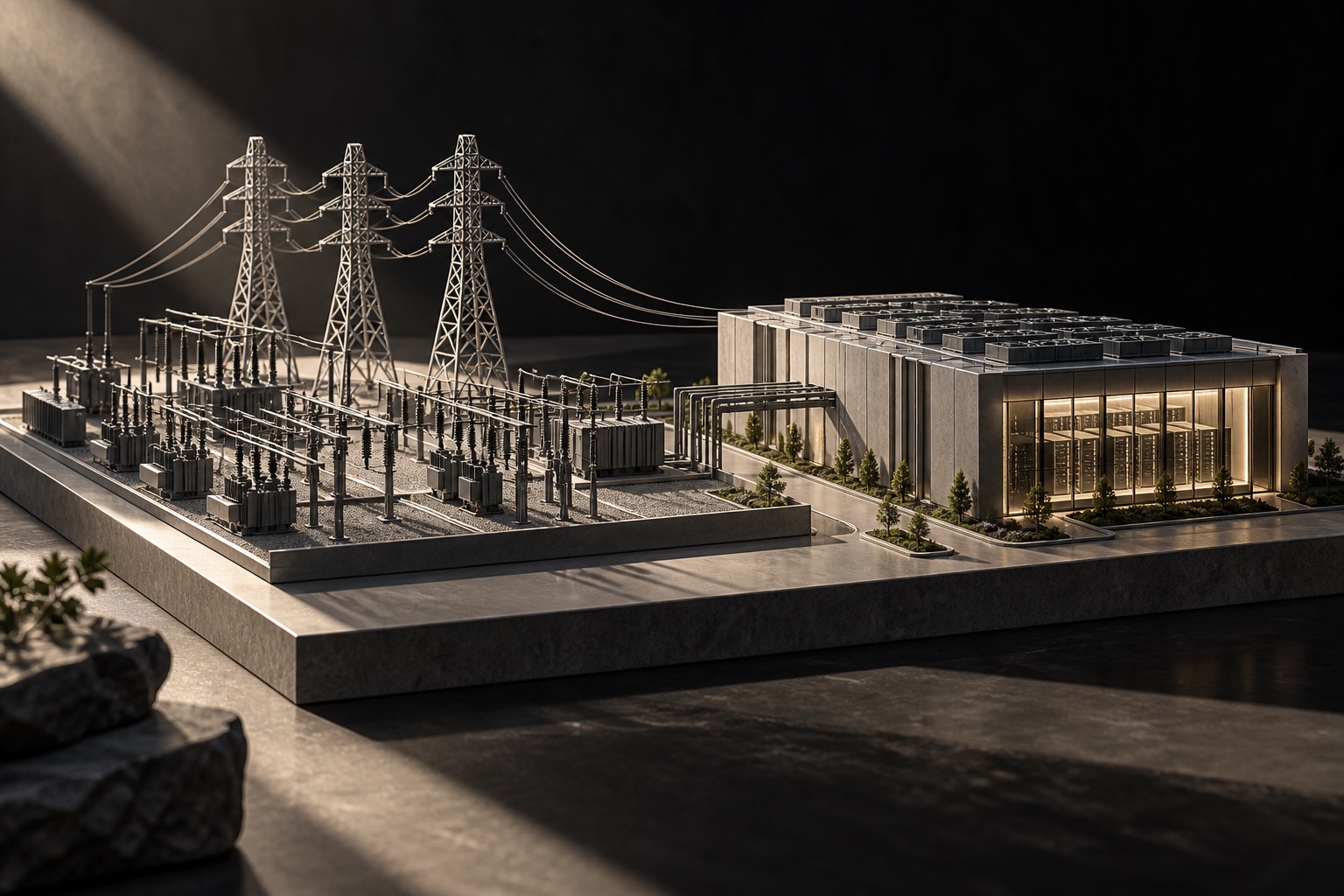
Power becomes an economic advantage when it can reach a useful location, on a credible schedule, at a cost the workload can support. Announced capacity is only the beginning of that chain.
A data center announcement can make capacity sound immediate. Land has been selected, capital raised and equipment ordered. Yet the facility may still need a utility connection, a new substation and permission to draw its intended load. Even after energization, commissioning and customer acceptance can stand between the building and recurring revenue.
That gap is why I keep returning to power. The scarce resource is often a combination of electricity, delivery infrastructure, equipment and execution. Each has to arrive in the right sequence. Calling all of it “megawatts” hides the distinctions that determine whether a project works.
The constraint is local
National generation is too broad a measure for one site. A region can have electricity available in aggregate while a particular connection lacks transmission capacity, transformer capacity or a workable service schedule. Large loads concentrated in the same area can require shared infrastructure upgrades.
The IEA’s 2025 electricity-supply analysis describes why the location and timing of data-center demand matter alongside the amount. Its scenarios are conditional projections, not proof that every announced campus will operate. I use them to frame the problem, then look for evidence at the utility and project level. IEA: energy supply for AI.
Start with the units. Megawatts, or MW, measure power: the rate at which electricity is delivered or used. Megawatt-hours, or MWh, measure energy over time. A constant 10 MW load uses 240 MWh in 24 hours. A contract for a quantity of annual energy does not, by itself, specify how much power is available at every hour. EIA: measuring electricity.
The measurement boundary matters too. IT load covers computing equipment; facility load also includes cooling and electrical losses. PUE compares total facility energy with IT energy over the same period. In a simplified constant-load example, 10 MW of IT at a PUE of 1.2 implies an average facility load of 12 MW. A real connection must also accommodate its engineered peak requirements; an annual efficiency ratio alone is not a design specification. DOE data-center design guide, benchmarking section.
A power purchase agreement, or PPA, needs similar care. A physical PPA includes contractual delivery of power. A financial or virtual PPA settles a price arrangement without delivering that power to the buyer. Neither label alone proves that a particular campus has sufficient network capacity, continuous supply or permission to connect. EPA explains the distinction between physical PPAs and financial PPAs.
Which milestone has the project actually reached?
- Planned
A site and capacity ambition exist. Delivery can still depend on unresolved work.
- Power arranged
Review the connection conditions, upgrades, obligations, and delivery dates.
- Energized + commissioned
Power is available and the installed systems have been tested together.
- Customer service
Installed compute meets acceptance requirements and can support billable work.
Time to power is time to revenue
I would separate a preliminary utility discussion, a completed engineering study, an executed service agreement, funded upgrades, delivered equipment, energization and commissioning. Each removes a different uncertainty. Construction of the building can advance while the connection remains unresolved, so visible progress on site is not enough to establish the revenue date.
Queue statistics also need the correct label. Berkeley Lab’s Queued Up: 2025 Edition tracks proposed generation and storage seeking transmission interconnection through the end of 2024. It is not a national queue of data-center customers waiting for power. Large-load procedures are separate and region-specific; ERCOT, for example, publishes its own large-load integration requirements. Berkeley Lab queue report; ERCOT large-load integration.
Hypothetical example: $100 million of capital already committed carries an 8% annual financing cost. A six-month delay adds $4 million using simple interest. That excludes lost operating cash flow, contractual penalties and equipment aging. It also assumes the full amount is outstanding throughout; a staged spending schedule would produce a different result.
The value of earlier access is therefore more than the electricity tariff. It includes cash earned sooner and costs avoided. I would compare that benefit with the full premium for the earlier site, including construction, transmission charges, reliability requirements and future expansion. Speed can justify a premium without justifying any premium.
Delay has a carrying cost
Who captures the advantage?
A binding power constraint affects participants differently. A landowner may benefit from a valuable location. A developer may earn a return for delivering a completed facility. An equipment supplier may receive orders. The compute operator still needs customers willing to pay enough to cover the resulting cost.
For a developer, I would examine the capacity actually deliverable, the customer’s credit, the construction budget and who bears upgrade costs. For an operator, I would examine the all-in electricity bill, demand charges, efficiency and the right to pass energy costs to customers. For an equipment supplier, I would examine order quality, production execution and margins after competitors expand.
A utility’s growing load should not be treated as automatic windfall profit. I would check the applicable tariff and regulatory decisions: which assets can earn a return, what spending is recoverable, what the large customer must guarantee, and who pays if projected demand never arrives. Those terms are local, so a generic claim about utility economics is a poor substitute for the actual arrangement.
Customer concentration adds another dependency. One large tenant can support financing, but it can also leave a project exposed if acceptance is delayed or the tenant’s own funding weakens. Power is valuable only when the rest of the commercial chain can make use of it.
The case has limits
More efficient chips and software can reduce electricity per task. Total electricity demand can nevertheless rise if task volume grows faster than that efficiency improves. The IEA’s 2025 demand analysis explores multiple efficiency and adoption paths; its range is a reminder to test the assumptions separately. IEA: energy demand from AI.
Some workloads can move toward available supply or shift in time. Others face latency, data-location or customer requirements that limit that flexibility. New generation, storage and transmission can ease a constraint, but their delivery schedules and operating characteristics need to match the load. On-site generation changes the project’s dependencies; it still requires an executable fuel, equipment, operating and permitting plan.
I would become less enthusiastic if a valuation assumes permanent scarcity, a delivery date depends on uncommitted upgrades, or the customer can walk away while the developer keeps the costs. The stronger asset combines valuable near-term access with economics that remain workable after supply becomes less constrained.
A megawatt on a slide is an option. A megawatt delivered to a paying customer is a business.
Sources and review. Reviewed September 13, 2026. Primary sources are linked alongside the relevant claims. Company examples and forecasts are identified by date; technical descriptions do not establish future investment returns. Numerical examples are hypothetical.