Historical morning edition for October 8, 2026, prepared October 8. Source message timestamp: 04:34:57 PDT, chosen as this reconstruction’s historical information boundary, not an authenticated delivery time or original production cutoff. October 7 is the prior completed US cash session. Market quotations in the selected discussion are not a synchronized live feed.
1. The early snapshot shows a financing problem to investigate
Thursday's selected packet describes weaker early equity futures, higher energy quotations and renewed concern about long rates. This edition preserves the 04:34:57 PDT source-message boundary. It is neither the October 8 cash close nor a report on the later thirty-year auction. Different intraday peaks and daily observations remain separate throughout.
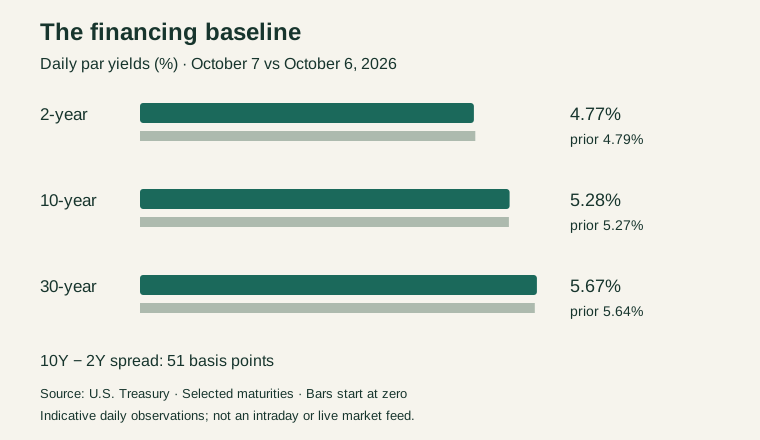
The official October 7 Treasury baseline was 4.77% at two years, 5.28% at ten and 5.67% at thirty. The spread between ten and two years was 51 basis points. Compared with Tuesday, the short maturity fell while the longer maturities rose. These daily figures are lower than some intraday highs circulated in the source. Treasury data
The economic concern is the combination of a high funding hurdle and a buildout requiring large payments before customers can use the equipment. A market can sustain that combination if expected returns improve sufficiently. The research task is to establish which companies can finance the interval and which depend on new capital arriving under favorable conditions.
2. A steeper curve is not automatically easier financing
A curve can steepen because short yields fall, long yields rise or both. Wednesday's selected-maturity observations include both. The two movements can imply very different things for borrowers: near-term policy expectations may become less restrictive while long-term capital becomes more expensive.
For banks, this is not a simple instruction to raise earnings forecasts. Asset repricing, deposit costs, hedges, securities marks and loan losses all affect the outcome. A bank whose funding costs adjust quickly may experience a different margin path from one with sticky deposits or fixed-rate assets. Credit quality can deteriorate even while the yield curve looks more favorable.
For property, utilities and data centers, the relevant hurdle is the actual cost of debt plus equity capital over the project's life. Cash-rich companies can avoid some external financing, but they still face an opportunity cost for their funds. Higher market yields can lower the value of distant profits even when no immediate refinancing is required. That connects the bond market to both industrial project returns and software valuations.
3. Energy pressure can reach AI through costs and discount rates
The packet attributes early oil strength to shipping and geopolitical concerns. Exact traffic counts, tanker incidents and reserve-release terms are not independently established in this briefing, so those allegations are not promoted into verified supply facts. The source's futures quotations also lack the common contract and timestamp needed for a clean return comparison.
The mechanism worth following is broader than the fuel bill of a single data center. More expensive energy can reduce household real purchasing power, raise transportation costs and complicate inflation expectations. If it changes the expected policy path or risk compensation, it can also raise the cost of financing the AI buildout.
A firm dollar could compound these pressures for foreign buyers of dollar-priced fuel or equipment while creating translation headwinds for US multinationals. The magnitude depends on currency hedges, customer location and contractual pass-through. Energy producers, refiners, airlines and power developers should therefore be analyzed through different revenue and cost channels. A single oil headline cannot establish the same earnings direction for all of them.
4. The macro evidence argues for separating growth from pricing
September's employment report, released October 2, recorded 29,000 additional payroll jobs and a 0.1% monthly gain in average hourly earnings. Monday's ISM services report meanwhile showed a headline index of 54.9 and a prices index of 74.0. The latter measures the breadth of reported price changes, not a 74% inflation rate. BLS employment report; ISM services report
This combination allows continued activity alongside cost pressure and cautious staffing. It is less consistent with treating every sign of slower hiring as immediate disinflation. Businesses can keep receiving orders while paying more for inputs and protecting margins by controlling headcount.
The minutes scheduled for release yesterday cover the September meeting, which preceded the jobs release. Only the release chronology is used here; a substantive reading of the minutes is not claimed because the document itself was not successfully retrieved in this check. The official calendar confirms the scheduled release. The next decision will incorporate a newer information set. Federal Reserve calendar
5. Concentration matters when the shared assumption changes
The source selection repeatedly raises index concentration, weak breadth and subdued equity volatility. Exact constituent weights and counts are excluded without a verified universe and timestamp. The important risk is that apparently different holdings may rely on the same assumptions about AI capital expenditure, financing availability and customer demand.
A portfolio of chip suppliers, networking companies, cloud operators and software platforms can contain genuine business-model diversity. It can still suffer together if investors reduce the expected return on the overall buildout. In that situation, correlations can rise precisely when the company narratives appear strongest individually.
Conversely, a common macro shock does not erase operating differences. A supplier with collected cash and limited obligations may be less exposed than a developer that must refinance before service begins. The useful research compares net cash, contractual commitments, maturity schedules and customer concentration. Low option volatility alone does not prove complacency, and a large futures short does not prove an imminent forced unwind without evidence about hedges, collateral and leverage.
6. The financing diagram needs dates and legal obligations
Thursday's packet combines several proposed compute relationships, investments, guarantees and capacity plans into very large headline totals. Those sums are not reproduced here. They mix different years, conditional amounts and potentially overlapping projects. A commercial commitment to buy service is economically different from a supplier's investment in the customer and from a lender's funding commitment.
The first diligence step is a transaction map: who owes cash to whom, when payment is due, what must be delivered and what happens if delivery fails. The second is a downside map: who owns the equipment, who bears residual-value risk and whether a guarantee is capped. Without that work, a seemingly diversified financing network may contain repeated exposure to the same customer.
Nscale's documented financing structure illustrates the timing issue, with an initial tranche and a separate NVIDIA commitment expected later. It does not verify the packet's other large guarantee or Broadcom-financing claims. Nscale announcement The relevant conclusion is a need to inspect terms, rather than a blanket allegation that interconnected financing is fraudulent or proof that every announced dollar is already available.
7. Custom silicon can gain share without shrinking the market
The selected custom-accelerator discussion proposes large future shifts in the compute mix. Its exact market-share percentages and lab capacity allocations are not independently verified, so they remain forecast leads. The broader possibility is straightforward: total AI demand can grow while individual architectures gain or lose share.
For cloud-designed chips and AVGO, the opportunity is closer alignment between a workload and a specialized system. For NVIDIA, flexibility, software maturity and the ability to redeploy hardware across customers can be valuable. For AMD, adoption depends on customer qualification and reliable operation at scale. These factors determine realized economics more directly than a theoretical performance comparison.
Diversification also affects bargaining power. A credible alternative supplier may improve a buyer's negotiating position before it captures a large share of shipments. But operating several platforms can raise engineering and support costs. Investors should watch production deployment, workload portability, effective utilization and repeat purchasing. A planned gigawatt allocation is several steps away from installed hardware running a paid workload at an attractive margin.
8. Cash collection improves evidence, not the entire system's return
The packet contrasts suppliers receiving cash with customers making long-term promises. That distinction is useful if applied carefully. Micron's September release reports an 86.8% fourth-quarter GAAP gross margin, while its annual cash-flow statement separately lists customer contract-liability deposit proceeds. Deposits and recognized revenue must not be added together as a measure of current sales. Micron results
A customer paying early provides stronger financing support than an entirely unfunded promise. The supplier still has to fulfill the contract, and the customer still needs an economic use for the delivered equipment. Upstream cash collection can reduce one company's risk while moving more capital at risk onto another balance sheet.
For memory, networking and power suppliers, the next questions include price durability, customer concentration and capital needed to expand output. High margins can finance additional capacity and attract competition. For buyers, expensive components can increase the revenue required to earn an adequate return. This is why the same supply shortage can support one company's earnings while reducing the value of the downstream project.
9. The pricing contest should use accepted work as its unit
A selected Claude developer post is the source for new API-credit claims, and other posts compare usable subscription volume across providers. Exact credit allowances and the claimed five-times volume advantage are not authenticated against a dated primary plan announcement here. They are not presented as universal current pricing or an equal-task test.
A fair comparison would hold the workload, success criterion, reasoning effort, tool environment and retry policy constant. It would then include subscription or API cost, required add-ons, human review and the time lost to rate limits. A generous quota can be valuable while a slower system still costs more in an urgent workflow. A higher token rate can be economical if the task completes reliably in fewer attempts.
OpenAI's late-September Sol launch publishes separate standard input, output and cached-input prices. That source supports a rate-card comparison, not a blanket reduction in every customer's task bill. Launch page; dated launch recap For investors, the commercial question is whether better economics lead to durable paid usage with acceptable provider margins.
10. Agent workflows extend the bottleneck beyond the accelerator
An agent may alternate model inference with retrieval, code execution, storage access and external tools. The resulting system performance depends on more than accelerator throughput. A slow tool call or data-transfer path can leave expensive hardware waiting and lengthen the time to a completed task.
That creates potential opportunities in networking, host compute, memory, storage and orchestration. It does not establish that every workload needs the same topology or that every networking vendor benefits equally. Customer architecture, product qualification and competitive pricing determine who captures the spending.
NVIDIA's published 800 VDC direction also makes power distribution part of the system design rather than an afterthought. The roadmap addresses efficiency and density; it does not eliminate interconnection approvals, cooling requirements or site commissioning. Architecture explanation For ANET, VRT, ETN and GEV, the financial evidence should connect a specific product to awarded work, delivery and collections. General statements that the bottleneck has moved are a starting point for that research, not a substitute for it.
11. Mathematics and provenance answer different questions
OpenAI's October 6 mathematics release concerns an internal frontier model and a process for sharing and revising results. It does not identify a named public model as the system responsible. It also supplies no demonstrated break of elliptic-curve cryptography. Claims about an imminent cryptocurrency failure would require separate technical evidence. Research announcement
The October 5 provenance update is a different subject. OpenAI says it is expanding its work to text in the EU for AI Act compliance. That short update should not be expanded into a claim that every output is universally detectable after any transformation or that the complete legal scope has been established by one social summary. Provenance update
Both developments can matter commercially. Scientific capability may expand valuable research tasks, while provenance can affect enterprise controls and regulatory implementation. Neither automatically establishes product availability, customer adoption or margins. Technical evaluation, deployment constraints and willingness to pay remain separate evidence requirements. Keeping them separate makes the opportunity easier to assess without minimizing the importance of the underlying research.
12. Selected posts reveal the debate, not a consensus
The preserved leads include mrmagoon's financing discussion, convequity's custom-silicon thesis, ClaudeDevs' credit announcement lead and Christopher_QMS's cryptography response. They come from the dated selection and include continuing themes from prior days. Direct wording, author identity through the linked account and engagement were not independently authenticated in this research.
The strongest connection across the selection is the shift from capability alone to the cost of operating and financing useful service. The investor debate asks whether commitments become cash invoices. The builder debate asks whether subscriptions deliver enough accepted work. The engineering debate asks whether power, memory and networking let the hardware operate effectively.
These are complementary questions, but none answers the others. A capable model can be expensive to serve, a popular subscription can have poor margins, and a fully financed site can be delayed. The most useful next evidence crosses those boundaries: a paying customer using a commissioned system repeatedly under terms that leave each necessary provider with sustainable economics.
13. The remaining day and next week still contain unknowns
The selected source places the thirty-year auction later today; its result is outside this early cutoff and is not supplied here. September CPI is scheduled for October 14 at 8:30 a.m. Eastern. The FOMC meets October 27–28 without a scheduled Summary of Economic Projections; references to October dots would be incorrect. BLS calendar; original FOMC schedule
A constructive path would bring relief in energy and funding costs alongside continued customer demand. Better AI task economics could then widen adoption while completed infrastructure earns cash. A mixed path would keep component suppliers busy but expose differences in financing strength and project timing. The adverse path would combine persistent input inflation, expensive capital and weaker customer spending, reducing both expected earnings and the multiple investors pay for them.
The practical evidence is financing completed on workable terms, capacity entering service, paid usage retained and cash collected. No exact index target or scenario probability is justified by this source set. Thursday's morning conclusion is narrower: the opportunity remains substantial, while the burden of proof increasingly sits in delivery and returns rather than the size of the next announcement.
Sources & reading notes
Historical edition prepared October 8, preserving the dated morning information window; not a live market feed. Primary releases, observations and plans remain distinguished. Selected X links are unauthenticated leads; scenarios are research rather than portfolio instructions.
Daily observations through the prior cash session. Indicative bid-side inputs near 3:30 p.m. Eastern; not transaction prices or an intraday feed.
October 2 initial September estimates and then-published revisions. Later employment revisions are excluded.
September 2026 report body and tables; the page browser title retains a stale 2025 label. October 5 release timing corroborated against ISM calendar. Diffusion indexes are not growth percentages.
Calendar schedules September meeting minutes for October 7 at 2 p.m. Eastern; chronology only, not a summary of minutes content.
September 25 issuer announcement distinguishes the initial tranche, future NVIDIA funding and IPO-dependent conversion.
September 30 release for the year ended September 3. Quarterly revenue, annual deposit proceeds and liability balances are distinct.
Launch-page standard token prices; task economics depend on usage and quality. Late-September launch predates these editions; no current rolling price page substituted.
Dated September 29 recap anchors the Sol launch before this historical edition.
May 2025 technical roadmap; architecture and prospective benefits do not establish a specific site is operational.
October 6 report refers to an internal frontier model and a consultation/revision process; it does not identify a public model or demonstrate a cryptographic break.
October 5 update says provenance work is expanding to text in the EU; full legal scope and universal detectability are not inferred.
Selected original-source lead; direct text and engagement unauthenticated. It is not a platform-wide consensus measure.
Selected original-source lead; direct text and engagement unauthenticated. It is not a platform-wide consensus measure.
Selected original-source lead; direct text and engagement unauthenticated. It is not a platform-wide consensus measure.
Selected original-source lead; direct text and engagement unauthenticated. It is not a platform-wide consensus measure.
September CPI is scheduled for October 14 at 8:30 a.m. Eastern. Calendar viewed October 8; published February calendar vintage.
Original dated announcement establishes October 27–28 and December 8–9, 2026. October has no scheduled Summary of Economic Projections.