Historical morning edition for October 6, 2026, prepared October 8. Source message timestamp: 04:34:50 PDT, chosen as this reconstruction’s historical information boundary, not an authenticated delivery time or original production cutoff. October 5 is the prior completed US cash session. Market quotations in the selected discussion are not a synchronized live feed.
1. The rally and the funding market are telling different stories
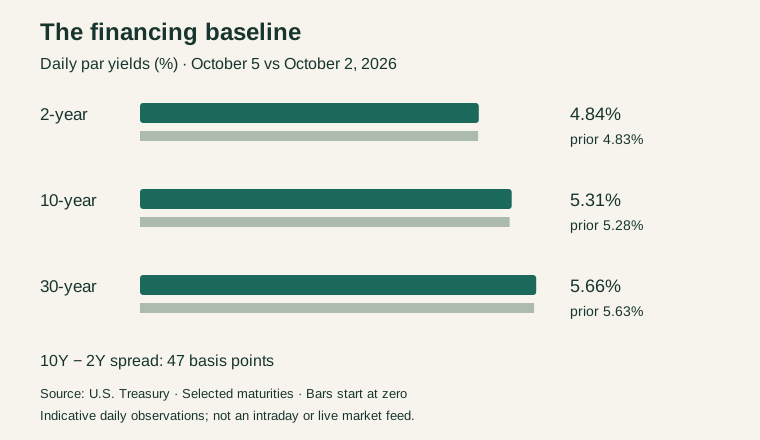
Tuesday's selected discussion describes Monday strength in large technology companies and an equity market approaching earlier highs. The clearer independently checked price evidence is in bonds: October 5 Treasury daily par yields were 4.84% at two years, 5.31% at ten and 5.66% at thirty. The longer maturities rose more than the two-year compared with Friday. Those are Monday observations, rather than Tuesday's early quotations. Treasury series
That combination is economically possible. Investors can raise their expectations for a concentrated group of companies' earnings while requiring a higher return to hold long government debt. Trouble begins when the equity thesis depends on cheap, abundant external funding that the debt market no longer supplies on the same terms.
The relevant question is consequently whether earnings and cash generation can carry the investment program. The packet's exact forward earnings, market-cap and valuation estimates lack a consistently dated underlying dataset, so they are not used as verified inputs. A strong narrative about growth cannot substitute for that reconciliation.
2. Policy patience has a different meaning from easier money
Friday's employment release gave the market fresh evidence of modest hiring: 29,000 additional payroll jobs in September and 4.2% unemployment. The negative prior-month revisions also matter. The figures establish slower labor-market momentum; they do not by themselves establish a near-term rate cut or an imminent recession. BLS release
Policy remains at the 3.75%–4.00% range established by September's quarter-point increase. A pause at the next meeting would leave that level in place. Businesses refinancing debt would still face the prevailing Treasury curve plus their own credit spread and fees. A reduced chance of further tightening may help sentiment without immediately lowering the cash interest bill. September decision
Tomorrow's minutes cover the September 15–16 meeting. They cannot show how officials reacted to an employment report released on October 2. Their value is to reveal the earlier reasoning that markets can compare with subsequent data. Any claim that the committee already incorporated Friday's result into that meeting reverses the actual chronology.
3. The consumer test is income as well as spending
The latest dated PCE release showed August real spending increasing 0.6% while real disposable income was flat. Core PCE prices increased 0.2% during the month and 3.0% over the year. This is a useful demand-and-inflation combination, with the caution that it describes August and includes the annual-update vintage. BEA release
For equities, the central issue is the sustainability of spending growth when employment gains are modest. High-income customers with assets can behave differently from households whose consumption closely tracks each paycheck. Aggregate spending can therefore look resilient while a retailer's specific customer base weakens.
Company evidence should identify volumes, price realization and promotional activity. Revenue growth achieved through higher prices is less reassuring if unit demand deteriorates and the customer needs more financing. Conversely, a stable volume trend with better productivity could protect margins despite slower hiring. The interpretation should come from this operating detail rather than treating a softer labor report as uniformly bullish for every consumer business.
Monday's ISM services report adds a more recent cross-check: September's headline diffusion index was 54.9, employment 50.1 and prices 74.0. Expansion in activity alongside barely expanding employment and widespread input-price increases complicates a simple cooling story. These are survey diffusion readings, not percentage growth rates. The report body's September 2026 heading and tables establish the vintage despite a stale browser-title year. Services report; release calendar
4. Dollar strength can amplify an expensive long end
The source selection repeatedly pairs a firm dollar with high long yields. Exact currency quotations are omitted because the packet mixes time windows, but the transmission channels are clear. Foreign customers paying in dollars may face a higher local-currency bill for energy and technology. US companies translating overseas profits can see a headwind even if local demand is unchanged.
For a foreign borrower with dollar debt, currency weakness can also increase the burden of servicing that debt. Hedging reduces some exposure but carries its own cost and maturity. An unhedged comparison of Treasury yields and foreign sovereign yields therefore does not establish which asset offers the better return to a particular investor.
These channels matter to the AI buildout because hardware purchases, construction spending, customer contracts and financing may be denominated in different currencies. A local power advantage can be offset by financing or exchange-rate risk. Project economics should be tested on cash flows in matching currencies, rather than by comparing headline energy prices across countries in isolation.
5. Cheaper crude would help, but the product bill is the test
Monday and early Tuesday commentary describes crude relief while diesel remains a pressure point. This edition retains that distinction as an attributed theme and avoids stitching the packet's different futures contracts into one price chart. A verified change in the consumer's delivered fuel cost would be more informative than a single lower crude quotation.
For logistics, fuel surcharges may adjust with a lag. For industrial companies, freight and feedstock costs arrive through different contracts. Refiners can benefit from tight product markets even when crude falls, while upstream companies face lower realized selling prices. An energy move has different earnings consequences across these business models.
If relief persists through products and freight, it could improve real household purchasing power and reduce working-capital needs. If geopolitical or refining constraints keep products expensive, the macro benefit would be smaller. A reserve-release headline should be evaluated through timing, product composition and physical delivery. This research does not presume that the unverified releases or diplomatic terms discussed in the source have already taken effect.
6. Index strength needs an earnings breadth check
The curated discussion argues that technology and energy account for much of the resilience since the earlier market high. That observation is not upgraded to a measured sector-return ranking here because the return window and dataset are not independently rebuilt. It nonetheless identifies a sensible vulnerability: an index supported by a small earnings cluster has less room for disappointment in that cluster.
A participation test should ask whether profit revisions are improving outside the leaders, whether financing remains available to smaller issuers and whether equal-weight performance confirms the capitalization-weighted move. No one measure is sufficient. Small caps can rally on positioning while their interest coverage weakens; large companies can outperform because their cash flows are genuinely more resilient.
Liquidity also has several meanings. An active stock market does not prove construction finance is easy, and cheap option protection does not prove leveraged bond positions are safe. Evidence of stress would come from financing terms, market depth and collateral behavior. Unsourced aggregate short-position figures cannot carry that conclusion on their own.
7. A power shortage can hurt different suppliers at different times
Tuesday's source packet circulates precise forecasts of power shortfalls and claims that some chip vendors would be protected while adjacent suppliers absorb the delay. Those forecast tables were not obtained in their original form, so exact gigawatts and percentage gaps are excluded. Geography, timing and whether the figures measure demand or installed capacity would materially change their meaning.
The underlying mechanism is more useful than a universal ranking of winners. A developer may already own accelerators while waiting for an electrical connection. The chip supplier may have recognized a sale, but future orders can still be exposed if the customer's first deployment earns poorly. A cooling or networking supplier may have later acceptance milestones and feel the delay sooner.
Investors should trace cancellation rights, deposits, customer acceptance and the order of cash payments for each contract. A backlog alone does not show who absorbs an unfinished site. Neither does a headline that a campus has secured power: the timing and conditions of delivery determine when usable capacity can actually support service revenue.
8. Guarantees move risk; they do not remove it
A prominent thread in the selected discussion concerns vendor guarantees and residual values of AI equipment. The packet's large campus-guarantee totals are not supported here by dated underlying contracts or filings. They are diligence leads, not liabilities assigned to NVIDIA or another issuer in this briefing.
A guarantee can improve a project's borrowing terms by substituting the guarantor's credit for the project's own uncertain cash flows. In exchange, the guarantor assumes contingent exposure. The amount ultimately at risk depends on triggers, caps, collateral, recourse and duration. A maximum headline number cannot be treated as cash already paid, and a guarantee cannot be added to a loan as if both represent separate capital expenditure.
Nscale's actual announcement offers a narrower documented example: part of its convertible financing is an additional NVIDIA commitment expected to fund in November. Timing remains a contractual and execution variable. Financing announcement For public investors, the relevant questions are whether financing supports profitable customer demand and whether downside obligations are concentrated in the same companies whose sales depend on that demand.
9. Multi-chip demand changes the shape of the market
The source selection's multi-cloud discussion is worth separating from its unsourced capacity totals. A customer can use GPUs, custom accelerators and different cloud providers for different workloads. The choice depends on software compatibility, model architecture, availability, latency and total operating cost, not simply the advertised chip price.
For NVIDIA, a broad developer ecosystem and flexible workloads can be valuable when customers want to move between uses. For AMD, the commercial test is whether customers can deploy and operate the platform economically at scale. For AVGO and cloud-designed silicon, deeper workload specialization may improve efficiency while increasing dependence on a smaller number of customers or designs. These are business-model distinctions, not verified current share estimates.
Migration also has a cost. Rewriting kernels, validating results and operating multiple fleets can consume engineering resources. A lab's announcement that it will diversify is therefore an early indicator rather than a completed shift in delivered service. The useful milestones are qualified systems, stable production workloads and repeat orders supported by measured economics.
10. Gemini has been announced; access is the remaining question
Google announced Gemini 4 Argon on September 30, initially rolling out to trusted cyber defenders through Fairwind. Tuesday's packet language anticipating the model's announcement is stale. Broader access can still be prospective. Google's stated one-million-token output limit also needs to remain distinct from an input-context specification. Google announcement
Availability changes the competitive read. A restricted research or defensive rollout cannot be assumed to be accessible to every enterprise buyer immediately. The product may influence expectations and technical evaluation before it affects billed usage or customer retention across a broad market.
For investors in Alphabet and competing platforms, the useful questions are distribution, conversion to paid workflows and the cost of serving sustained usage. Launch evaluations describe selected tests under specified conditions. They do not establish universal superiority across all professional work. A customer will also consider security controls, integration, reliability and support, which can preserve an incumbent's position even when another vendor reports a better benchmark score.
11. Usage limits are part of the product economics
Builder commentary in the packet contrasts subscription quotas and agent behavior across providers. The anecdotes describe genuine purchasing considerations, but they are not a controlled cost comparison. A monthly subscription includes availability, limits and a user experience; an API invoice charges a workload more directly. Neither should be reduced to a single token price without understanding the task.
OpenAI's GPT-6.1 Sol launch page lists standard prices of $2 per million input tokens, $10 per million output tokens and $0.10 per million cached-input tokens. Those are different categories, not one blended rate. Launch pricing; September 29 launch recap
A demanding task can use repeated context, tool calls and retries, so caching, orchestration and acceptance rate affect the bill. A cheaper model may need more attempts; a more expensive model may solve the job with less supervision. For software businesses, the margin question is cost per accepted outcome at the service level customers require. For infrastructure, lower task costs could broaden demand, but the resulting total compute usage must be observed rather than assumed.
12. The selected conversation is a research agenda
Three preserved leads illustrate Tuesday's debate: Gary Black's market discussion, Jessie Dong's multi-chip commentary and riabcevv's infrastructure discussion. These were selected in the original dated material; their direct wording and engagement are not independently authenticated here. They are neither a platform-wide sentiment survey nor evidence of what institutional investors as a group believe.
The constructive interpretation ties stronger AI earnings to a wider set of paid workloads. The skeptical interpretation asks whether customer financing and power constraints postpone the returns required to sustain the purchases. Both deserve tests that can fail. Supplier orders, service availability and cash collections are better tests than repeating a broad claim that demand is unlimited.
The selection also contains allegations, precise private financing terms and product anecdotes whose scope cannot be established. Those details are omitted rather than made authoritative through an endnote. This leaves an evidence boundary while preserving the useful questions: who pays, when capacity works, and whether customers buy again after the initial commitment.
13. Tomorrow's record is old; the next decision uses new data
September's minutes are due October 7. September CPI follows October 14 at 8:30 a.m. Eastern, and the next regular FOMC meeting is October 27–28. October has no scheduled Summary of Economic Projections. Auction discussion in the selected source is a financing-demand watch item; unverified issue totals and auction outcomes are not treated as established facts. Fed schedule; minutes release calendar; BLS schedule
The constructive scenario would see slower hiring accompanied by stable spending, contained inflation and profitable AI usage. Higher long yields could then be absorbed by stronger cash generation. A mixed scenario would sustain component demand while financing and site delays keep cloud returns uneven. The adverse scenario would combine weaker customers with stubborn inflation, leaving both revenue and refinancing under pressure.
These paths are distinguished by evidence, not arbitrary index targets. Watch the cost and availability of new funding, the conversion of contracts into service, and the breadth of earnings revisions. Tuesday's early information set does not include its cash close, tomorrow's minutes or the later mathematics research announcement. Each belongs to its own dated assessment.
Sources & reading notes
Historical edition prepared October 8, preserving the dated morning information window; not a live market feed. Primary releases, observations and plans remain distinguished. Selected X links are unauthenticated leads; scenarios are research rather than portfolio instructions.
Daily observations through the prior cash session. Indicative bid-side inputs near 3:30 p.m. Eastern; not transaction prices or an intraday feed.
October 2 initial September estimates and then-published revisions. Later employment revisions are excluded.
September 16 quarter-point increase to a 3.75%–4.00% target range.
September 30 release and annual-update vintage; August observation period.
September 2026 report body and tables; the page browser title retains a stale 2025 label. October 5 release timing corroborated against ISM calendar. Diffusion indexes are not growth percentages.
October 2026 calendar schedules services on October 5 at 10 a.m. Eastern.
September 25 issuer announcement distinguishes the initial tranche, future NVIDIA funding and IPO-dependent conversion.
September 30 announcement; trusted-defender rollout and prospective wider access are different availability states. Vendor evaluations remain attributed.
Launch-page standard token prices; task economics depend on usage and quality. Late-September launch predates these editions; no current rolling price page substituted.
Dated September 29 recap anchors the Sol launch before this historical edition.
Selected original-source lead; direct text and engagement unauthenticated. It is not a platform-wide consensus measure.
Selected original-source lead; direct text and engagement unauthenticated. It is not a platform-wide consensus measure.
Selected original-source lead; direct text and engagement unauthenticated. It is not a platform-wide consensus measure.
Original dated announcement establishes October 27–28 and December 8–9, 2026. October has no scheduled Summary of Economic Projections.
Calendar schedules September meeting minutes for October 7 at 2 p.m. Eastern; chronology only, not a summary of minutes content.
September CPI is scheduled for October 14 at 8:30 a.m. Eastern. Calendar viewed October 8; published February calendar vintage.