Historical morning edition for October 4, 2026, prepared October 8. Source message timestamp: 04:34:47 PDT, chosen as this reconstruction’s historical information boundary, not an authenticated delivery time or original production cutoff. October 2 is the prior completed US cash session. Market quotations in the selected discussion are not a synchronized live feed.
1. Sunday starts with Friday's unfinished argument
The useful question this weekend is why a softer employment report gave equities breathing room while long-term financing stayed expensive. The selected market discussion describes a Friday rally led by technology with some small-cap participation. That is a reasonable starting hypothesis for Monday's research, but it does not establish a synchronized market dashboard. At this edition's early Sunday cutoff, the regular futures reopening was still ahead. Weekend crypto trading and social quotations cannot supply a new US cash close.
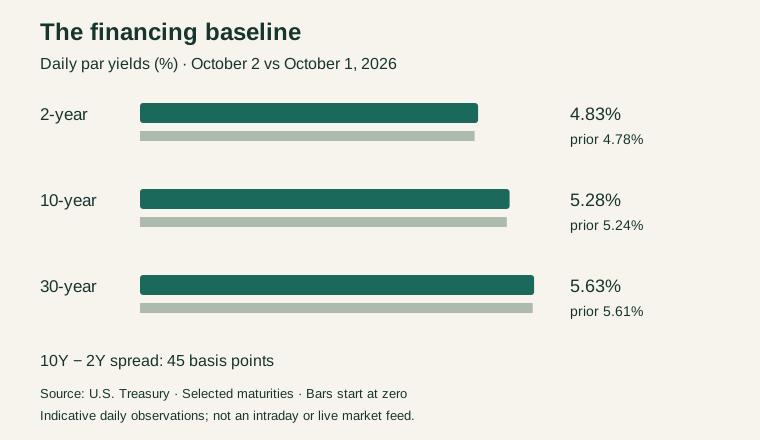
The consistent official baseline is October 2 Treasury par yields: 4.83% at two years, 5.28% at ten and 5.63% at thirty. All three exceeded October 1's observations. The ten-year minus two-year spread was 45 basis points. A positive slope says little by itself about whether borrowing has become affordable. For an investor underwriting a factory, apartment building or data center, the absolute financing rate can matter more than the shape of the curve. Treasury observations
2. The jobs report changes the balance of risks
September payrolls increased 29,000, unemployment was 4.2%, and July and August payroll revisions removed a combined 60,000 jobs. Average hourly earnings rose 0.1% during September. These are the October 2 release's estimates, available by this weekend. An independently reconciled forecast survey is absent, so the release is not labeled a quantified consensus miss. Employment report
The investment implication depends on the route from slower hiring to profits. Companies may be protecting margins by adding fewer employees while existing workers and capital produce more. Alternatively, hiring can slow because managers see less demand ahead. The first interpretation supports operating leverage; the second warns that current earnings could overstate the next quarter's run rate. One headline cannot distinguish them.
The next useful evidence is therefore hours, real spending, business orders and company commentary considered together. A lower probability of another rate increase could help valuation immediately. Weaker household income would reach revenue more slowly. Both channels can operate during the same rally, which is why labor relief should not automatically become a broad cyclical earnings upgrade.
3. Spending and inflation leave the Fed a mixed picture
August real consumption rose 0.6%, while real disposable income was unchanged. Headline PCE inflation was 3.4% over the year and core inflation 3.0%; the monthly changes were 0.3% and 0.2%. The September 30 BEA release included an annual update. These observations describe August, rather than the economy's condition on Sunday. BEA release
Spending outpacing real income can persist when households use savings or credit, but that makes the source of demand worth examining. Retailers with higher-income customers, essential-service providers and discretionary sellers need not experience the same outcome. Inflation also affects their margins differently: some can adjust selling prices quickly while others absorb higher freight, wages or inputs under fixed customer contracts.
The Fed's September increase placed the policy range at 3.75%–4.00%. That decision and Friday's employment data belong to different information sets. The coming decision will weigh additional evidence. Assigning a precise probability from assorted weekend posts would create more apparent accuracy than the source material supports. September policy statement
4. Why long yields can resist a softer payroll print
Long-term nominal yields reflect expected future nominal short rates and a term premium; expected inflation influences both. Fiscal issuance, investor demand and uncertainty about the future path can influence that compensation. Friday's official observations establish a rise in yields; they do not independently identify which component caused it. The selected discussion's term-premium explanation is plausible, but a decomposition requires an actual model and a dated estimate.
This matters because a company can benefit from a prospective pause in short-term policy while still facing a higher cost to issue ten-year debt. Floating-rate interest and long-term refinancing are different exposures. A profitable platform with cash can fund investment internally; a smaller developer may need an outside lender before it can convert a signed customer agreement into usable capacity.
For valuation, stronger future earnings could offset a higher discount rate. The hurdle is that those earnings must arrive with enough cash and durability. Extending a distant margin assumption while simultaneously ignoring a higher funding rate makes the thesis more fragile, even when the index is advancing.
5. Energy relief travels through several balance sheets
The packet describes easing crude prices alongside persistent concern about refined products and geopolitical supply. Its oil quotations mix contracts and observation times, so this edition does not combine them into one exact return. Reported reserve-release discussions also remain discussions here; they are not counted as physical barrels delivered to refineries.
The causal distinction is important. An upstream producer earns from realized crude prices and volumes. A refiner earns a processing margin between products and feedstock, affected by outages and regional logistics. An airline or freight operator cares about its actual fuel bill and how quickly surcharges recover it. A fall in crude can help the last group while leaving diesel-intensive businesses under pressure.
Currency adds another layer. A stronger dollar can make dollar-priced energy and imported equipment more costly for foreign buyers whose revenues are local. US multinationals can face translation pressure even when domestic demand is firm. No exact DXY or foreign-exchange level is asserted because the packet does not provide a common timestamp and benchmark across those observations.
6. Participation is a confirmation test, not a slogan
Friday's source-reported small-cap participation is worth following because smaller businesses often have less access to cheap capital and less ability to finance investment from retained earnings. One good session, however, does not establish an improvement in their refinancing economics or aggregate profits. The more durable signal would combine wider equity participation with stable credit terms and improving earnings revisions.
Low equity volatility can coexist with difficult financing conditions. Equity options describe the price of a particular kind of risk over a particular horizon; they do not measure whether a data-center borrower can obtain a construction loan. Similarly, a rising index does not reveal the cash available to dealers or leveraged investors during a volatile bond session.
A useful monitoring set is therefore broader than an index close: equal-weight performance, small-company earnings, corporate spreads and auction demand alongside actual funding terms. Exact breadth counts, speculative-position totals and volatility comparisons are left out where the source universe and measurement time have not been reconciled. The absence of those numbers limits precision, not the importance of the questions.
7. AI financing deserves its own cash-flow map
Nscale's September 25 financing announcement separates a $2.36 billion initial tranche from an additional $1 billion NVIDIA commitment expected in mid-November. The convertible notes are designed to convert when an IPO completes. Future funding and a future listing therefore should not be treated as events already finished. Nscale announcement
The broader lesson is to map each agreement by payer, recipient, maturity and condition. Equity investment gives the investor an ownership claim. A customer prepayment can finance construction but creates an obligation to deliver service. A loan adds interest and repayment requirements. A guarantee can transfer downside risk without producing cash immediately. Adding all four together as current capital expenditure obscures who actually bears the risk.
The packet's precise Broadcom lending and lease figures are not established by a dated underlying agreement in this research. They are excluded from the factual balance sheet. Vendor financing remains a legitimate diligence question: the commercial benefit of selling equipment needs to be weighed against the supplier's credit exposure if the customer cannot earn an adequate return.
8. A modular building still needs a working connection
Sunday's infrastructure discussion is most useful when it moves from national electricity totals to a specific project's critical path. Aggregate generation cannot tell an investor whether a site has a completed substation, a transmission connection or permission to draw the required load. A modular facility can compress work on the building and still wait for equipment or approvals outside its walls.
NVIDIA's published 800 VDC architecture describes reducing conversion stages and current requirements as rack power rises. That is an engineering roadmap, not proof that any named campus is commissioned. It does not create a universal wattage threshold beyond which all AC systems fail. NVIDIA technical explanation
For suppliers, the revenue question is where their product sits in the sequence. A transformer order may be placed early; installation and acceptance occur later. Cooling equipment can be delivered before the racks are operational. A cloud operator's billed service may begin only after customer acceptance. Schedule risk therefore moves through the chain unevenly rather than hitting every infrastructure company on the same day.
9. Memory shows demand, but deposits need careful accounting
Micron reported fiscal fourth-quarter revenue of $54.23 billion and an 86.8% GAAP gross margin on September 30. Its annual cash-flow statement separately reports $12.747 billion of customer contract-liability deposit proceeds. That deposit figure is for the fiscal year, not the quarter, and it is not additional product revenue. Micron results
Deposits can improve a supplier's financing position and indicate that customers value scarce capacity. They also bring delivery obligations and contract-specific refund or performance conditions. The quality of the evidence lies in understanding those terms, rather than treating every dollar collected as unrestricted economic profit.
For MU, the forward questions are mix, manufacturing execution, customer concentration and the supply response to exceptionally attractive margins. For equipment and materials suppliers, a memory investment cycle could create orders before the resulting chips become available. For the customers, expensive memory raises the cost of installed compute. Strong results at one part of the system can therefore coexist with pressure on returns elsewhere.
10. Agent economics should be measured after verification
The curated AI discussion spends time on test-time computation and verifiers that select or check an agent's next action. The exact benchmark improvement circulated in the packet is not independently reproduced here. The economic idea is still worth examining: spending more computation on checking a step can be worthwhile if it prevents a much more expensive failure later.
The appropriate denominator is a completed, accepted task. Counting generated tokens alone rewards activity even when the result needs rework. A coding agent that produces a patch quickly but fails tests may consume more total resources than a slower system that gets the job right. Human review, tool usage, retries and recovery belong in the comparison.
For software vendors, better reliability could expand the number of workflows customers are willing to delegate. For infrastructure providers, efficiency can lower cost per task while increasing total usage if demand responds strongly. Neither outcome follows mechanically from a benchmark. Paid retention and repeated task completion would provide stronger commercial evidence than a successful demonstration or a new product name.
11. Match the company to the economic exposure
NVDA and AVGO sit close to accelerator and custom-compute investment, but their customer concentration, financing commitments and product economics require separate analysis. More total AI spending does not guarantee constant market share or constant gross margins. A customer can diversify architectures while expanding its overall budget.
VRT, ETN and GEV are exposed to the delivery of cooling, electrical equipment and power infrastructure through different products and contract structures. Long backlogs can improve visibility while creating execution, working-capital and price-escalation risks. A delayed site can protect a backlog number while postponing the cash collection investors were expecting.
ORCL, CRWV and NBIS should be evaluated through usable capacity, customer quality, financing and service economics. Their exposure differs from that of a component supplier paid on delivery. Banks deserve attention for both loan demand and credit quality; a steeper Treasury curve alone does not establish improving net interest income. These are research channels, not a single basket with identical upside or downside.
12. What the selected X conversation contributes
The saved Sunday selection emphasizes physical constraints, vendor financing and verification. Its infrastructure leads include antfeedapp and TheFrankzy, while dair_ai is preserved as a lead for the agent-computation discussion. Direct post text, engagement and underlying research have not been authenticated here. The links retain the provenance of the selected themes without turning them into a claim about all of X.
The productive disagreement is whether scarce capacity protects supplier economics or delays the customer returns needed to finance further purchases. Both can be true for a period. A sold-out component can earn strong margins even as the overall project delivers below-plan cash flow.
The weaker part of the conversation is the leap from individual anecdotes to system-wide measurements. One delayed campus cannot establish aggregate idle GPU value. One successful agent cannot establish universal replacement of paid software seats. These claims need a defined sample and comparable economics before they can carry a valuation conclusion. Branding debates add less than evidence about delivery, pricing and repeat use.
13. The coming week has several different clocks
The next regular FOMC meeting is October 27–28, and it is not a scheduled projections meeting. September's minutes are a retrospective record; they cannot contain the committee's reaction to the October employment release. September CPI is scheduled for October 14 at 8:30 a.m. Eastern, in the following week rather than the first full October trading week. Fed schedule; BLS calendar
Before those events, the market will continue to process financing supply, energy developments and company commentary. Those categories should be treated as monitoring priorities, not invented dated announcements. An actual contract, commissioning milestone or revised guidance can matter more for an infrastructure company than a general macro speech.
The Sunday exchange reopening will provide a new tradable reference after this edition's cutoff. Monday's cash session will then test whether the relief described on Friday broadens or fades. Keeping these sequence boundaries explicit prevents weekend speculation from being backfilled with price movements that had not yet happened.
14. Three ways the next phase could develop
A constructive path would combine stable employment income, contained inflation and wider earnings participation. Long yields would not need to collapse; financing would need to remain available at rates projects can actually support. AI customers would begin converting installed capacity into recurring cash receipts, making the buildout less dependent on the next funding announcement.
A mixed path would preserve strong component demand while higher financing costs and local power delays slow service revenue. That environment could favor particular suppliers without validating every cloud operator or software multiple. It would require company-level discrimination, especially around contract duration and cash conversion.
The adverse path would combine weaker final demand with persistent energy pressure and expensive refinancing. Lower short-rate expectations might then offer less equity relief because earnings and credit quality would deteriorate together. Evidence that changes the view includes delivered capacity, customer collections, financing terms and the breadth of profit revisions. None of these scenarios is assigned a spurious probability. The weekend's central task is to identify what must happen next, rather than declare the debate settled.
Sources & reading notes
Historical edition prepared October 8, preserving the dated morning information window; not a live market feed. Primary releases, observations and plans remain distinguished. Selected X links are unauthenticated leads; scenarios are research rather than portfolio instructions.
Daily observations through the prior cash session. Indicative bid-side inputs near 3:30 p.m. Eastern; not transaction prices or an intraday feed.
October 2 initial September estimates and then-published revisions. Later employment revisions are excluded.
September 30 release and annual-update vintage; August observation period.
September 16 quarter-point increase to a 3.75%–4.00% target range.
September 25 issuer announcement distinguishes the initial tranche, future NVIDIA funding and IPO-dependent conversion.
May 2025 technical roadmap; architecture and prospective benefits do not establish a specific site is operational.
September 30 release for the year ended September 3. Quarterly revenue, annual deposit proceeds and liability balances are distinct.
Selected original-source lead; direct text and engagement unauthenticated. It is not a platform-wide consensus measure.
Selected original-source lead; direct text and engagement unauthenticated. It is not a platform-wide consensus measure.
Selected original-source lead; direct text and engagement unauthenticated. It is not a platform-wide consensus measure.
Original dated announcement establishes October 27–28 and December 8–9, 2026. October has no scheduled Summary of Economic Projections.
September CPI is scheduled for October 14 at 8:30 a.m. Eastern. Calendar viewed October 8; published February calendar vintage.