Friday’s employment report gives the policy debate evidence of slower hiring, yet the completed Treasury session does not show a durable fall in borrowing benchmarks. That gap is the weekend’s main investment question. AI-linked equities can benefit from expectations of policy restraint while their customers still face costly funding, constrained infrastructure and demanding utilization targets. Relief in one part of the story should not be mistaken for resolution of the whole investment cycle.
Information window: Friday, October 2 releases and completed-session observations, plus selected discussion available by the Saturday source message timestamp of 04:34:40 Pacific. There is no new Saturday U.S. cash session. The next CPI release is October 14, beyond the coming October 5–9 business week.
1. Equities and bonds answered different questions
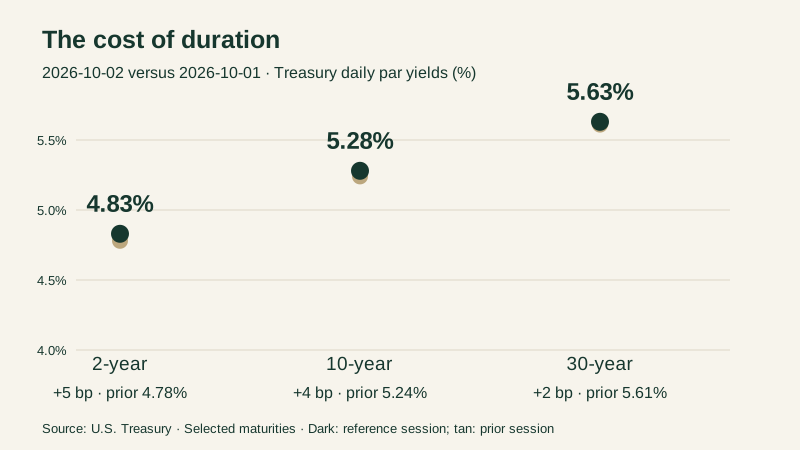
The source briefing reports a Friday equity rebound led by technology and a small number of large contributors. The exact equity closes and contribution estimates are not independently rebuilt here. Official Treasury daily observations provide a firmer cross-check: the two-year ended at 4.83%, the ten-year at 5.28% and the thirty-year at 5.63%, all above Thursday’s readings.
That does not mean the employment release had no effect. It means the completed-session evidence is different from a simple narrative in which soft jobs produced lower yields everywhere. Prices can react initially to one component and later reflect positioning, inflation concerns or other information. The observed outcome does not identify the contribution of each cause. For investors, the consequence is more concrete: the benchmark financing environment remained expensive at the weekend. An equity rebound might express confidence in future earnings or policy restraint, but it did not itself reduce the borrowing rate facing a company planning a long-lived investment.
2. The payroll report shows limited hiring and downward revisions
BLS reported September payroll growth of 29,000, unemployment of 4.2% and monthly average hourly earnings growth of 0.1%. July and August payroll gains were revised down by a combined 60,000. These are the initial September-release estimates, not later revisions or a statement about an independently measured consensus forecast. BLS’s archived October 2 release.
The combination weakens the argument for treating labor demand as uniformly strong. It does not establish a recession by itself. Payrolls and unemployment come from different surveys; the former measures jobs and the latter people’s labor-force status. A careful earnings assessment asks whether slower hiring is translating into less aggregate income growth, weaker customer demand or reduced bargaining pressure. Downward revisions matter because they alter the starting level from which the current month is interpreted. The relevant economic path is therefore broader than whether one headline appears reassuring for the next Fed meeting.
3. Softer wage pressure is not an unqualified consumer positive
Slower wage growth can reduce an employer’s cost pressure. For households, the same change can restrain income growth, especially if hours or employment also weaken. Whether purchasing power improves depends on the prices those households face. If energy and other necessary expenses stay elevated, a modest wage increase can leave less room for discretionary purchases.
This creates different corporate exposures. A labor-intensive service company may benefit from easing recruitment pressure but still suffer if customers reduce volumes. A retailer may need promotions to sustain unit sales, sacrificing gross margin even when freight or wage costs stabilize. A lender can see delinquencies respond with a lag after household cash flows weaken. The constructive scenario is a gradual cooling that restores balance without a sharp reduction in spending. Evidence for that path should come from income, transactions and credit performance over time. The employment report contributes to the assessment; it does not eliminate the need to observe the consumer directly.
4. Long-term funding has its own risk premium
The source attributes Friday’s late bond weakness to a mixture of inflation and fiscal-duration concerns. The verified yield observations support the outcome, not a precise causal decomposition. A long yield combines expectations for future short rates with compensation for uncertainty and duration exposure. Different combinations can produce the same headline level.
The distinction is central for property, utilities and data centers. These businesses often commit capital now against cash flows many years ahead. If investors demand more compensation for that duration, the required project return can stay high even when the near-term policy path becomes less aggressive. Existing fixed-rate debt can delay the cash impact, while refinancing and new construction expose the change sooner. Banks may experience a different mix of asset yields, deposit costs and credit risk. A steeper curve is therefore not a universal buy signal for financials, just as a weaker payroll number is not a universal reason to assume funding conditions have eased.
5. Energy and the dollar can complicate the labor signal
Weekend discussion remains preoccupied with the gap between energy relief headlines and delivered fuel costs. The source contains reserve-release and shipping claims whose precise terms are not verified in this edition. Rather than elevate those claims into a causal account of Friday, the useful question is whether inventories, transport and product availability improve enough to reduce costs faced by businesses and households.
The dollar adds a second channel. A weaker currency can improve translation for U.S. exporters and multinationals while increasing some import costs. A stronger currency can ease imported inflation but tighten conditions for foreign dollar borrowers. Those effects depend on hedging, invoicing and the timing of contracts. An inflation assessment should therefore avoid assuming that weaker domestic labor mechanically lowers every relevant price. The favorable combination would be moderating labor costs, stable demand and easing delivered energy expenses. If labor cools while those other costs remain firm, margins and purchasing power can be squeezed together.
6. A Friday rebound needs confirmation beyond its largest contributors
The curated source describes technology leadership and an outsized role for individual mega-cap names. It also describes weaker participation across the full week. Exact breadth, credit-spread and weekly-return figures are not treated as verified because their construction is not established. Friday’s session and the September 28–October 2 week are distinct observation periods; October 1–2 alone is only the opening fragment of Q4.
The next useful test is whether improving conditions reach businesses outside the existing leadership group. Strong semiconductor demand can coexist with softer employment in other sectors. A consumer-discretionary index can rise because of one heavily weighted company without showing a broad improvement in household demand. Equal-weight participation, small-company earnings and credit performance would help separate a narrow relief move from a wider economic improvement. Conversely, concentration is not proof of imminent collapse. It means investors depend more heavily on a few companies’ execution and on the valuations assigned to those outcomes.
7. The AI hardware debate is moving toward data movement
The source’s weekend technical discussion emphasizes memory bandwidth, capacity and the energy required to move data. Its numerical energy ratios and system-wide percentages are not reproduced without the underlying studies and workload definitions. The economic argument is still clear: an accelerator cannot deliver useful performance while waiting for the data needed by the workload.
Different memory and interconnect technologies address different constraints. More capacity can permit larger workloads; more bandwidth can reduce waiting; better placement can avoid unnecessary transfers. Those improvements should not be grouped into one undifferentiated market. A buyer needs the right combination for its applications, and a supplier’s revenue depends on which designs are qualified and deployed. Long contexts and persistent agent state can raise memory requirements, but software efficiency can offset some of that demand. For Micron and other memory suppliers, the sustainable opportunity depends on content, pricing and supply response. For networking vendors, it depends on topology and actual traffic, rather than the mere existence of more AI tokens.
8. Better utilization changes both supply and demand economics
Increasing useful output from an installed system lowers cost per completed task if the improvement does not require proportionately more spending elsewhere. That can make a cloud operator more competitive. It can also change the value of older hardware and the schedule on which customers choose to replace it. Faster new systems do not automatically make existing equipment worthless; remaining contracts, power efficiency and alternative workloads all matter.
The demand response is equally important. Lower cost may increase the number of commercially viable tasks, allowing total compute consumption to grow even as each task gets cheaper. But that response should be measured rather than assumed. A provider can lose revenue per unit faster than it gains volume. An application can absorb the savings in its margin or pass them to customers. The resulting distribution of profit determines whether efficiency is most valuable to the chip supplier, infrastructure operator, model provider or end user. A broad productivity benefit does not guarantee equal investment returns across that chain.
9. Delay claims need a project-level ledger
One source-linked discussion lists large numbers of supposedly delayed data centers and very long infrastructure timelines. The underlying project list and definitions are not independently available here, so the count is excluded. Financing delays, grid delays and construction delays are different risks; aggregating them without status and expected completion dates would overstate what is known.
A useful project ledger would identify committed funding, utility milestones, equipment ownership, customer obligations and the date revenue can begin. Hardware stored before commissioning can incur financing and economic-obsolescence costs even if accounting depreciation has not yet begun. A customer may retain demand but renegotiate its timing. An operator may preserve a contract while absorbing higher capitalized costs. For Oracle, Microsoft, Alphabet, Meta and neoclouds, the relevant exposure depends on their actual projects and contractual positions. The existence of bottlenecks supports deeper diligence; it does not justify assigning an identical delay or loss estimate to every company associated with a campus.
10. Product availability and permission design determine adoption
Google’s Argon announcement establishes a phased release beginning with trusted defenders. Wider access remains a separate step. The weekend source also collects enthusiasm for persistent agents and competing workspaces, but social descriptions of launches, government offerings and regulatory allegations are not elevated into verified product facts.
The more durable commercial issue is control. An agent that can read, write and act across applications needs boundaries appropriate to the task. A clear distinction between permitted actions, actions requiring approval and prohibited actions can make a product more usable in a real organization. Review, audit trails and recovery increase operating cost, but they may also be necessary to win deployment. The same applies to model selection: a capable system that is unavailable or difficult to govern may have less immediate commercial value than a more limited system already integrated into a trusted workflow. Adoption should be judged through completed, accepted work and retained customers, not product-surface enthusiasm alone.
11. The curated conversation combines physical skepticism and product optimism
The market selection includes Kautious and mdtrade; the infrastructure and product selection includes rdd147, Neil Shah and marksplainitall. These are preserved discovery links. Direct post wording and engagement are not independently authenticated.
The selection’s most useful tension is that investors can believe in long-run AI demand while disagreeing sharply about the near-term return on building capacity. Product optimism creates reasons for demand to grow; physical and financing constraints determine when suppliers can monetize it. The two arguments operate on different timelines. Neither the most enthusiastic demonstration nor the most alarming delay count settles the question. Company-level cash flows, customer retention, utilization and construction milestones provide the evidence that can connect the narratives to a defensible investment view.
12. The next week is a follow-through test; CPI comes later
The coming business week is October 5–9. The September FOMC minutes are scheduled for October 7 and describe the September meeting, not a committee response to Friday’s new payroll report. CPI is scheduled for October 14 at 08:30 Eastern. The regular policy meeting follows on October 27–28. These dates keep the observation sequence honest: markets can reinterpret old minutes using new data, but the original participants did not have that later report.
Constructive path: labor cools gradually, inflation pressure moderates and longer-term financing finally follows the policy relief. Broader participation and healthier downstream AI margins would strengthen the case. Uneven path: large platforms and scarce-component suppliers keep growing while consumers and leveraged developers struggle. Index resilience could coexist with weak breadth. Adverse path: softer labor damages demand while energy costs and long yields remain elevated, squeezing margins and project returns together. The most informative follow-through is whether real financing and operating conditions improve. Friday provides evidence of slower hiring; the weekend cannot manufacture evidence of a cheaper or easier investment cycle.
Sources & reading notes
Historical editorial synthesis prepared October 8, 2026 from the dated source window and linked primary-source checks; not a live market feed. Later verification preserves the chosen historical boundary. Curated X themes are attributed discussion, not authenticated quotations or consensus. Scenarios are conditional research, not portfolio instructions.
Official daily par yields for the identified completed sessions. These observations are distinct from intraday highs or executable quotes.
The October 2 archived release preserves the initial September report, including revisions to July and August.
Google’s September 30 announcement describes initial restricted access. Performance claims remain vendor-reported.
NVIDIA’s technical architecture explains a planned voltage transition and engineering tradeoffs; it does not certify every site’s readiness.
The BLS calendar establishes release dates and Eastern times.
The Federal Reserve calendar establishes the scheduled meeting dates; outcomes remain unknown at these cutoffs.
Selected original-post link preserved from the dated source discussion. Wording, engagement and platform-wide representativeness were not independently authenticated.
Selected original-post link preserved from the dated source discussion. Wording, engagement and platform-wide representativeness were not independently authenticated.
Selected original-post link preserved from the dated source discussion. Wording, engagement and platform-wide representativeness were not independently authenticated.
Selected original-post link preserved from the dated source discussion. Wording, engagement and platform-wide representativeness were not independently authenticated.
Selected original-post link preserved from the dated source discussion. Wording, engagement and platform-wide representativeness were not independently authenticated.