The market reaches payroll Friday with some relief in short-term yields and no settled answer on long-term financing. The employment report can change expectations for policy, but the AI investment cycle faces additional tests: the price of scarce memory, the timing of usable power and the cash required before customer revenue arrives. A softer labor headline would not automatically resolve those problems.
Information window: Thursday, October 1 completed-session observations and selected discussion available by the source message timestamp of 04:35:06 Pacific on Friday, October 2. The 08:30 Eastern employment release is still 54 minutes and 54 seconds away. No payroll outcome or subsequent market response is included.
1. The starting point is a yield reversal, not an established trend
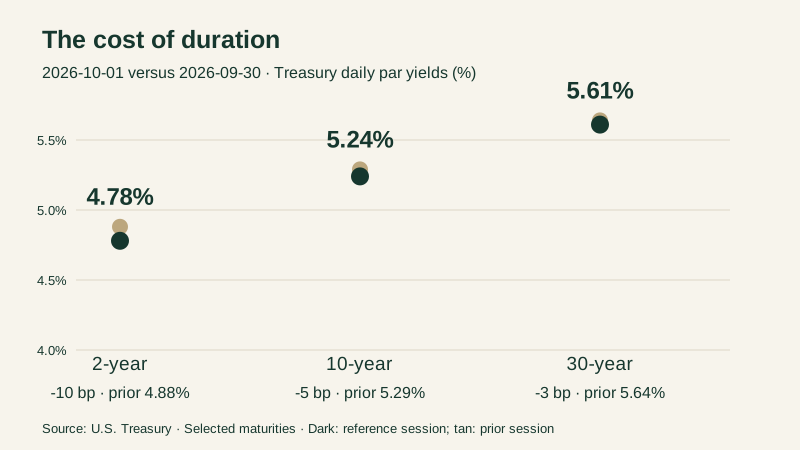
Official October 1 daily Treasury par yields were 4.78% at two years, 5.24% at ten years and 5.61% at thirty years. The two-year fell more than the long end, leaving a 46-basis-point 2s10s spread. These daily observations are distinct from the intraday highs discussed in the source. The chart therefore measures a comparable session-to-session change rather than combining an extreme with a closing quote.
The source reports that equities recovered from intraday weakness and describes Friday futures as firmer. That is useful context, but the available source does not establish a synchronized premarket snapshot. The opening question is whether easier short-rate expectations reach longer-duration funding and a broader set of equities. A one-session bond rally can relieve valuation pressure without changing the cost of financing a multiyear project. The first payroll reaction should be evaluated against that starting condition, rather than interpreted as though markets begin the morning with no expectations already embedded.
2. Read payrolls as several tests, not a single score
The September employment report is scheduled for 08:30 Eastern. The dated discussion expects a moderation in hiring, but its estimate range is not independently established as market consensus. There is no reason to turn that range into a precise hurdle. The relevant evidence will include payroll growth, revisions, unemployment, participation, wages and hours.
A weaker establishment number with stable hours and contained wage growth would suggest a different demand path from falling payrolls accompanied by shorter workweeks. A higher unemployment rate can reflect people entering the labor force as well as job losses. Revisions can reveal that a seemingly resilient prior month was less strong than first reported. Those distinctions matter to the expected policy path and to corporate earnings. A low-hiring, low-layoff economy can remain stable for a period while becoming less forgiving of a new shock. A report should be read as a set of connected measurements, with survey differences and uncertainty preserved.
3. The beneficial version of softer labor has conditions
The favorable market interpretation would be enough cooling to restrain wage and service-price pressure without a material deterioration in household income or credit performance. That could help valuation-sensitive businesses while leaving sales forecasts intact. It is a plausible scenario, not the inevitable meaning of a weak headline.
The adverse version is that labor demand weakens before inflation-sensitive costs subside. Consumer firms could then face slower volumes and continued input pressure. Banks could experience deteriorating credit quality despite a more favorable policy outlook. Small companies may benefit from lower borrowing benchmarks only if lenders remain willing to extend credit at reasonable spreads. For that reason, corporate spreads, lending standards and actual issuance terms provide essential context after the report. Treasury relief can be offset by wider private-credit compensation. An equity rally driven entirely by expectations for policy would be less persuasive if businesses still faced worsening all-in funding costs and households reduced discretionary spending.
4. Reserve-release discussion needs a physical transmission test
The source selection describes competing energy headlines: supply concerns on one side and discussion of reserve releases on the other. Specific proposed volumes, tanker incidents and geopolitical assertions are not independently verified here. They are excluded from the factual baseline. The economic question can be stated without them: would additional supply arrive in the product, place and timeframe where the constraint exists?
Releasing crude into a system with constrained refining does not have the same effect as releasing a finished fuel. Transport and insurance can remain costly even if headline supply increases. Conversely, credible future supply can affect expectations before a barrel is delivered. For equities, distinguish immediate market repricing from realized cost relief. Airlines, freight businesses and manufacturers need sustained improvement in delivered costs; upstream producers face the opposite revenue sensitivity. Refiners depend on product spreads and operating conditions. The strongest macro relief would combine lower energy costs with stable demand, while a demand-driven energy decline could signal a much less constructive earnings environment.
5. Rates, the dollar and earnings estimates must be read together
A payroll surprise can move the dollar through relative interest-rate expectations. If U.S. yields decline while foreign rates hold, the currency response could improve translation for U.S. multinationals. It could also ease some dollar funding pressure abroad. The source’s currency levels are not used as a verified cross-asset table because the observation conventions differ.
The earnings-yield comparison circulating in the source is best treated as a valuation question, not a mechanical timing signal. Equity earnings can grow, shrink or be retained; Treasury coupons have a different contractual structure and risk. Comparing the two requires assumptions about future growth, payout and uncertainty. A high multiple becomes more vulnerable when expected earnings are revised down at the same time that discount rates rise. Conversely, stronger cash generation can partly offset a higher hurdle. The test after payrolls is therefore whether changing financial conditions improve the expected cash flows as well as the price investors are willing to pay for them.
6. The next rally needs a broader earnings explanation
The dated source describes a small group of large technology and semiconductor names supporting Thursday’s index recovery. Its precise sector and advance-decline counts are not independently reconciled, so they do not appear as certified market statistics. The observed theme is narrow leadership, with little confidence that a broad consumer or industrial acceleration is underway.
Payrolls could create a short-term bid across rate-sensitive shares. To become more than a valuation rebound, that move would need support from orders, credit conditions and earnings expectations. Memory, optical connectivity and cooling are different products, but all may depend on the same concentrated customer spending. Their simultaneous strength does not independently confirm broad economic demand. A healthier expansion would show participation among companies with unrelated revenue drivers. A failure to broaden would not prove that leadership must immediately fall; it would show that index performance remains dependent on a narrower collection of outcomes than the headline suggests.
7. Micron moves the question downstream
The memory supplier’s Wednesday results are already available to this edition. The important follow-through question is how customers absorb scarce-component economics. Higher memory content can improve model performance and expand useful workloads, but it also raises the capital attached to each installed system. The resulting return depends on utilization, realized pricing and the useful life over which that cost is recovered.
For a cloud operator, depreciation continues even when demand is temporarily weak. For a customer paying a fixed contract rate, rising hardware costs may be borne by the operator unless repricing is allowed. For a supplier receiving advances, financing improves before all the associated production obligations are complete. None of these relationships can be inferred from one headline order figure. The research task is to map the obligations across counterparties. A strong supplier result is evidence of value captured at that stage of the chain; it is not independent proof that every purchaser will earn an attractive return on the same equipment.
8. AI financing headlines need a term sheet before a valuation
The source includes large figures for chip financing, laboratory commitments and possible transactions. The underlying dated agreements are not available in the verified set used here. Their precise amounts, counterparties’ obligations and proposed capital structures are therefore not presented as established facts. The relevant mechanism is the growing importance of financing between an equipment supplier and the ultimate user.
Debt secured on hardware depends on collateral value, residual life and the borrower’s ability to generate cash. Senior and junior claims bear different losses. An offtake contract may improve visibility, but its value depends on enforceability, cancellation terms and customer credit. A guarantee can transfer risk to a stronger balance sheet without eliminating the economic loss. These distinctions matter for Broadcom, NVIDIA, cloud operators and their financiers in different ways. Financing can accelerate deployment and expand a supplier’s addressable market; it can also make the demand chain more correlated if many obligations rely on the same small set of end customers.
9. The useful power metric is commissioned capacity
Forecasts of enormous future data-center power gaps feature prominently in the source. Without the underlying definitions, geography and overlap, adding those forecasts would manufacture precision. A cumulative shipment estimate, a building’s nameplate capacity and an instantaneous energized load measure different things. None can be substituted for another.
The practical diligence sequence begins with a site’s actual milestones: utility service, electrical completion, equipment installation, cooling readiness, commissioning and customer acceptance. NVIDIA’s 800VDC design explains one response to growing electrical density, including the tradeoff between higher voltage and lower current. It does not establish a universal rack-power limit or solve a missing grid connection. For Vertiv and other infrastructure suppliers, the opportunity depends on the design selected and the equipment delivered. For developers, a delay can consume cash and postpone revenue even when customer demand remains genuine. The timing of usable capacity belongs beside the expected utilization rate in any return calculation.
10. Argon is a capability milestone with a gated revenue path
Google’s September 30 Argon announcement describes trusted-defender access first and wider availability later. Its stated one-million-token limit concerns output, not an interchangeable claim about input context. These distinctions prevent a product announcement from being mistaken for a universally available commercial service. Google’s launch announcement.
Longer reasoning can create value on difficult tasks while consuming more time and resources. The user’s willingness to pay depends on the reliability and value of the finished work. An enterprise may prefer a faster, cheaper model for routine tasks and a more capable model for expensive exceptions. That suggests a portfolio of workloads rather than one universal winner. For Alphabet, distribution and cloud integration could be important advantages, but adoption requires access, acceptable service terms and demonstrated usefulness. Vendor benchmark leadership can motivate evaluation; it cannot substitute for an organization testing its own documents, software, controls and failure costs.
11. Agent reliability is part of the margin calculation
The source’s builder discussion emphasizes checkpoints, permissions and independent evaluation. Its specific failure percentages and cross-model rankings are not reproduced because their experimental protocols are not verified. The general operating issue is straightforward: a chain of actions has more opportunities for failure than a single answer, particularly when tools can modify external systems.
Review gates add time and cost, but they can prevent much larger remediation expenses. The correct comparison is the total cost of successfully completing a task with acceptable risk, including human review and recovery. An agent that produces more tokens or acts more frequently is not necessarily more productive. In enterprise software, controls can therefore support adoption rather than merely restrain it. The commercial question is which provider can deliver useful autonomy with clear accountability and integration into existing work. That is a different competition from a benchmark contest and may favor products that are easier to supervise and audit.
12. Discussion themes and the conditional path after payrolls
The curated links include Gary Black on valuation, Hilsden Trading on rates, and Kautious on the AI stack. Bridgebench appears in the model-evaluation discussion. These are attributed themes in a selected source, not authenticated quotations, engagement rankings or consensus.
Constructive: the report shows manageable cooling, financing costs ease and participation broadens. Inflationary: labor and wages remain firm while energy pressure persists, keeping duration and project finance under strain. Demand deterioration: weaker labor encourages policy relief but damages earnings and credit enough to offset it. The observation to prioritize is the combined response of long yields, private funding and earnings-sensitive equities. The next scheduled CPI is October 14 and the FOMC meets October 27–28. This morning’s report will add evidence to those decisions; its result is still unknown at this edition’s cutoff.
Sources & reading notes
Historical editorial synthesis prepared October 8, 2026 from the dated source window and linked primary-source checks; not a live market feed. Later verification preserves the chosen historical boundary. Curated X themes are attributed discussion, not authenticated quotations or consensus. Scenarios are conditional research, not portfolio instructions.
Official daily par yields for the identified completed sessions. These observations are distinct from intraday highs or executable quotes.
BEA’s September 30 release establishes the August estimates and annual-update context; later rolling tables are not substituted.
Google’s September 30 announcement describes initial restricted access. Performance claims remain vendor-reported.
NVIDIA’s technical architecture explains a planned voltage transition and engineering tradeoffs; it does not certify every site’s readiness.
The BLS calendar establishes release dates and Eastern times.
The Federal Reserve calendar establishes the scheduled meeting dates; outcomes remain unknown at these cutoffs.
Selected original-post link preserved from the dated source discussion. Wording, engagement and platform-wide representativeness were not independently authenticated.
Selected original-post link preserved from the dated source discussion. Wording, engagement and platform-wide representativeness were not independently authenticated.
Selected original-post link preserved from the dated source discussion. Wording, engagement and platform-wide representativeness were not independently authenticated.
Selected original-post link preserved from the dated source discussion. Wording, engagement and platform-wide representativeness were not independently authenticated.