The fourth quarter begins with a useful contradiction. Micron has delivered extraordinary reported economics, while the bond market is making the rest of the investment chain more expensive to finance. Wednesday’s inflation release leaves a mixed picture, but strong spending and higher long yields prevent an easy all-clear. The central question is where scarce-component profits end and the customer’s return on capital begins.
Information window: Wednesday, September 30 completed-session observations and discussion available by the Thursday source message timestamp, 04:34:26 Pacific. Wednesday’s BEA and Micron releases are available. Thursday’s ISM release and Friday’s employment results remain ahead.
1. A new quarter does not reset the financing burden
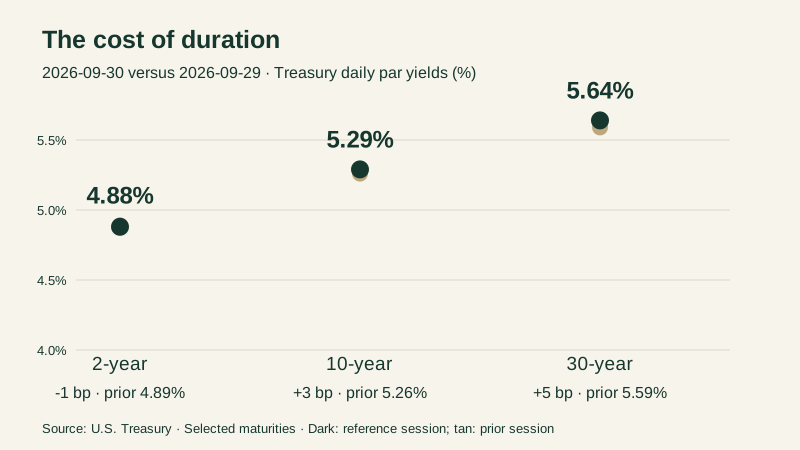
The September 30 Treasury reference is 4.88% for two years, 5.29% for ten years and 5.64% for thirty years. Long maturities rose while the two-year edged lower. That divergence is more informative than calling the whole market hawkish or dovish. The front end and the long end can respond to different parts of the economic outlook.
The source describes a split equity session, with technology relatively resilient and industrial and dividend-sensitive shares weaker. Exact cross-market rankings are not independently reconstructed here. The important opening condition is that corporate financing still occurs against an expensive benchmark. An enterprise with a distant payoff has to generate more future cash, pay less for its assets or secure cheaper funding to preserve its prospective return. Changing the date from September to October does none of those things by itself. After quarter-end portfolio adjustments pass, financing terms and earnings revisions will provide a better test of whether the pressure is durable.
2. Core PCE rose less than headline inflation, while spending increased
BEA’s September 30 release reports August headline PCE inflation of 0.3% monthly and 3.4% annually; core inflation was 0.2% and 3.0%. Real spending rose 0.6%, while real disposable income was unchanged. The release incorporates an annual update. Those are reported estimates, not a reason to discard the inflation information. BEA’s dated release.
The combination leaves a genuine tension. A smaller core increase than the headline suggests that price pressure was not uniform, while the core monthly pace still increased from July’s 0.1%. Spending running ahead of real income can also be less durable than spending funded by expanding earnings. One month does not determine the answer. Retailers and consumer lenders therefore need a different read-through from software and semiconductor suppliers: whether demand is supported by household income, credit or reduced saving matters to how confidently they can project the next quarter. Revisions should be studied consistently across the time series rather than used selectively to validate an existing market view.
3. A policy pause would not guarantee cheaper long-term debt
The source discussion interprets the data through the likelihood of another Fed move. Exact probability screens are omitted because their timestamps and contracts are not reconciled. Even a correctly measured change in policy expectations would answer only part of the financing question. Longer yields also incorporate future inflation, uncertainty and the compensation investors demand for holding duration.
This matters especially for infrastructure. A project can be exposed to a floating construction loan now and a long-term refinancing later. Lower short rates might help the first expense without improving the second. A profitable platform may avoid issuing debt, but its shareholders still compare prospective returns with alternatives. The same hurdle can affect acquisition prices, buybacks and capital spending. The regular Fed calendar runs to October 27–28 and December 8–9. Until then, realized data and financing conditions are more useful than treating the next meeting as an automatic switch for all asset prices.
4. Defensive demand does not remove valuation risk
Utilities and staple companies are often described as defensive because their sales can be less cyclical. Their shares can nevertheless be sensitive to interest rates, particularly when investors value predictable distributions or when the businesses need substantial capital. Stable demand and stable share prices are different propositions.
For regulated utilities, examine the allowed return, the timing of rate recovery and the funding needed to build new assets. For independent generators, contracts, fuel exposure and realized power prices matter. AI demand does not make every power business economically equivalent. A long contract may stabilize revenue while leaving construction inflation with the supplier; a merchant position may provide upside while exposing the company to volatile prices. For staple producers, pricing power has to be tested against volumes and customer substitution. The source’s rotation narrative is therefore best understood as a question about cash-flow duration and funding, rather than proof that all defensive businesses have suddenly lost their economic role.
5. Micron provides reported evidence of memory pricing power
Micron reported fiscal fourth-quarter revenue of $54.229 billion and GAAP gross profit of $47.047 billion. Its next-quarter revenue outlook is $61.5 billion, plus or minus $1.5 billion. The first pair is historical financial reporting; the outlook is management’s forecast. Micron’s release and statements.
The investor question is what makes these economics sustainable. Scarcity can transfer substantial profit toward a component supplier, but customers eventually respond through architecture changes, purchasing discipline and alternative supply. High margins may finance additional capacity, which can change the later balance. None of that invalidates the current result. It changes the period over which it should be extrapolated. The source describes a restrained share-price response, but there is no independently verified event-study return here. More broadly, an excellent quarter can coexist with a modest stock reaction when expectations and discount rates are already demanding. Earnings quality and valuation need separate assessments.
6. Customer deposits change financing before they become revenue
Micron’s statements show $12.747 billion of customer-contract deposit proceeds for the fiscal year and $12.895 billion of noncurrent customer contract liabilities at September 3. These are different measures, and neither is a quarterly revenue figure. The source’s additional supply-agreement totals are not treated as interchangeable with those financial-statement categories.
For a supplier, an advance can help fund assets or secure demand before delivery. For the buyer, it brings forward a cash requirement and may constrain flexibility. The economic allocation depends on cancellation rights, pricing formulas, delivery obligations and recourse. A balance-sheet liability is a stock measured at a date; a cash-flow line measures movement over a period; a commercial commitment may describe deliveries over several future years. Adding them together would create an artificial measure of demand. The useful diligence question is who bears the loss if equipment, power or end-customer demand arrives later than expected. Deposits can reduce one party’s financing problem while moving more risk onto another.
7. Higher memory prices can flatter revenue and pressure customers
When a scarce component gets more expensive, server revenue can rise without a proportional improvement in the assembler’s economics. If the higher cost is passed through with little markup, gross-profit dollars may hold up while gross-margin percentage falls. If contracts fix selling prices before components are purchased, the impact can be worse. Inventory and receivables can also require more cash simply because each unit now carries a higher dollar value.
That makes Dell, HPE and Super Micro analytically different from the memory supplier. The appropriate questions concern pricing terms, order conversion, inventory ownership and collection timing. Hyperscalers and neoclouds sit further downstream: they must recover the system cost through useful compute or associated services. CPU demand, storage demand and accelerator demand can all increase with agent workloads, but the attach rate does not establish which supplier gains share. A broad AI hardware revenue boom can contain sharply different margins and funding needs. The financial statements should determine the read-through, not the shared theme label.
8. Higher voltage is an engineering response, not a universal threshold
NVIDIA’s published 800VDC architecture addresses rising rack density by reducing current and conversion stages. Its explanation supports a directional efficiency and copper argument, with implementation challenges still identified. It does not establish that AC universally becomes unusable at a 100-kilowatt rack threshold. NVIDIA’s engineering explanation.
The distinction matters financially. A technology transition can create demand for new equipment while raising integration, safety and commissioning costs. A supplier’s opportunity depends on qualification and its role in the final design. Higher voltage does not create an interconnection, finish a substation or remove heat from a chip by itself. Nor does a gigawatt-scale campus imply one mandatory generation technology. Reliable delivered power, operating constraints, local rules and project timing determine the mix. Investors should follow completed designs and contracted delivery milestones rather than assume that every electrical component benefits equally from the same architecture announcement.
9. Utilization may matter as much as another hardware purchase
The curated source highlights discussion of Nebius and inference software aimed at cold starts and idle capacity. The transaction details are not independently verified here, so no acquisition economics are assigned. The operating problem is still worth examining: a paid-for accelerator earns little during idle periods, and a slow model startup can prevent an operator from serving bursts of demand efficiently.
Better scheduling and model placement can increase useful output from the existing fleet. The benefit has limits. Keeping more models resident may use memory that could otherwise serve active workloads; batching can improve throughput while worsening latency; maximizing average utilization can leave too little headroom for demand spikes. The customer’s service requirement determines the sensible tradeoff. This is why cost per token alone can mislead. Revenue depends on useful, timely output that a customer accepts. Operators able to demonstrate lower total cost at the required service level have a stronger commercial argument than operators reporting only installed accelerator counts.
10. Argon’s announcement and its availability are separate facts
Google announced Gemini 4 Argon on September 30 with initial access for trusted cyber defenders through Fairwind and plans for wider access later. The announcement is therefore available to this edition, but it is not evidence of an unrestricted rollout. Google’s capability claims remain vendor claims. Google’s announcement.
Restricted access changes the commercial timeline. An enterprise cannot replace a production workflow with a model it cannot yet obtain under suitable terms. Once access expands, migration still requires evaluation, security review, integration and a plan for failures. For Alphabet, stronger capability can help distribution and cloud demand, but near-term monetization depends on availability and deployment. For competitors, the relevant response may involve price, reliability, tooling or capacity rather than a single benchmark. The evidence supports a new product-development milestone; it does not establish the eventual market share or unit economics of the finished service.
11. The X debate is shifting from growth to allocation of profit
The dated selection links Kurt S. Altrichter on dividend-sensitive equities and Bluekurtic on a historical yield analogy. Its infrastructure discussion includes TheValueist and JSCC2020Lee. These links identify the curated discussion; direct wording and engagement are not authenticated.
The useful disagreement is whether scarcity profits justify the valuation paid to obtain them. Suppliers can earn exceptional margins while downstream returns deteriorate. Alternatively, better models and more efficient inference can expand customer demand enough to support the whole chain. A historical bond-market analogy cannot choose between those outcomes. Nor can a ticker list prove that every company on it controls a bottleneck. The evidence that would matter is durable pricing power, cash collection and successful deployment, accompanied by an honest accounting of who finances the interval between spending and revenue.
12. ISM and payrolls now test the split economy
Thursday’s manufacturing survey is still ahead at this cutoff. Its orders, employment and price components should be separated rather than collapsed into one growth label. Friday’s September jobs report is scheduled for 08:30 Eastern. The next CPI release is October 14; it should not be pulled forward to fit the immediate trading narrative. The BLS calendar anchors the labor and inflation dates.
Improving outcome: demand remains sufficient, inflation pressure moderates and financing conditions stop deteriorating. Broader participation would make the equity response more credible. Margin-squeeze outcome: expensive inputs and funding persist while downstream customers struggle to monetize AI investment. Suppliers could initially retain strength as customers weaken. Growth-scare outcome: softer employment reduces tightening pressure but also undermines sales and credit quality. The distinction is important: the best case for long-duration valuations is not necessarily the best case for every cyclical business. Q4 begins with stronger evidence for memory economics, not a universal answer for equities.
Sources & reading notes
Historical editorial synthesis prepared October 8, 2026 from the dated source window and linked primary-source checks; not a live market feed. Later verification preserves the chosen historical boundary. Curated X themes are attributed discussion, not authenticated quotations or consensus. Scenarios are conditional research, not portfolio instructions.
Official daily par yields for the identified completed sessions. These observations are distinct from intraday highs or executable quotes.
BEA’s September 30 release establishes the August estimates and annual-update context; later rolling tables are not substituted.
Micron’s September 30 release distinguishes reported financial statements, future guidance and customer-deposit financing.
Google’s September 30 announcement describes initial restricted access. Performance claims remain vendor-reported.
NVIDIA’s technical architecture explains a planned voltage transition and engineering tradeoffs; it does not certify every site’s readiness.
The BLS calendar establishes release dates and Eastern times.
The Federal Reserve calendar establishes the scheduled meeting dates; outcomes remain unknown at these cutoffs.
Selected original-post link preserved from the dated source discussion. Wording, engagement and platform-wide representativeness were not independently authenticated.
Selected original-post link preserved from the dated source discussion. Wording, engagement and platform-wide representativeness were not independently authenticated.
Selected original-post link preserved from the dated source discussion. Wording, engagement and platform-wide representativeness were not independently authenticated.
Selected original-post link preserved from the dated source discussion. Wording, engagement and platform-wide representativeness were not independently authenticated.
ISM schedules its September manufacturing report for October 1 and September services report for October 5. No October 1 result is included in this morning window.