September ends with two tests of the same market assumption: that strong nominal demand can keep supporting earnings without making capital prohibitively expensive. Inflation and activity data arrive this morning; Micron reports later. Between them sits a more selective AI argument. Selling chips, energizing a building and earning a return on an inference workload are separate milestones. The market needs progress across all three.
Information window: Tuesday, September 29 cash observations and selected discussion available by 04:34:44 Pacific on Wednesday, September 30. This is before this morning’s GDP and PCE releases and before Micron’s results. Subsequent outcomes are intentionally absent.
1. The quarter ends with an expensive discount rate
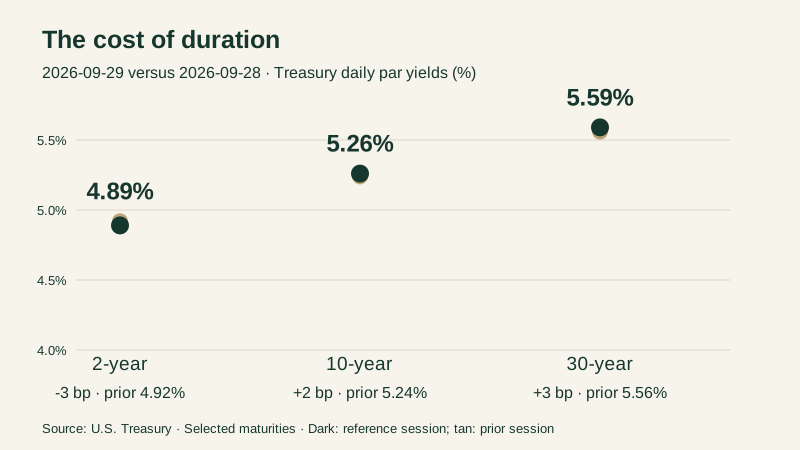
Tuesday’s official Treasury observations give the cleanest starting point: 2-year 4.89%, 10-year 5.26% and 30-year 5.59%. The spread between the 10-year and 2-year is 37 basis points. The source briefing describes a modest decline in the major equity indexes and weaker participation beneath them, but its intraday oil and dollar observations do not share a common timestamp. They should not be assembled into a synthetic closing dashboard.
The curve matters because a positive slope can arise for uncomfortable reasons. A higher long yield can reflect growth, inflation uncertainty, duration supply or compensation for holding a long asset. It is not automatically evidence that credit creation is accelerating. For a business issuing debt today, the level of the borrowing rate still matters even if the curve looks more normal. Quarter-end flows may amplify individual moves, so the useful test is whether financing pressure persists after the calendar turns.
2. PCE: specify the test before seeing the answer
The August PCE release is due at 08:30 Eastern, as announced in BEA’s preceding release. The source discussion leans toward a benign-versus-sticky inflation contest, but there is no independently reconstructed consensus distribution here. It is more useful to state the transmission mechanism than to give an unsourced expectation false precision. Softer core inflation would reduce one reason for additional tightening. Strong real spending would simultaneously make a rapid demand slowdown less likely.
Read the monthly and annual measures separately, alongside revisions and income. A favorable monthly number can coexist with an elevated year-over-year rate. Falling annual inflation can partly reflect the comparison period. Real spending measures the volume purchased after price changes; nominal spending measures the dollars changing hands. Investors need both because one bears on demand and the other on revenue and working capital. The best equity combination would be easing price pressure with spending supported by income, rather than spending sustained only through a lower saving rate.
3. Growth and employment will answer different questions
The GDP update looks backward at an already completed quarter; the prior BEA notice schedules it for September 30 at 08:30 Eastern. The source’s event watch also includes ADP’s separate private-payroll estimate. Friday’s government employment report adds establishment and household survey evidence. None should be treated as a substitute for the others, and today’s results cannot be inferred from the market’s anticipation of them.
For cyclical businesses, the composition of growth is more informative than an annualized headline alone. Inventory accumulation can raise measured output while creating a later production headwind. Imported equipment can support future domestic capacity even as imports subtract in GDP accounting. Capital spending that is concentrated in data centers can therefore coexist with uneven conditions across consumer and industrial firms. Labor data deserve the same discipline: lower hiring is different from rising layoffs. Hours and wage income can weaken before a company announces a major headcount reduction. The sequence matters for revenue forecasts and for how quickly a policy change could reach the real economy.
4. Energy reaches earnings through several channels
The curated discussion places crude, refined products and shipping at the center of the inflation debate. Its exact export-flow estimates and incident claims have not been independently established. The durable analytical point is narrower: additional crude supply does not guarantee adequate diesel or jet-fuel supply at the right location. Refinery capacity, transport costs and inventories can interrupt the transmission from a cheaper barrel to a cheaper delivered product.
That distinction creates different exposures. An upstream producer is more directly tied to realized crude prices. A refiner’s margin depends on the difference between product revenues and feedstock costs, adjusted for operating conditions. An airline faces fuel expense but may lack the pricing power to pass it through. A retailer can face freight pressure even when its own selling prices are stable. Energy relief would be most convincing if it reached these downstream costs; a single futures quote does not establish that broader improvement. No specific maritime allegation is necessary to make this earnings distinction.
5. Dollar strength is a funding question as well as a translation question
The source describes a firm dollar alongside higher yields. Without a synchronized currency series, the interpretation remains conditional. If higher U.S. yields attract capital and strengthen the dollar, overseas revenues translate into fewer dollars for U.S. multinationals. For borrowers earning local currency but servicing dollar debt, the same move raises the burden of repayment. Hedging policies and debt maturities determine how quickly either effect appears.
Liquidity also needs a more precise meaning than an index rising or falling. A liquid Treasury market, available corporate financing and plentiful cash at an AI laboratory are different conditions. A company can have enthusiastic customers and still face a cash shortfall between equipment deposits and customer collections. Into quarter-end, watch funding terms and issuance execution rather than assume a broad liquidity regime from one day’s equity performance. For internally funded platforms, cash generation provides flexibility that a development-stage operator may not have, although it does not protect the platform’s valuation from a higher discount rate.
6. Narrow leadership changes the burden of proof
Tuesday’s source sample describes indexes holding up better than the average stock. Its precise breadth percentages lack a defined universe and calculation, so they are not repeated as verified statistics. The research implication still holds: when a small leadership group carries an index, the index becomes more dependent on those companies delivering against demanding expectations.
A broadening rally would need participation from businesses with different earnings drivers. Memory suppliers, optical suppliers and cooling vendors all moving together may broaden the AI supply chain while leaving the wider economy untouched. Banks would require a separate assessment of credit costs and deposit pricing; small companies would need relief in financing and demand; consumer businesses would need evidence on unit sales and margins. Conversely, narrow leadership alone does not date a market reversal. It identifies concentration risk and raises the value of observing what happens outside the largest constituents after the inflation release.
7. Micron is the earnings test, with the result still ahead
Micron’s scheduled September 30 results provide a concrete bridge from AI enthusiasm to reported financial statements. Before the release, the right questions concern pricing, shipment volume, product mix, customer commitments and cash conversion. A memory shortage can improve a supplier’s economics while increasing the cost of the customer’s entire system. Those two outcomes can occur at the same time.
Look for whether stronger revenue is driven primarily by more bits sold, richer products or higher prices. Then compare operating cash generation with capital expenditure and changes in receivables and inventory. Customer advances would be relevant to financing, but they should never be confused with revenue already earned. Guidance also needs its own label: management’s forecast for a future quarter is not a realized result. A strong release could support the memory thesis without insulating the share price from a higher market discount rate. The useful surprise is the gap between delivered economics and the expectations embedded in the stock, which cannot be measured from the release alone.
8. Sol makes token pricing a workflow-economics test
OpenAI’s September 29 DevDay recap introduces GPT-6.1 Sol; its linked launch page lists standard prices of $2 per million input tokens, $10 per million output tokens and $0.10 per million cached-input tokens. The capability comparisons are OpenAI’s evaluations. The commercial relevance is the possibility of running more useful work within a fixed budget; it is not proof that every application’s bill falls by the same percentage. OpenAI’s launch details.
Consider an agent that repeatedly reads the same instructions but generates a long new answer each time. Caching can make the repeated input inexpensive, while output and tools remain material costs. Another workflow may save more through fewer failed attempts than through cheaper tokens. That is why the appropriate operating measure is cost per accepted task, including review and retries. Lower prices expand the range of economically sensible applications, but a provider still needs enough utilization and contribution margin to fund the infrastructure behind them.
9. The power constraint is about delivery dates
The source’s most forceful infrastructure claims describe unpowered GPUs and very large future capacity gaps. Those totals are not verified installed-base measurements and are omitted. The underlying project question can be evaluated without them: when can an individual site accept equipment, draw reliable power, remove heat and serve paying workloads?
A utility agreement is one milestone. Completed substations, protection systems, commissioning and cooling are others. Power can be physically available in a region without being deliverable to a specific building on the required date. A delay is costly because interest, staffing and some contractual obligations continue before revenue starts. Yet it can also create an advantage for an already operating competitor. The investment distinction should therefore be site-specific and contractual, rather than a blanket preference for anything labeled power. An energized facility with unattractive economics is not automatically valuable, and a delayed facility is not automatically a permanent loss.
10. Follow the cash across the AI stack
A chip vendor, a cloud operator and an application provider recognize economic success at different points. The vendor may sell a system before the operator completes installation. The operator may secure a multiyear contract before collecting all the associated cash. The application provider may attract users before establishing a repeatable margin. Aggregating their headline announcements can count the same underlying demand several times.
For NVIDIA and AMD, follow deliveries and the customer’s ability to put systems to use. For Microsoft, Amazon and Alphabet, compare incremental capacity with the revenue and cash generation it supports. For neoclouds, debt service, collateral and customer concentration can be as important as the order book. For power and cooling suppliers, backlog conversion and payment terms matter. These are research questions, not an assertion that any named company is currently unable to fund itself. The purpose is to identify where timing risk sits before it becomes a reported earnings problem.
11. What the selected X discussion adds
The source’s macro selection includes DeItaone and zerohedge links around energy and rates. Its AI selection includes Sam Altman and Darrin Mylet links around product economics and infrastructure. These are preserved discovery links from a curated source, not authenticated quotations or evidence of platform-wide consensus.
The interesting disagreement is between scarcity and efficiency. One argument expects physical bottlenecks to transfer value toward powered capacity. Another expects cheaper inference and better orchestration to change how much capacity is required per task. Both can be right over different horizons. Higher efficiency can reduce resources per request while encouraging more requests. The demand response, the price response and the construction timetable determine who captures the benefit. Engagement counts would not resolve that economic question, even if they were available.
12. The next evidence that would change the view
Today’s calendar includes the 08:30 Eastern BEA releases and Micron later in the day. ADP is also a separate labor input in the source’s event watch; its release sequencing is not used to infer a result. Friday, October 2 brings the September employment report at 08:30 Eastern. The regular FOMC meeting is October 27–28, followed by December 8–9. The calendar creates opportunities to update a view; it does not make the outcome knowable this morning.
Constructive path: inflation pressure eases, income supports demand, long yields stabilize and Micron provides evidence that AI spending is converting into cash. Confirmation would include broader equity participation and improving project economics. Adverse path: sticky costs and expensive financing persist while earnings strength remains concentrated. Even intact orders could then coexist with multiple compression. Mixed path: reassuring inflation but softer demand leaves duration-sensitive assets better supported and cyclical earnings more exposed. Distinguishing these paths requires the complete releases and subsequent financing conditions, rather than a reflexive interpretation of the first headline.
Sources & reading notes
Historical editorial synthesis prepared October 8, 2026 from the dated source window and linked primary-source checks; not a live market feed. Later verification preserves the chosen historical boundary. Curated X themes are attributed discussion, not authenticated quotations or consensus. Scenarios are conditional research, not portfolio instructions.
Official daily par yields for the identified completed sessions. These observations are distinct from intraday highs or executable quotes.
The launch page establishes advertised standard token prices. Actual workflow costs depend on usage and execution quality.
The BLS calendar establishes release dates and Eastern times.
The Federal Reserve calendar establishes the scheduled meeting dates; outcomes remain unknown at these cutoffs.
The issuer’s dated notice establishes the scheduled results event, without importing the subsequent financial outcome.
Selected original-post link preserved from the dated source discussion. Wording, engagement and platform-wide representativeness were not independently authenticated.
Selected original-post link preserved from the dated source discussion. Wording, engagement and platform-wide representativeness were not independently authenticated.
Selected original-post link preserved from the dated source discussion. Wording, engagement and platform-wide representativeness were not independently authenticated.
Selected original-post link preserved from the dated source discussion. Wording, engagement and platform-wide representativeness were not independently authenticated.
The August 26 release announced September 30 at 08:30 Eastern for the next PCE report; only that advance schedule is used here.
The August 26 release announced the September 30, 08:30 Eastern GDP update. No later GDP result enters this morning edition.
The dated September 29 recap corroborates that GPT-6.1 Sol was announced before this edition’s chosen historical boundary.