The next labor and inflation releases arrive against a tougher financing backdrop. Monday's Treasury observations show yields rising across the selected maturities, while NVIDIA's new repurchase authority highlights the difference between intended supplier capital returns and customers still funding their buildout. The question for Tuesday is whether demand can stay healthy without keeping the cost of capital elevated.
Reconstruction notice: Reconstructed on October 8, 2026. No original September 29 daily email was recovered. This edition assumes a September 29 cutoff of 7:30 a.m. EDT, before the U.S. cash open; September 28 is the prior completed cash session. It is not a reproduction of a contemporaneous email. Same-day releases after that cutoff are excluded. There is no verified curated-X ranking for this date.
1. Start with Monday's financing baseline
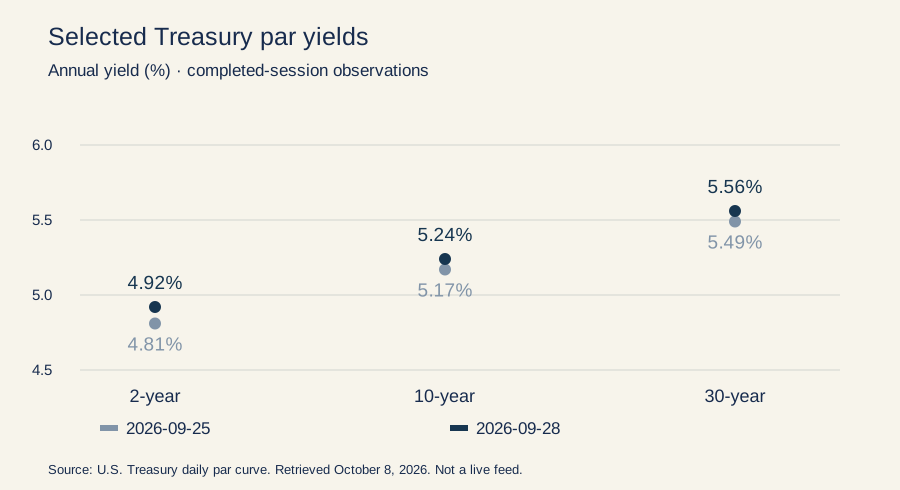
The most defensible numerical market anchor is Treasury's September 28 daily par curve: 4.92% at two years, 5.24% at ten years and 5.56% at thirty years. Relative to September 25, those yields rose 11, 7 and 7 basis points. The ten-year minus two-year spread narrowed from 36 to 32 basis points. This was a broad upward move in yields with modest flattening, rather than a fresh steepening at those endpoints. Treasury observations.
These are indicative par yields derived from pricing near 3:30 p.m. Eastern, not executable Tuesday quotes. A synchronized September 28 equity, oil, dollar and volatility close panel has not been independently verified for this reconstruction. Leaving that panel incomplete is preferable to joining incompatible observations into a precise-looking snapshot. The useful starting point is nevertheless clear: the long-duration funding hurdle rose before this morning's labor-demand test.
2. Higher yields reach companies on different schedules
The immediate valuation effect is easiest to see in businesses whose expected profits lie far in the future. A higher required return reduces what investors can pay today for the same future cash flows. The operating effect arrives through refinancing, new borrowing and project approval. A company with cash and fixed-rate debt can have a very different near-term experience from a developer drawing construction finance.
That distinction matters for AI infrastructure. An equipment supplier may collect while its customer's facility is still being commissioned. A cloud operator may need to cover interest and power commitments before utilization reaches a profitable level. Utilities must compare financing costs with their allowed or contracted returns. Those are separate earnings models even when all three benefit from the same investment cycle.
The next questions are which obligations reprice soon, how much spending precedes customer acceptance, and whether the customer can delay without compensation. The Treasury move raises those questions; it does not answer them for every issuer.
3. JOLTS is still ahead, with hiring as important as openings
The September 1 BLS release put July job openings at approximately 7.3 million, with hires and separations each around 5.1 million. It scheduled the August report for September 29 at 10 a.m. Eastern. That is the available baseline and the next release time. This morning reconstruction does not incorporate the August results released later today. Archived July JOLTS release and next-release notice.
The distinction between a vacancy and a hire is economically useful. A firm can keep a position advertised while slowing actual recruitment. Quits offer a different window into workers' willingness to move, while layoffs reveal involuntary separations. A lower openings count accompanied by stable hiring and limited dismissals would have a different demand implication from falling hires and rising layoffs together.
The company read-through also varies. Staffing firms depend on placements; consumer businesses depend more directly on household income and confidence. Treating every softer labor indicator as immediate support for equity valuations would miss that earnings channel.
4. Policy, liquidity and the dollar need distinct evidence
The Federal Reserve raised its target range by a quarter percentage point to 3.75%–4.00% on September 16. Its statement described elevated inflation alongside solid activity and continued ample reserves. That establishes the policy setting entering this week. It does not establish a market-implied probability for October, and no timestamped probability estimate is inserted here. September policy statement.
Ample reserves do not mean every private borrower can obtain inexpensive finance. Bank balance-sheet capacity, collateral, maturity and credit quality still matter. Likewise, a rise in Treasury yields is not by itself proof of a shortage of settlement liquidity. Funding-market spreads and actual issuance terms would be needed to make that argument.
A firmer dollar could tighten conditions for unhedged dollar borrowers and reduce translated overseas revenue. It could also moderate some imported costs. Without a comparable dated currency series, this remains a transmission framework rather than a claim that Tuesday's dollar has already confirmed either outcome.
5. Tomorrow's inflation report must be read with spending
BEA's July income release scheduled August personal income and outlays for September 30 at 8:30 a.m. EDT. It also warned that the annual update would revise historical estimates. Those advance notices matter because a new release can change both the latest month and the starting point used to judge momentum. The results and revised history are outside this edition's cutoff. BEA's dated notice.
The investment question is broader than a favorable core inflation decimal. If price pressure eases while real consumption and income remain healthy, the earnings and discount-rate channels could reinforce each other. If softer inflation comes with a sharp loss of demand, economically sensitive companies may receive less benefit than a simple rates narrative suggests.
The next comparison is nominal spending with real spending, then compare both with disposable income. Spending that persistently outruns income may have a different durability from spending supported by rising purchasing power. Revision-aware comparisons are essential before calling a new trend.
6. Energy works through both prices and margins
No exact Tuesday crude price or physical-supply change is established here. The relevant research distinction is between the upstream commodity, refined products and the final cost paid by a business. A cheaper barrel need not immediately mean cheaper freight, air travel or electricity. Refinery availability, local transport and contract structures can delay that transmission.
For producers, realized prices and production volumes influence revenue. Refiners face a different spread between feedstock and product prices. Airlines, logistics operators and retailers have to decide how much higher fuel cost can be passed through without losing demand. These exposures should be separated before assigning an entire sector the same macro interpretation.
The next useful evidence would be dated inventory and throughput data, realized product margins, and company commentary on surcharges. Geopolitical headlines may change expectations quickly, but an assumed improvement in physical flows should not be written as an observed normalization. That boundary is particularly important when reconstructing a morning after the fact.
7. NVIDIA's authorization frames the capital-return test
NVIDIA's September 28 announcement added $150 billion to its repurchase authority, bringing the remaining authorization to $235 billion. The company said it expected to execute the remaining program through fiscal 2028. This prior-day disclosure is available to the reconstruction; the authority is not a record of purchases already completed. NVIDIA announcement.
The analytical value is the capital-allocation contrast. A company able to fund investment and return capital has more flexibility than a customer dependent on continuous external financing. Actual repurchases can affect the share count, but their eventual value depends on price, execution and the alternative uses of that cash.
There is also a limit to the inference. Supplier cash generation does not establish that every customer's installed accelerator earns an adequate return. The analysis should keep customer deployment, repeat orders and collections beside the capital-return story. The authorization signals intended capital returns without completing the industry-wide demand test.
8. Akamai makes the broader compute workload tangible
Akamai announced its Anthropic agreement on September 24 at 4:01 p.m. EDT. The release described an $11.6 billion multiyear commitment for CPU workloads, with potential additional business of up to $9 billion. It estimated approximately $5.5 billion of associated capital expenditure. Those are distinct commercial and spending measures, with different timing and conditions. Akamai disclosure.
The contract makes a useful point about agents: model inference sits within a larger workflow involving execution, retrieval, storage and orchestration. Demand for that surrounding infrastructure can grow even if the attention remains on accelerators. It does not follow that CPUs replace GPUs one-for-one or that every cloud provider has the same economics.
For Akamai, the research should move toward procurement, activation and cash requirements. A seven-year commercial relationship cannot simply be divided by seven and treated as this year's revenue. The ramp and the gap between construction spending and customer billing determine how much financing the opportunity consumes.
9. Qualification reduces one deployment risk
NVIDIA's September 21 DSX Ready announcement described qualification for AI-factory power and cooling products, beginning with battery energy storage systems and cooling distribution units. That provides a concrete mechanism for reducing integration uncertainty. It is a component-level program, rather than proof that a whole campus has energized or a customer has accepted service. DSX Ready announcement.
A deployment can still be delayed by a grid connection, permitting, installation or commissioning after qualified equipment has been ordered. The economic consequence depends on who pays during that delay and whether revenue can start in phases. Equipment delivery, usable power and billable capacity belong on separate lines of a project model.
For cooling and electrical suppliers, the relevant checks are orders converting to deliveries, installation complexity and margins after warranty obligations. For the operator, the relevant checks are energized capacity and utilization. Large aggregate gigawatt claims are less useful when they combine proposed buildings, purchased equipment and operating facilities.
10. Agent adoption needs an accepted-work denominator
Microsoft's September 25 Copilot announcement introduced Home, Code and Autopilot with staged access and preview language. That is useful evidence of the product direction before this morning. It should not be turned into a claim that every feature was broadly available to every customer by September 29. Microsoft announcement.
The practical measure is cost per accepted task. That includes model usage, tools, unsuccessful attempts, human review and the time required to repair errors. A product that produces more output may still create less value if the user must check everything again. Distribution makes trial easier; retention requires useful work.
For platforms, stronger usage only improves economics when retained revenue covers serving, support and distribution costs. For customers, the relevant comparison is with the complete workflow being replaced. This edition deliberately leaves later September 29 model launches out of its morning account because their availability before 7:30 a.m. has not been established.
11. Micron's coming report can separate demand from financing
Micron's advance announcement scheduled its fiscal fourth-quarter results call for September 30 at 4:30 p.m. Eastern. The results themselves are still ahead of this cutoff. Memory provides a company-level check on whether AI spending is translating into shipped product, pricing, customer commitments and cash generation. Micron event notice.
The first distinction is product mix. High-bandwidth memory, conventional DRAM and NAND do not necessarily have the same supply response or pricing cycle. The second is timing: an order, a deposit and recognized revenue each say something different about customer demand and supplier obligations.
The report should clarify the relationship between capital expenditure, contracted deliveries and cash conversion. Customer funding can reduce immediate financing pressure while committing future capacity. Strong current pricing can support expansion while also attracting a later supply response. The useful question is how much durable return survives those commitments, not just whether the headline quarter is large.
12. No reconstructed social consensus
No original daily email or verified curated-X sample was recovered for this date. There is therefore no defensible ranking of Tuesday's most discussed posts, no authenticated engagement comparison and no basis to describe the arguments here as a measured social consensus. The dated issuer and government releases carry the factual load.
The recurring research questions are still substantive: can model improvements produce paid usage, can equipment turn into usable capacity, and can customer economics support supplier growth? Those are the questions selected for this reconstruction, rather than claims about what the whole market was discussing at a particular hour.
A useful contrary case deserves the same discipline. If infrastructure supply is excessive, the evidence should appear in utilization, renewals, pricing or funding conditions. If scarcity supports strong returns, it should appear in collections and margins. Repetition of an attractive or alarming headline cannot substitute for either set of observations.
13. This week's remaining releases contain separate tests
Tuesday's August JOLTS release is scheduled for 10 a.m. Eastern. Wednesday's August income and outlays release follows at 8:30 a.m., with Micron's results call at 4:30 p.m. Friday's September employment report is scheduled for October 2 at 8:30 a.m. Eastern. BLS calendar. Each event answers a different part of the demand, inflation and corporate-return question.
The sequence matters. A weaker vacancy count may change the interpretation of subsequent payrolls, while spending and wage evidence can challenge a simple labor-cooling narrative. A company result can validate demand for one scarce component without establishing broad economic acceleration.
Before each release, the comparison should use the same vintage and measurement period. Afterward, separate the new month's change from revisions. A market response would also require its own dated observation. This reconstruction records the upcoming tests without importing the answers or the eventual trading reaction.
14. What would change the interpretation?
Constructive: labor demand normalizes without a sharp employment break, inflation moderates, and company results show spending becoming collected revenue. That would give earnings a chance to offset the higher discount-rate hurdle. Evidence should extend beyond a single large-cap share-price move.
Mixed: demand stays firm enough to keep financing costly, while cash-rich suppliers and internally funded platforms remain resilient. Projects with slower activation or refinancing needs could struggle within the same investment cycle. The differentiator would be cash-flow timing and balance-sheet capacity.
Stress: weaker hiring arrives with persistent cost pressure and delayed deployments. That combination would threaten both customer revenue and the return on committed capital. Funding may keep a project alive without restoring its original economics.
The analysis should change when observed demand, financing terms or operating milestones change. The strongest research outcome this week would be a clearer connection between what customers need, what companies deliver, and what remains as cash after paying for the buildout.
Sources & reading notes
Historical reconstruction prepared October 8, 2026 with an assumed 7:30 a.m. EDT cutoff on the coverage date; not a live market feed. No original daily email or verified curated-X ranking was recovered. Dated primary releases are distinguished from analysis; later outcomes are excluded. Treasury historical rows were retrieved October 8 and are not immutable contemporaneous captures. Research scenarios are not portfolio instructions.
Two-, ten- and thirty-year daily par observations, in percent, near 3:30 p.m. Eastern. Historical rows retrieved October 8.
July openings about 7.3 million; August release scheduled September 29 at 10 a.m., after the assumed cutoff.
Quarter-point target-range increase to 3.75%–4.00%; no probability snapshot inferred.
August income and outlays scheduled September 30 at 8:30 a.m. EDT, with annual revisions.
Additional $150 billion authority, $235 billion remaining, expected execution through fiscal 2028. Authorization is not execution.
$11.6 billion commitment and potential $9 billion expansion; capital expenditure approximately $5.5 billion is separate.
Power and cooling product qualification; does not certify an operational campus.
Staged product rollout and preview language, not universal availability.
September 30 earnings call scheduled for 4:30 p.m. Eastern; actual results excluded.
October 2 employment release at 8:30 a.m. Eastern; later outcome excluded.