The useful question this Monday is how much cash the AI buildout can produce while the cost of financing it stays elevated. The latest completed Treasury observations show a steeper, higher curve. At the company level, financing announcements and large compute agreements offer evidence of demand, but their cash payments, equipment purchases and service revenue arrive on different schedules. Those clocks need to be separated before another large headline can improve the investment case.
Historical edition for September 28, 2026. Prepared October 8 from the original morning snapshot with a source message timestamp of 04:34:19 Pacific, plus dated primary evidence. Friday, September 25 is the last completed U.S. cash-session reference. The source message timestamp does not establish delivery time or a synchronized market-data cutoff. Later economic results are excluded. The same-date NVIDIA announcement is discussed with an explicit publication-time limitation.
1. Monday baseline: start with a comparable set of observations
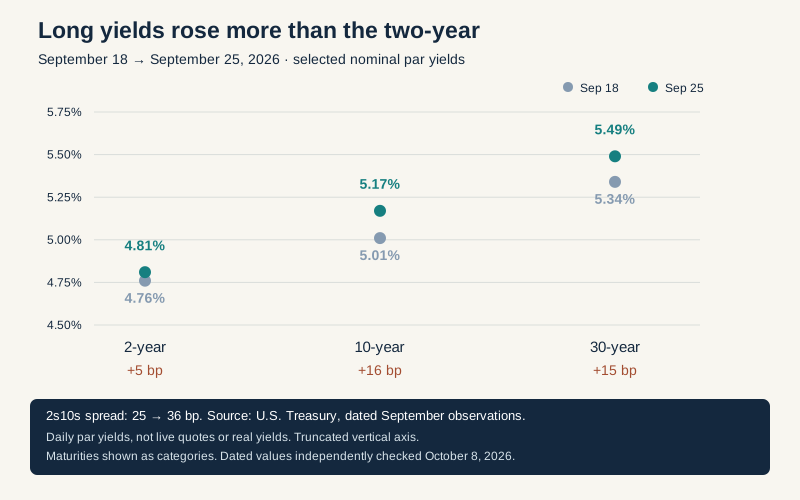
The cleanest quantitative baseline is the Treasury curve. Between September 18 and September 25, the two-year daily par yield increased from 4.76% to 4.81%, the ten-year from 5.01% to 5.17%, and the thirty-year from 5.34% to 5.49%. That is a 5, 16 and 15 basis point rise, respectively. The ten-year less two-year spread widened from 25 to 36 basis points. Treasury observations.
| Nominal par yield | September 18 | September 25 | Change |
|---|---|---|---|
| 2-year | 4.76% | 4.81% | +5 bp |
| 10-year | 5.01% | 5.17% | +16 bp |
| 30-year | 5.34% | 5.49% | +15 bp |
The morning source describes weaker futures and renewed oil pressure after Friday's relief. A common timestamp and contract basis for its equity, oil, dollar, gold and volatility quotes has not been established, so those precise levels are excluded. That leaves a narrower market dashboard, but a more defensible one. The curve is a completed-session reference, not a claim about where bonds were trading at Monday's open.
2. A steeper curve raises a company-level question
This was a bear-steepening over the week: yields rose, with the longer maturities rising more. The arithmetic does not establish the cause. It cannot, by itself, tell us how much came from inflation compensation, real yields, Treasury supply or term premium. In particular, nominal yields alone do not prove that real yields spiked.
The equity implication depends on the balance sheet. A profitable platform can fund investment from retained cash. A developer that must borrow before a campus produces revenue faces a different timing problem. Higher funding costs can reduce the value of a project even when its expected demand is unchanged. A delay makes that worse if interest, construction overhead or equipment depreciation starts before customer billing.
The counterargument is stronger earnings. If productive investment lifts profit and cash generation fast enough, firms can absorb more expensive capital. The useful test is therefore the return on incremental investment and the cash collected along the way. Applying one higher-rate story to every semiconductor supplier, software company and infrastructure operator misses that distinction.
3. Growth looks different once the vintages are corrected
The growth figures in the source snapshot need correction. The Atlanta Fed's September 25 GDPNow estimate was 5.0% annualized growth for the third quarter. It was a model nowcast, down from 5.1% on September 17, not a fourth-quarter forecast or an official GDP result. The third quarter had not ended. Dated GDPNow commentary.
The BEA release available at this cutoff put second-quarter real GDP growth at 1.5% annualized. Its August 26 second estimate also reported 4.2% growth in real final sales to private domestic purchasers. Those measure different things: the narrower domestic-demand aggregate excludes trade, inventories and government. The September 30 revision is outside this edition's window. BEA's then-available estimate.
That supports a more interesting question than a simple growth-boom slogan. Can resilient domestic demand and investment coexist with an uneven headline growth path and expensive financing? Yes, but it leaves substantial dispersion across businesses. A strong nowcast does not establish broad earnings upgrades, and annualized quarter-on-quarter growth should not be mistaken for year-on-year growth.
4. Inflation and policy still need separate tests
The latest completed Fed decision was a September 16 quarter-point increase to a 3.75% to 4.00% target range. That is the actual policy baseline. The source's changing probabilities for the next meeting are not a timestamped, independently reproduced futures series, so they are not presented as market consensus. September statement.
August CPI, released September 11, rose 0.4% month on month and 3.4% year on year. Core CPI rose 0.3% and 2.4%, respectively. Gasoline increased 3.9% in the month and accounted for more than one-third of the headline monthly increase. Monthly figures are seasonally adjusted; annual comparisons are not. These are CPI readings, not the forthcoming PCE figures. Archived CPI release.
An energy shock can pressure consumer purchasing power while raising headline inflation. Policy cannot directly produce additional oil, but demand and financial conditions still affect how broadly a shock spreads. This week's releases need to be assessed through the combination of inflation, real consumption and income. A softer price reading accompanied by deteriorating demand has different earnings implications from disinflation with resilient spending.
5. Energy matters through margins as well as inflation
The source snapshot attributes Monday's nervousness to renewed doubts about supply normalization. Its precise diplomatic sequence and barrel-flow claims are not independently established here. A dated official baseline does exist: the EIA's September 9 outlook assumed continued Hormuz constraints into the fourth quarter, forecast 5.7 million barrels a day of Middle East crude production shut-ins in the fourth quarter, and projected U.S. distillate inventories below 100 million barrels in October. These were forecasts and assumptions, not measured September 28 outcomes. September EIA forecast vintage.
The company implications are not uniform. Upstream producers respond to realized prices and production costs. Refiners depend on product margins, throughput and maintenance. Transport companies face fuel costs but may recover part through pricing or surcharges. Utilities and power equipment suppliers operate through still different contracts and regulatory arrangements.
That is why a broad energy-versus-technology rotation is an incomplete framework. The better questions are who can pass through costs, how quickly, and whether demand holds after that repricing. An actual improvement in flows and inventories would be more useful evidence than another optimistic headline.
6. NVIDIA's buyback headline needs a timing boundary
The morning source already described an additional $150 billion NVIDIA repurchase authorization and $235 billion of remaining authority. A company release dated September 28 independently corroborates those amounts and the expectation of execution through fiscal 2028. However, the issuer page does not establish its posting hour. This is a claim present in the original snapshot with same-date issuer corroboration obtained during later review, not an independently timestamped premarket announcement. Issuer release.
The distinction in economics is equally important. Authorization permits repurchases; it does not mean the money was already spent or that the stock has a guaranteed buyer at a particular price. Capital returns can be supported by a strong cash engine while customers elsewhere in the infrastructure chain face deployment delays.
The relevant comparison is repurchases alongside shares issued, operating cash flow and investment requirements. The authorization does not measure how many customer accelerators are operating, their paid utilization, or the return earned on the facilities housing them.
7. Nscale: financing has its own delivery schedule
Nscale, Akamai and Copilot are carryovers from the weekend research. Monday's distinct addition is the source-reported NVIDIA authorization, with the issuer timing limitation above. Revisiting the earlier deals is useful because their funding and delivery schedules are the framework for evaluating the new headline.
Nscale's September 25 announcement described $3.36 billion of convertible financing, consisting of an initial $2.36 billion tranche at closing and a $1 billion NVIDIA commitment expected to fund in mid-November. It also reported more than $103 billion in total contracted value. Those three figures should not be combined into cash received or current revenue. Nscale announcement.
The financing can support construction and equipment purchases before services begin. That improves a project's ability to proceed, but it leaves execution, customer concentration and contract economics to underwrite. Convertible financing also has a different eventual capital structure from recurring operating cash flow.
The useful milestones are funds available, equipment ordered, power delivered, customer acceptance and billable service. A large contracted-value figure can provide visibility while still leaving a difficult bridge between spending and collections. The size of the announcement alone does not tell us whether that bridge is adequately funded.
8. Akamai makes the CPU side of the buildout concrete
Akamai's September 24 announcement provides firmer evidence of demand beyond accelerators: an $11.6 billion, seven-year commitment for Anthropic CPU workloads. The filing makes the conditions important. Payment commitments depend on delivery and service availability, and each project's seven-year term begins when that service starts. Potential additional business of up to $9 billion is conditional rather than part of the initial committed total. Announcement; Contract disclosure.
Akamai estimated approximately $5.5 billion of associated capital expenditure, including about $1.7 billion of additional 2026 spending to secure components such as memory, while leaving its 2026 revenue guidance unchanged. That is a concrete example of spending preceding the revenue ramp. It should focus attention on activation schedules, procurement, operating costs and financing, rather than a simple annual average of the contract headline.
Agent workloads can involve orchestration, code execution, retrieval and state management alongside inference. This agreement supports the relevance of CPU infrastructure to that broader workload. It does not establish a universal CPU shortage, quantify GPU substitution or validate every claimed rental-price increase.
9. Qualification helps; usable capacity remains the milestone
NVIDIA's September 21 DSX Ready announcement describes a qualification program for power and cooling products, initially including battery energy storage systems and cooling distribution units. The program has defined testing and qualification boundaries. It does not replace site engineering or certify that a whole campus has become operational. DSX Ready announcement.
The practical sequence still runs from permits and firm power through facility completion, installation, commissioning and customer acceptance. Better component qualification can reduce integration uncertainty. It cannot make an unavailable grid connection appear, and it does not establish profitable demand for every commissioned machine.
The source's large estimates of warehoused GPUs and construction completion rates lack a defined universe and sufficient primary support. Those figures are excluded. A project-level delay, actual acceptance date and financing obligation provide a much better foundation for analysis than a striking industry-wide figure that cannot be reproduced.
10. Agent products move the question from seats to accepted work
Microsoft's September 25 Copilot announcement introduced Home, Code and Autopilot with staged rollout and preview language. Home and Code were to roll out through Frontier, while Autopilot was expanding to private preview at month-end. That does not establish broad availability on September 28. The announcement also distinguishes everyday subscription access from usage-based advanced agent workloads. Microsoft announcement.
For customers, the comparison should include inference, retries, tool execution and human review per accepted outcome. A cheaper token rate can coexist with a more expensive completed task if the system needs more attempts or supervision. For providers, more usage becomes attractive only if retained revenue exceeds the serving and support costs.
Distribution and workflow integration may create an advantage, but launch claims do not prove retention or positive customer returns. The useful evidence is repeated paid usage, the share of work accepted without correction, and whether pricing captures part of the value produced. Unsupported model rankings and robotics productivity anecdotes add little to that calculation.
11. The company map should follow cash flows
| Exposure | What matters next | What could weaken the interpretation |
|---|---|---|
| NVDA and semiconductor suppliers | Repeat orders, collections, customer deployment and margins | Equipment delivery outruns profitable customer use |
| AKAM | Service activation, component procurement and cash requirements | Capex advances while acceptance or billing slips |
| MU | Upcoming guidance, product mix, shipped volume and supply investment | Commitments are mistaken for current revenue or every memory category is grouped together |
| CRWV, NBIS and ORCL | Billable capacity, utilization, financing and customer concentration | Construction and debt obligations precede cash collections by too long |
| MSFT and agent platforms | Paid adoption and cost per accepted task | Usage grows faster than useful outcomes or retained margin |
| Power, cooling and networking suppliers | Orders converted into installed products at sustainable margins | Qualification or backlog is treated as completed deployment |
This is a research map, not a claim about holdings or a list of trade instructions. The financing burden and revenue clock differ even among companies that share an AI-infrastructure label. A supplier can collect before its customer's project earns a return; the customer's risk does not disappear because someone else has already recognized a sale.
12. What the curated discussion adds, and what it cannot prove
The original source snapshot puts two arguments beside one another: capital returns and large commitments as evidence of durable demand, and power constraints and deployment lag as reasons to question the speed of monetization. Those arguments are worth investigating together. They are not mutually exclusive: strong component demand can coexist with weak returns in part of the customer base.
Original research leads include the NVIDIA authorization discussion, energy and producer economics, deployment-lag commentary, and CPU-infrastructure discussion. Their wording and engagement are not authenticated here. These are selected links retained from the dated source, including continuing themes from earlier days, not a measured ranking of everything posted on X.
The analytical work begins after the headline: define the population, period, contract obligation and observation being claimed. An idle-capacity estimate without those boundaries should not become a precise fact simply because several accounts repeat it.
13. The calendar contains tests, not known outcomes
Pre-cutoff official releases scheduled August JOLTS for September 29 at 10 a.m. Eastern, August personal income and outlays and the third estimate of second-quarter GDP for September 30 at 8:30 a.m., and September employment for October 2 at 8:30 a.m. Micron's August announcement scheduled its September 30 earnings call for 4:30 p.m. Eastern. No later results are incorporated here. JOLTS notice; BEA notice; Employment notice; Micron notice.
Read labor demand, wage growth, hours and revisions together. Read inflation with consumption and income. For Micron, separate pricing, volume, product mix, customer commitments and capital spending. One favorable headline does not resolve all of those questions.
The regular FOMC meetings ahead were October 27 to 28 and December 8 to 9. There was no regular November meeting. That matters when translating the source's loose meeting language into a scenario. Original meeting-schedule announcement.
14. What would change the interpretation?
Constructive broadening: energy supply conditions improve, inflation moderates without a sharp demand break, financing stabilizes, and company results show investment turning into paid service. The evidence would be broader earnings resilience and operating milestones, rather than only another rally in the largest index constituents.
Selective resilience: demand holds but capital stays expensive. Internally funded businesses and suppliers with credible collections retain advantages, while developers with long gaps between spending and billing face more scrutiny. The differentiator would be cash generation and funding needs, not an indiscriminate preference for every AI exposure.
A renewed squeeze: energy pressure persists, inflation constrains policy and infrastructure delivery slips. That would combine pressure on valuation with delayed operating cash flow. A financing package can soften the immediate liquidity problem without restoring the original project return.
The central analytical test is the connection between the macro and company evidence. Higher nominal yields set a tougher hurdle; they do not decide the outcome alone. Large contracts and product launches supply reasons to investigate; they do not complete the underwriting. The next useful evidence is what gets delivered, accepted, paid for, and retained as cash.
Sources & reading notes
Historical edition prepared October 8 using the September 28 morning source message and dated primary evidence; not a live market feed. Source message time is not proof of receipt or a synchronized quote cutoff. Dated government and issuer evidence checked independently; issuer plans and forecasts remain qualified. X URLs are unauthenticated source leads. Analytical scenarios are research, not portfolio instructions. NVIDIA same-date posting time unresolved and disclosed.
U.S. Treasury daily nominal par observations for September 18 and 25. Indicative pricing is at or near 3:30 p.m.; the page is not an immutable historical upload record or a live Monday feed.
September 25 commentary: Q3 2026 real GDP model nowcast of 5.0% annualized. A nowcast is not an official GDP result or a Q4 forecast.
August 26 second estimate: Q2 real GDP rose 1.5% annualized and real final sales to private domestic purchasers rose 4.2%. Later revisions are outside this edition.
September 16 statement: a quarter-point increase to a 3.75% to 4.00% target range. This establishes the policy decision, not probabilities for the next meeting.
August CPI rose 0.4% month on month (seasonally adjusted) and 3.4% year on year (not seasonally adjusted); core rose 0.3% and 2.4%, respectively. Gasoline rose 3.9% in the month and contributed more than one-third of the headline increase.
September 9 forecast vintage. Fourth-quarter shut-ins and October distillate stocks are forecasts, not observed September 28 flows or prices.
Issuer date and authorization amounts independently verified on October 8; exact September 28 posting hour unresolved. Source snapshot reported the claim before cutoff; no claim of independently established premarket issuer availability.
The announced financing includes a future funding commitment; contracted value is not recognized revenue, and IPO conversion had not occurred.
CPU-services agreement with conditional expansion. Initial commitments, possible additional business and estimated capital spending are separate measures.
September 24 filing: delivery, service availability and termination conditions apply. Project terms begin at service start; the September 18 event date is not the filing publication date.
Product qualification within specified boundaries does not establish site commissioning, available utility power or profitable utilization.
September 25 announcement describes staged rollout and private previews. Announced cost controls do not establish measured customer returns.
Preserved from original dated source packet. Direct post wording and engagement not authenticated; curated lead, not platform-wide consensus.
Preserved from original dated source packet. Direct post wording and engagement not authenticated; curated lead, not platform-wide consensus.
Preserved from original dated source packet. Direct post wording and engagement not authenticated; curated lead, not platform-wide consensus.
Preserved from original dated source packet. Direct post wording and engagement not authenticated; curated lead, not platform-wide consensus.
September 1 JOLTS release schedules the August report for September 29 at 10 a.m. Eastern. The later result is excluded.
August 26 release schedules August personal income and outlays for September 30 at 8:30 a.m. Eastern. Later results and annual-update revisions are excluded.
September 4 employment release schedules the September report for October 2 at 8:30 a.m. Eastern. The later result is excluded.
August 26 issuer notice schedules the September 30 earnings call for 4:30 p.m. Eastern. Subsequent results and guidance are outside the information window.
Original August 2024 schedule announcement establishes the October 27 to 28 and December 8 to 9 regular 2026 FOMC meetings. No regular November meeting is listed.