A nearly unchanged S&P 500 concealed a more important split: long-term financing costs remained elevated, smaller and rate-sensitive businesses struggled, and investors kept looking for AI companies capable of turning strong demand into cash. Akamai’s new Anthropic agreement made that last question unusually concrete. The announcement supports a broader compute-demand thesis, while its upfront spending and delivery conditions expose the financing problem behind the headline.
Information window: Thursday, September 24 cash trading and early Friday commentary in the briefing received at 04:33:06 Pacific on September 25. Friday’s durable-goods release, final consumer sentiment and closing prices were still ahead. Primary-source checks below use information available by that window. Social themes describe the saved email’s curated X sample, not a measured ranking of all X activity.
1. Market dashboard: flat equities, expensive money
| Market | Dated observation | Reading and evidence |
|---|---|---|
| S&P 500 | Approximately 7,704; −0.02% Thursday | Source-reported cash-session snapshot: headline stability, with weaker participation underneath. |
| Dow / Russell 2000 | Approximately 51,350 / 2,836; −0.31% / −0.11% | Source-reported; industrial/value and small-cap exposures did not confirm a broad advance. |
| Nasdaq | Described as flat to modestly positive | The email mixes Composite and Nasdaq-100 levels. A precise level is withheld rather than combining different indexes. |
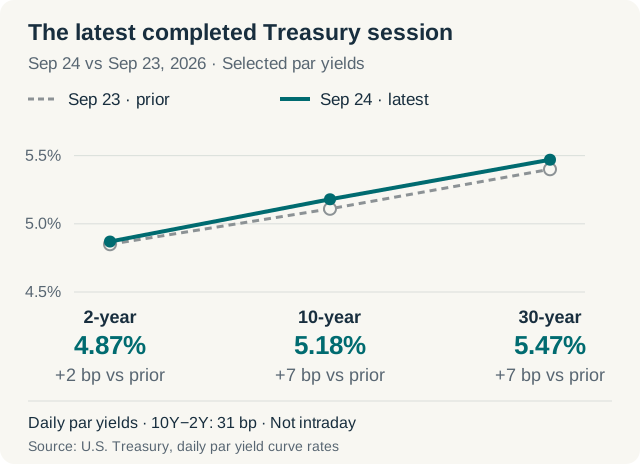
| 2Y / 10Y / 30Y Treasury | 4.87% / 5.18% / 5.47% on September 24 | Verified Treasury daily par yields, not Friday intraday quotes or auction yields. |
| Oil / gold / dollar / volatility | Early-Friday discussion described oil easing, gold firm and equity volatility subdued | Directional source reports only; timestamps and instrument definitions conflict, so no synchronized price dashboard is implied. |
The yield curve’s 10-year-minus-2-year spread was 31 basis points, calculated from Treasury’s matched daily observations. A positive slope does not automatically mean easier financial conditions: both maturities can be high enough to constrain refinancing. This is the key distinction between a comforting index close and the price of capital confronting actual borrowers. Treasury daily rates.
2. Rates and the Fed: separate the policy path from the long end
The dated policy anchor is the Fed’s September 16 increase to a 3.75%–4.00% target range. The email’s October-hike probabilities are trader estimates, not a commitment by policymakers. Its stronger point is that the long end can tighten financing even without a new Fed announcement. Long yields reflect expected short rates, inflation compensation and compensation for holding duration; the curve alone cannot isolate a term-premium shock. September 16 FOMC statement.
For equities, the first effects fall on refinancing, investment hurdle rates and valuation. Homebuilders face a buyer-affordability channel; property owners face debt rollover; utilities must fund assets before recovering their cost; a compute operator may owe interest before a campus begins billing. Strong cash-generating semiconductor suppliers have a different exposure from a leveraged capacity developer, even when both are described as “AI.”
The contrary view deserves weight: high yields can coexist with healthy profits if growth and productivity remain strong. To distinguish that outcome from an inflation squeeze, follow earnings revisions, credit spreads and investment conversion alongside Treasury yields. A falling bond price is not, by itself, evidence that every listed business is deteriorating.
3. Growth, labor and inflation: resilience cuts both ways
The source’s macro discussion combines strong activity surveys with low initial claims. It reports claims of 197,000; that observation remains attributed to the briefing here, rather than being presented as a newly reconstructed labor series. Low layoffs can support household spending and corporate sales, but they do not establish rapid hiring, improving hours or easy job-finding. Those require separate evidence.
Friday’s durable-goods report was the immediate business-investment test. The useful distinction was aircraft-driven headline orders versus nondefense capital goods excluding aircraft, then orders versus shipments. An order points toward demand; shipments are closer to delivered equipment and realized activity. Neither should be casually described as AI spending without industry detail.
Consumer sentiment and inflation expectations were also still pending. Higher expected prices can hurt discretionary confidence even while nominal revenue grows. For retailers, branded goods and restaurants, the test is units, mix and margin—not nominal sales alone. The email’s scattered earnings surprises and tariff-cost figures need issuer-level checks before becoming a company conclusion.
4. Energy, geopolitics, FX and gold
The recurring macro chain in the curated X discussion was energy disruption → inflation pressure → yields → equity financing and valuation. Reports of possible Hormuz-related talks created the opposite chain for a relief move. Those reports did not establish a durable reopening. Physical traffic, insurance costs, delivery times and available supply would be stronger confirmation than repeated negotiation headlines.
Energy exposures also differ. XOM and CVX have upstream sensitivity but diversified operations; a refiner’s economics depend on product margins and feedstock costs; an airline benefits from lower fuel only if passenger demand and fares hold. A lower crude price can represent improved supply or weaker demand, with very different equity consequences.
The dollar, gold and Bitcoin served as cross-checks in the email. Dollar strength can tighten funding conditions and reduce translated foreign earnings. Gold can respond to geopolitical or reserve demand as well as real yields, while crypto remains exposed to liquidity and positioning. Conflicting gold and dollar prints are therefore left out; different benchmarks should not be used to manufacture a precise causal story.
5. Breadth, rotation and positioning
The source describes Nasdaq leadership for the week alongside a softer Dow and weak small-cap participation. It also reports energy and selected defensive sectors holding up on rising-yield days. This is a rotation hypothesis, not a verified advance/decline series: a few large companies can support a capitalization-weighted index while the median stock struggles.
Watch equal-weight versus capitalization-weighted performance, small-cap participation, new lows and the behavior of rate-sensitive sectors together. One weak breadth statistic is not a timing signal. Improvement lasting several sessions would be more persuasive than a single futures bounce after an oil headline.
The X packet also discusses bond-fund outflows, auction weakness, quarter-end pension rebalancing and crowded semiconductor exposure. Exact flow totals and auction tails were not reconciled here. Their analytical value is the competing setup: a persistent funding squeeze versus a positioning-driven bond rebound. Crowding cannot be measured from repeated bullish posts, and an expected rebalance is not a guaranteed order.
6. Akamai and Anthropic: what the contract actually changes
Akamai announced $11.6 billion over seven years for Anthropic CPU workloads, with a possible additional $9 billion. It estimated approximately $5.5 billion of related capital expenditure, including an incremental $1.7 billion in 2026, and left 2026 revenue guidance unchanged. Expansion is an option, not a second signed revenue stream. Akamai’s September 24 announcement.
The filing makes the cash-flow conditions clearer: payment commitments depend on delivery and service availability, each project’s seven-year term begins with service, and termination provisions apply. It also describes customer warrants and an arrangement to purchase memory through Jabil. These are economically relevant contract terms, not footnotes to a single total-contract-value number. Akamai 8-K.
The investment question is now a sequence: procure equipment, activate capacity, meet service requirements, recognize revenue, collect cash and earn an adequate return after operating costs and capital replacement. Dividing the commitment evenly by seven would obscure the ramp. A larger backlog can improve visibility while increasing working-capital and execution demands.
7. AI demand broadens from accelerators to the agent stack
The contract supports a specific demand observation: CPU services matter to an important AI customer. The broader interpretation—that agents increase host-compute demand—is plausible because tool execution, retrieval, browser sessions, orchestration and state management consume resources outside the accelerator. It is not proof that every CPU supplier receives the same uplift or that CPU use replaces GPU inference.
Separate three economics: model inference, the surrounding application and the complete successful task. A model can become cheaper per token while a longer workflow consumes more total tokens, CPU time and external services. Conversely, caching, better routing and fewer retries may reduce cost without reducing the number of useful tasks. The operating measure is cost per completed task at a specified reliability and latency.
For AMD, Intel and server assemblers, the relevant evidence is actual design wins, shipped configurations and margin. For Akamai, it is activation and utilization. For Microsoft, Amazon and other platforms, it is paid adoption and incremental gross profit after inference and support costs. A list of AI-linked tickers cannot substitute for those different revenue drivers.
8. Memory, networking and the next hardware checkpoint
The dated discussion gives memory greater prominence because securing CPUs or GPUs is insufficient if their working data cannot be stored and moved efficiently. HBM attached to accelerators, server DRAM and persistent storage serve different jobs; they should not be treated as one interchangeable shortage. The Akamai announcement’s component spending makes supply planning concrete without establishing a universal memory-price forecast.
For Micron’s forthcoming results, separate pricing from shipped bits, product mix from unit growth, and customer reservations from recognized revenue. For networking and optics suppliers such as Broadcom and Credo, follow link content per system, qualified products, customer concentration and delivery schedules. A bottleneck can increase a supplier’s value per installation but also delay the installation that generates its sale.
Micron’s issuer notice schedules the call for Wednesday, September 30, at 4:30 p.m. Eastern. The date matters because some circulating calendars mislabel the weekday. No earnings result or unsupported consensus estimate is assumed. Micron event notice.
9. Power, permits and the difference between scarcity and delivery
The source’s strongest infrastructure debate pits constrained capacity against claims of purchased GPUs waiting for power or buildings. Those conditions can coexist: equipment can be scarce in one configuration and idle elsewhere because another component is missing. Aggregate warehouse-GPU estimates and company-specific force-majeure allegations in the X packet remain unverified leads.
For a neocloud or campus developer, distinguish announced megawatts, contracted utility service, energized capacity, installed equipment and billable customer usage. For VRT and GEV, equipment orders need conversion, delivery and margin evidence. For CEG and VST, a demand narrative needs contract terms, available generation and regulatory context. None is a mechanical claim that “power wins.”
Higher financing costs raise the price of a delay. The bull case is that scarce, operating capacity earns attractive returns under enforceable customer commitments. The bear case is that upfront capex, concentration and uncertain service dates leave the supplier financing its customer’s ambitions. Customer warrants may align incentives, but they do not independently prove profitable end-user demand.
10. Products, applications and security
One documented application-layer development was OpenAI’s September 23 MentalHealthBench, an open evaluation developed with more than 80 licensed mental-health experts. It measures responses in realistic conversations; a benchmark release is different from evidence of commercial adoption or real-world clinical outcomes. Official benchmark announcement.
The commercial implication is the need for evaluation matched to the task. Enterprise agents likewise require permission boundaries, auditability and reliable recovery, not merely a stronger general leaderboard score. PANW and CRWD are research candidates for security demand, but a larger attack surface does not automatically establish bookings or margin gains for either company.
Unconfirmed subscription tiers, model names and viral performance claims are not treated as product launches. The reader should distinguish a shipped feature, a limited demonstration, a research evaluation and an anonymous leak before assigning revenue significance.
11. X discussion: the arguments worth testing
The saved briefing repeatedly groups the discussion into three debates: whether high yields reflect healthy growth or a financing squeeze; whether oil relief is durable; and whether AI commitments represent attractive customer demand or costly capacity risk. These are recurring themes in the curated sample, not independently measured platform-wide consensus.
- Macro source leads: Deltaone, unusual_whales and ZeroHedge were included in the source’s market ledger.
- Compute-contract source leads: VanquishTrader, NorthMacro and freestyle_error appear in the AI ledger.
Direct post retrieval was restricted during this review. The links preserve the original trail; individual post wording, engagement and supporting claims are not authenticated. The contract analysis above rests on the issuer announcement and filing instead.
12. Calendar, scenarios and what would change the view
At the historical cutoff, Friday’s durable-goods report was due at 8:30 a.m. Eastern and Michigan’s final sentiment report at 10 a.m. The next larger macro checkpoint was BEA’s September 30 release of August income/outlays and the third estimate of second-quarter GDP. Census calendar; Michigan survey; BEA calendar.
| Scenario | Confirmation | Equity implication |
|---|---|---|
| Selective resilience | Activity holds, energy pressure eases only partially, financing remains expensive | Cash conversion and balance-sheet quality matter more than broad AI exposure. |
| Broader relief | Credible supply normalization, calmer yields and improving equal-weight/small-cap participation | Rate-sensitive companies can participate; the argument for concentrated leadership weakens. |
| Funding squeeze | Energy pressure returns, credit worsens and project activations slip | Leveraged infrastructure and distant cash flows face both operating and valuation pressure. |
Research posture: require proof of delivered capacity and sustainable cash generation. A calmer bond market without better breadth would be incomplete confirmation; strong orders without service activation would be incomplete confirmation in AI. These are monitoring conditions, not trade instructions or numerical price targets.
Sources & reading notes
Historical synthesis of dated original briefings and specifically linked primary-source checks; not a live market feed. Market quotes retain their source attribution and session dates. X discussion is the saved briefing’s curated sample, with direct retrieval restricted. Scenarios and company implications are editorial research, not portfolio instructions. Later verification preserves the original information window.
Primary source checked for the specific dated fact or schedule cited. Company announcements establish stated plans and commitments, not independently proven future performance.
Primary source checked for the specific dated fact or schedule cited. Company announcements establish stated plans and commitments, not independently proven future performance.
Primary source checked for the specific dated fact or schedule cited. Company announcements establish stated plans and commitments, not independently proven future performance.
Primary source checked for the specific dated fact or schedule cited. Company announcements establish stated plans and commitments, not independently proven future performance.
Primary source checked for the specific dated fact or schedule cited. Company announcements establish stated plans and commitments, not independently proven future performance.
Primary source checked for the specific dated fact or schedule cited. Company announcements establish stated plans and commitments, not independently proven future performance.
Original-post link preserved from the dated briefing. Direct post wording and engagement were not authenticated; this is a curated source sample, not a platform-wide ranking.
Original-post link preserved from the dated briefing. Direct post wording and engagement were not authenticated; this is a curated source sample, not a platform-wide ranking.
Original-post link preserved from the dated briefing. Direct post wording and engagement were not authenticated; this is a curated source sample, not a platform-wide ranking.
Original-post link preserved from the dated briefing. Direct post wording and engagement were not authenticated; this is a curated source sample, not a platform-wide ranking.
Original-post link preserved from the dated briefing. Direct post wording and engagement were not authenticated; this is a curated source sample, not a platform-wide ranking.
Original-post link preserved from the dated briefing. Direct post wording and engagement were not authenticated; this is a curated source sample, not a platform-wide ranking.
Primary source checked for the specific dated fact or schedule cited. Company announcements establish stated plans and commitments, not independently proven future performance.
Primary source checked for the specific dated fact or schedule cited. Company announcements establish stated plans and commitments, not independently proven future performance.
Primary source checked for the specific dated fact or schedule cited. Company announcements establish stated plans and commitments, not independently proven future performance.