Monday opens with a more constructive market setup and a harder question about AI economics. The morning source describes firmer technology futures, easing crude and a crypto rebound. Underneath that relief, the substantive industry discussion has moved toward usable power, optical interconnects, host processors and the funding needed to turn ambitious capacity plans into revenue.
Information window: Monday, September 21, 2026, before the U.S. cash open. The complete dated briefing was received at 05:38 a.m. Pacific. Friday, September 18 remains the last completed cash session. Overnight and premarket observations are attributed to that source, with different timestamps and contracts kept separate. Monday’s eventual close and announcements whose availability before this window cannot be established are excluded.
1. The starting point: Friday’s uneven close, Monday’s better tone
| Reference | Dated observation | Status |
|---|---|---|
| S&P 500 | 7,650.50; +0.17% Friday | R: original market briefing |
| Nasdaq Composite / Dow | 26,522.55 / 51,682.64; about +0.4% / −0.18% | R: Friday cash session |
| Russell 2000 | 2,860.40; about −0.5% | R: Friday cash session |
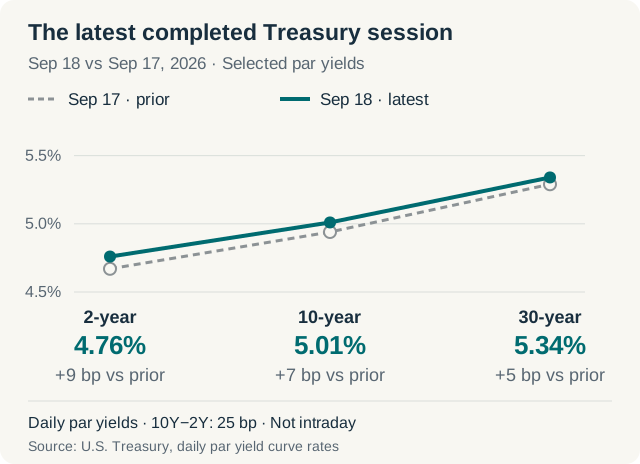
| Two / ten / thirty-year Treasury | 4.76% / 5.01% / 5.34% | V: September 18 daily par observations |
The morning input describes S&P and Nasdaq futures higher as oil eases. It also reports a Friday VIX close near 14.8, a calm equity-volatility reading relative to the concerns expressed about financing and fuel costs. These market quotes were not independently reconstructed. Treasury’s published daily series is the consistent rate baseline. Treasury data.
That distinction matters: an overnight move below 5% in the ten-year, as described by the source, is a new intraday observation. It is not a revision to Friday’s official daily figure or evidence that Monday’s session has already confirmed a lasting change.
2. Cheaper oil helps; it does not undo restrictive policy
The FOMC’s September 16 action left the policy range at 3.75%–4.00%. The September projections’ median year-end funds rate is 4.1%, a conditional forecast rather than a promised next-meeting hike. Precise market-implied odds in the original are not independently verified here. Fed decision; projections.
The price baseline remains August CPI: 3.4% headline inflation over a year and 2.4% excluding food and energy. The corresponding monthly gains were 0.4% and 0.3%. BLS release.
The source’s most interesting macro observation is that Friday’s crude decline did not prevent a Treasury selloff. That is a warning against a one-variable explanation: bond yields can reflect policy expectations, real growth, term compensation and issuance as well as energy. Monday’s relief case becomes stronger if lower fuel pressure is accompanied by sustained easing in financing costs. Oil alone cannot establish that outcome.
3. Labor resilience and equity concentration can coexist
August payrolls increased by 162,000 and unemployment was 4.1%, according to the September 4 release. That was the available monthly labor baseline before this morning; it is not a fresh Monday report. BLS employment report.
Meanwhile, Friday’s reported split favored semiconductors and the Nasdaq over the Dow and smaller companies. The original describes weak participation and new lows exceeding new highs in parts of the market. Those detailed breadth statistics remain attributed, but the index divergence itself defines a useful question: is AI investment supporting a narrow group of suppliers, or starting to improve earnings expectations across the economy?
Equal-weight participation, small-company financing and consumer-sensitive earnings would help answer that question. A low volatility index and a semiconductor rally do not substitute for those checks. Equally, weak participation does not prove that the leading companies lack real demand; concentration is a portfolio and market-structure risk, not automatic evidence of fictitious earnings.
4. Diesel, the dollar and crypto tell different stories
The morning source reports lower crude prices and continued tightness in diesel. Its contract and timestamp differences are too large to create one reliable commodity snapshot, so no synthetic WTI or Brent “current price” is calculated here. The underlying distinction is consequential: a decline in crude can coexist with expensive delivered fuel if refining or transport capacity is constrained.
For energy equities, that creates different exposures across producers and refiners. For the rest of the economy, fuel surcharges and freight expenses may remain sticky after a headline crude retreat. Gold and the dollar are described as relatively subdued in the source, not as decisive confirmation of a new easing cycle.
Bitcoin’s reported overnight rise into the $84,000–$85,000 area belongs to a continuously traded market. The associated short-liquidation narrative is source-attributed and the precise totals are excluded. Crypto-linked equities such as Coinbase and Strategy may respond at the open, but a leverage unwind is not proof of stronger household demand or falling inflation.
5. Optical networking has a dated product catalyst
Marvell’s ECOC announcement describes demonstrations of 2 nm optical technology, including 400G-per-lane PAM4, an 800G ZR/ZR+ pluggable with MACsec and 1.6T coherent technologies. The release also describes a 102.4T co-packaged-optics platform among its demonstrations. These are company-described capabilities and demonstrations, not evidence that all products have reached volume shipments or recognized revenue. Marvell’s ECOC release.
The morning source’s focus on Marvell, Coherent, Lumentum, Ciena, Corning and Applied Optoelectronics therefore has a concrete technology context. Larger clusters need more data moved with manageable power consumption and latency. The commercial questions differ across DSPs, lasers, transceivers, fiber and systems: qualification, design wins, manufacturing yields and customer deployment schedules determine when a technology demonstration becomes an earnings contribution.
MACsec also makes security part of the networking product specification. That is a narrower, more supportable connection between AI infrastructure and security than assuming every security vendor benefits equally from the buildout.
6. Small, usable capacity versus large announced campuses
The original briefing says operators are discussing smaller 20–30 MW opportunities alongside much larger campuses. Those transaction-size claims are not independently confirmed. They illustrate the day’s practical debate: capacity available on a useful schedule can be more valuable than a much larger project that still needs permits, transformers, cooling and a utility connection.
For IREN, Cipher, CoreWeave, Nebius and other developers, announced capacity should be separated into land positions, contracted power, construction, energization and customer acceptance. Each stage has different spending requirements and failure modes. Customer orders arriving ahead of facilities can create costs rather than immediate revenue.
The same distinction applies to memory and cooling. A delivered accelerator does not make a rack operational if another component or the heat-removal system is missing. The research focus is the complete system and its service date. Treating all megawatts as interchangeable obscures geography, redundancy, power pricing and the workload the facility can actually support.
7. Flexible load is an operating contract, not free electricity
The AI Energy Management Alliance, announced September 16 by Emerald AI, Google and NVIDIA, proposes more responsive data-center demand and performance-based connection requirements. Its stated approach includes workload shifting, storage and paired generation, with obligations for response and reliability. Primary alliance announcement.
The investment question is whether flexibility reduces connection delays or total operating cost enough to offset interruptions and added infrastructure. A scheduled batch task differs from a real-time inference service. A cluster that can pause without losing substantial work differs from one that has to restart an expensive computation. Those differences affect the value of every promised megawatt of flexibility.
The source’s ambitious estimates for nationwide capacity unlocked by scheduling are not treated as measured supply. Utility acceptance, site constraints and performance during a real stress event remain essential. This favors examination of contracts and operating evidence rather than assuming an alliance announcement removes the physical bottleneck immediately.
8. Agents expand the compute stack beyond the GPU
The source’s agent-workload discussion highlights orchestration, tool calls and host processors. Its claimed utilization jumps are not verified and are omitted. The useful analysis is that an agent service spends time outside model inference: retrieving data, executing software, validating results and coordinating parallel tasks. A bottleneck in those stages can leave expensive accelerators waiting.
A related local-compute example circulating in the source is real but older. AMD published its four-node Ryzen AI Max+ Kimi K2.5 inference guide on February 25, using a quantized model across desktop systems. This is recirculated technical background, not a new September 21 launch. AMD’s dated guide.
The demonstration establishes one possible deployment configuration, not parity with a production cloud service. Throughput, context length, quantization quality, concurrency, electricity and administration all affect the comparison. Local hardware can change privacy and control choices while still imposing real costs. “No per-token invoice” does not mean zero economic cost.
9. The funding debate needs a cash-flow bridge
The original cites a SoftBank financing narrative, including more than $11 billion of proposed borrowing connected with further OpenAI investment, and large long-range spending and cash-burn estimates attributed to reporting. These figures are source-reported rather than verified financing completions. They are not entered as audited liabilities or certain forecasts. The linked discussion includes Kobeissi Letter’s overnight post, whose content could not be independently read.
The contrast is between a buildout that secures scarce inputs ahead of demand and one that accumulates obligations faster than customers generate cash. Revenue targets alone do not resolve it. The analysis needs operating margins after inference costs, working capital, leases, interest, equipment replacement and the timing of capital contributions.
NVIDIA’s already filed Ohio guarantee is relevant background: contingent support can connect a supplier to tenant credit risk. It is not a new Monday cash payment. August filing. A strong supplier order book and fragile customer financing can coexist; both sides deserve examination.
10. Software adoption must earn back the inference bill
The source does not provide a clean, verified enterprise-software earnings release for this window. Its substantive software debate concerns whether better models produce enough paid usage to justify infrastructure commitments. The relevant unit is successful work delivered, including the cost of retries and human supervision, rather than a benchmark score or token count alone.
That creates distinct questions for platform owners and application companies. Microsoft, Google and Amazon can capture infrastructure and distribution revenue, while an application vendor must show retention and gross profit after model costs. A cheaper model can expand demand or compress the price customers will pay; the effect depends on differentiation and switching costs.
The source also carries a security-incident anecdote that has not been independently substantiated. It is not repeated as a confirmed intrusion. The defensible implication is narrower: agents with tool access require isolation, scoped identity and auditability. More autonomy can increase the value of those controls, but it does not establish a particular vendor’s revenue outcome.
11. Today’s X map and company checkpoints
The morning market map links OptionsPro101 to the premarket setup and Charlie Bilello to the cross-asset context. These overnight and Monday-morning links are retained from the original. The infrastructure discussion also includes older September 20 links such as MorningWoodRsch and noxflux. They are carry-forward discussion, not new announcements authenticated here.
The company checklist follows the actual drivers: Marvell needs a path from optical demonstrations to customer shipments; AMD’s local-inference example needs workload-level economics; NVIDIA needs demand quality as well as system performance; memory suppliers need product-specific pricing; developers need commissioned capacity and cash collection. Intel’s reported Ohio-related talks and ARM sales-confidence chatter remain unconfirmed context, not completed transactions or updated guidance.
12. Catalysts and conditions that would change the reading
The dated morning source flags ECOC, this week’s product events, petroleum data, labor claims and U.S.–China policy headlines. These should be judged by what is actually announced or released, not the market’s anticipation. BEA’s calendar places the next GDP estimate and August personal income and outlays on September 30; Micron’s announced results date is also September 30. BEA schedule; Micron event notice.
Confirmation: lower fuel pressure and stable yields persist, equity participation improves, and infrastructure disclosures show better delivery and economics. Incomplete relief: technology remains strong while smaller companies and funding conditions fail to improve. Invalidation: renewed energy pressure meets higher borrowing costs or evidence of weaker AI utilization and customer funding. The largest risk to a concentrated leadership group is simultaneous disappointment in both the valuation backdrop and the earnings story.
13. Sources and evidence boundary
V identifies specifically checked primary-source facts; company product statements remain claims about their own technology, not independent performance certifications. R identifies dated market and reported observations in the full morning source. X identifies preserved social links and attributed themes, with no independently verified engagement or platform-wide sentiment claim. A identifies the analysis and conditional scenarios. The receipt time is an availability boundary, not a common timestamp for every quote. This edition deliberately retains the pre-open perspective.
Sources & reading notes
Dated research with V primary-source checks, R attributed market/reporting observations, X source-curated social discussion and A editorial analysis. Company announcements establish statements and plans, not independently proven performance or future results. Cash-session dates, source availability and quote windows remain separate. No platform-wide sentiment inference or live quote feed is claimed. This is not a live market feed.
Specifically cited facts were checked against this primary release. Company statements and future plans are not independently audited outcomes.
Specifically cited facts were checked against this primary release. Company statements and future plans are not independently audited outcomes.
Specifically cited facts were checked against this primary release. Company statements and future plans are not independently audited outcomes.
Specifically cited facts were checked against this primary release. Company statements and future plans are not independently audited outcomes.
Specifically cited facts were checked against this primary release. Company statements and future plans are not independently audited outcomes.
Specifically cited facts were checked against this primary release. Company statements and future plans are not independently audited outcomes.
Specifically cited facts were checked against this primary release. Company statements and future plans are not independently audited outcomes.
Specifically cited facts were checked against this primary release. Company statements and future plans are not independently audited outcomes.
Original link preserved from dated source research. Direct X retrieval was blocked in this review; post content, replies and engagement were not independently authenticated. Older posts are labeled as carry-forward context.
Specifically cited facts were checked against this primary release. Company statements and future plans are not independently audited outcomes.
Original link preserved from dated source research. Direct X retrieval was blocked in this review; post content, replies and engagement were not independently authenticated. Older posts are labeled as carry-forward context.
Original link preserved from dated source research. Direct X retrieval was blocked in this review; post content, replies and engagement were not independently authenticated. Older posts are labeled as carry-forward context.
Original link preserved from dated source research. Direct X retrieval was blocked in this review; post content, replies and engagement were not independently authenticated. Older posts are labeled as carry-forward context.
Original link preserved from dated source research. Direct X retrieval was blocked in this review; post content, replies and engagement were not independently authenticated. Older posts are labeled as carry-forward context.
Specifically cited facts were checked against this primary release. Company statements and future plans are not independently audited outcomes.
Specifically cited facts were checked against this primary release. Company statements and future plans are not independently audited outcomes.