Sunday’s central question is who carries the obligation behind the AI buildout. The last cash session left technology leadership intact, while higher financing costs, uneven participation and energy uncertainty complicated the broader market. The weekend adds two concrete research developments: a closer look at infrastructure guarantees, and a Chinese memory producer’s announcement that needs to be separated from the HBM scarcity story.
Information window: Sunday, September 20, 2026. U.S. cash-market comparisons refer to Friday, September 18. The original Sunday notification is partial; this edition supplements it with preserved Sunday research and dated primary releases. Sunday developments are not presented as having been available at the notification’s 04:43 a.m. Pacific receipt. Monday’s session and later announcements are excluded.
1. Friday’s snapshot: resilience without broad participation
The retained notification reports the S&P 500 at 7,650.50, up 0.17% Friday; the Nasdaq Composite at 26,522.55, up approximately 0.4%; and the Dow at 51,682.64, down 0.18%. It puts the Russell 2000 near 2,860, down about 0.5%. These are attributed market observations, not independently reconstructed exchange data. The source rounds the Nasdaq move differently across versions, so the rounded percentage is more defensible than choosing false precision.
| Friday reference | Observation | Evidence |
|---|---|---|
| S&P 500 / Nasdaq / Dow | 7,650.50 / 26,522.55 / 51,682.64 | R: dated original notification |
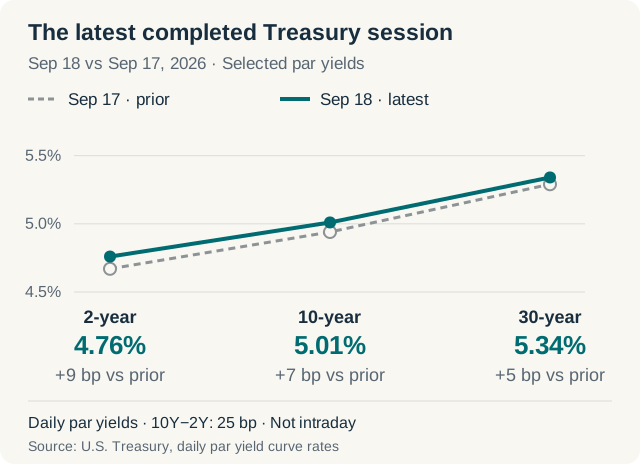
| Two / ten / thirty-year Treasury | 4.76% / 5.01% / 5.34% | V: September 18 daily par yields |
| Ten-year less two-year | +25 basis points | A: subtraction of official observations |
There is no Sunday U.S. cash close. The positive Treasury spread also corrects the source’s loose description of an inverted-to-flat curve. A positive slope does not mean financing is cheap: the level and movement of borrowing costs remain separate questions. Treasury’s dated observations.
2. The Fed has acted; the next move remains conditional
The September 16 FOMC decision raised the policy range by 25 basis points to 3.75%–4.00%, with a unanimous 12–0 vote. Its projections put the median year-end policy rate at 4.1%, but a projection is not an October commitment. The exact next-meeting probability circulating in the source has not been reproduced and is not used here. FOMC statement; September projections.
The inflation baseline is August CPI: headline prices rose 0.4% in the month and 3.4% over a year; core rose 0.3% and 2.4%. Those readings predate the weekend’s energy headlines. A subsequent oil move changes the forward risk, not the already measured August result. BLS August CPI.
The practical tension is that strong infrastructure investment can support activity while policy restrains other borrowers. That combination can sustain selected earnings and still leave housing, smaller companies and long-duration valuations exposed to expensive capital.
3. Labor and breadth answer different questions
The latest monthly labor baseline available to this edition showed August payrolls up 162,000 and unemployment at 4.1%. It offers no evidence of an abrupt weekend labor deterioration. Nor does a resilient employment headline prove that every equity sector should participate equally. September 4 employment release.
The saved Friday account describes semiconductor strength alongside weaker small caps and more declining than advancing stocks. Exact exchange breadth counts are not promoted to verified figures. The useful conclusion is narrower: index performance and the typical stock can diverge when a few large companies carry substantial weight.
For the reopening, the confirmation test is participation: can equal-weight equities and smaller companies improve while the leaders hold their gains? A rally confined to the same AI suppliers would support those businesses’ relative strength, but would offer less evidence of improving conditions across the domestic economy. This distinction matters more than a single green index close.
4. Crude relief does not automatically mean fuel relief
Energy remains the main bridge between geopolitical news and the policy debate. The original snapshot and the saved research contain inconsistent Brent references, so this edition does not combine them into a precise closing or Sunday quote. The dated research discusses supply-route risk, refinery disruptions and persistent diesel pressure. These remain reported themes rather than a synchronized commodity dataset.
The mechanism is useful even without an exact price: crude availability, refinery throughput, product inventories and distribution costs can move differently. Airlines, truckers and consumers purchase refined products; an upstream producer sells a different exposure. Refiners such as Marathon Petroleum, Valero and Phillips 66 therefore need analysis of product margins and operating availability, while Exxon and Chevron require upstream and downstream exposures to be considered together.
The notification references a dollar index around 100.2 and gold near $4,380 at Friday’s close. These source quotes are context only. Weekend crypto trades continuously and cannot be compared with frozen cash-market levels as if all assets shared one observation time.
5. NVIDIA’s guarantee makes the financing question concrete
NVIDIA’s August 17 filing describes residual-value guarantees connected with approximately 4.25 GW of IT load at SB Energy’s Ohio campus, with an OpenAI affiliate as tenant. The initial aggregate payment cap is $105 billion. Obligations depend on specified conditions, including facilities meeting ready-for-service requirements, expected beginning in 2028; tenant insolvency or payment failure can trigger exposure. This is contingent credit support, not $105 billion of cash already spent. NVIDIA’s filed agreement summary.
The analytical implication is that supplier revenue and customer financing may be connected. A supplier can help a project obtain capital today while accepting some future downside if the customer or residual value disappoints. The existence of a guarantee does not establish that a loss is likely. It changes which balance sheet deserves attention when assessing demand quality.
6. Follow the risk from contract to cash
The weekend research cites reports of broader guarantees and insurer participation in infrastructure financing. The aggregate exposure estimates are not independently reconciled here; they should not be added to the NVIDIA cap because scope and overlap may differ. The verifiable project example is enough to explain the economic chain.
A customer signs an offtake or lease; a developer raises project finance; construction and grid work proceed; the facility becomes usable; the tenant accepts capacity; utilization generates revenue; cash is collected. A delay at any step can move interest costs forward while moving revenue backward. A long contract can improve visibility without removing completion risk, customer concentration or equipment obsolescence.
For CoreWeave, Nebius and other infrastructure providers, the research questions are therefore specific: which capacity is energized, which payments are unconditional, who funds overruns, and how much renewal or residual value is assumed? The critical comparison is between contracted cash receipts and all-in cash obligations, including power, leases, interest and equipment replacement.
7. CXMT adds a conventional-memory challenge, not proof of HBM substitution
CXMT’s September 20 announcement says its fifth-generation DRAM platform has entered mass production and introduces two 24 Gb LPDDR5X products for mobile and portable devices. It also claims at least 50% more gross dies per wafer than its previous platform, normalized to an 8 Gb baseline. These are company claims, verified as statements in its release; production yield and customer economics have not been independently audited. CXMT G5 announcement.
LPDDR5X is not HBM. More gross dies per wafer does not equal more saleable output, and a process-density improvement does not establish qualification for an accelerator’s memory stack. For Micron, Samsung and SK Hynix, the consequences depend on product mix, customer qualification, packaging capacity and price competition.
The resulting investment debate is more useful than a blanket “memory shortage” label: conventional products can face expanding supply while advanced AI memory remains constrained. The next company disclosures should be read for segment-specific pricing and capacity allocation.
8. Power-ready capacity needs operating permission
The Sunday research puts community acceptance and project permissions beside the familiar power constraint. Specific local moratorium and polling claims remain reported material; they are not extrapolated into a nationwide construction halt. The broader analytical point is that land control, an interconnection application and a functioning facility are different stages.
A relevant primary development already existed by this weekend: Emerald AI, Google and NVIDIA announced the AI Energy Management Alliance on September 16 to advance data centers that can change electricity demand in response to grid conditions. AEMA announcement.
Flexibility has economic value only if the operator can deliver it reliably and the utility recognizes it in connection terms. Background tasks may tolerate interruption better than a customer-facing service with a strict response-time commitment. Batteries, scheduling and generation therefore need to be evaluated against the actual workload and connection agreement, not a generic promise that software will solve the grid.
9. Agents and software: measure the paid outcome
The preserved discussion repeatedly asks whether more capable models translate into better businesses. This weekend does not supply a new verified enterprise-software revenue event, and no model launch is inserted to fill that gap. The recurring research theme is the unit of value: a paid, successful task rather than tokens generated or a demonstration completed.
For an agent product, the cost stack includes inference, retries, tool access, storage and human review. Its usefulness depends on completion quality and the consequences of an incorrect action. A lower token price can be offset by longer reasoning or more attempts. A faster model can still be unsuitable if it requires broad access that an enterprise cannot safely grant.
This links software monetization to security: identity controls, scoped permissions, isolation, logging and approval boundaries can determine whether a pilot becomes a production workflow. That is a research framework, not evidence of a new breach or a forecast of a particular security vendor’s bookings.
10. The X debate is about risk allocation and bottlenecks
The dated research carries forward discussion links from September 13–14, rather than presenting them as new Sunday posts. Its component-shortage theme points to HyperTechInvest; the power-and-land thesis to gulVasikova; workload and energy optimization to murtuza_merc; and distributed-training questions to Alexander Long.
These are source-curated links, not independently authenticated post transcripts or a representative survey of X. The bullish interpretation is that constraints create pricing power for scarce, usable capacity. The skeptical interpretation is that the same constraints increase capital intensity and push returns farther into the future. Both can be true at different stages of the project.
The test is operational: complete racks delivered, usable power available, networking performance sustained and customers paying. Neither an aggregate GPU count nor an announced gigawatt total establishes those outcomes.
11. The coming week’s research agenda
Monday’s reopening should first test whether energy headlines change actual financing conditions and market participation. The dated source also flags this week’s optical-networking events, petroleum data, labor claims and potential U.S.–China policy headlines. These are scheduled or reported catalysts; this Sunday edition does not know their eventual outcomes.
Beyond the immediate week, BEA’s calendar lists the third estimate of second-quarter GDP and August personal income and outlays for September 30 at 8:30 a.m. Eastern. Micron has announced its fiscal fourth-quarter results for September 30. The former tests the growth-and-inflation narrative; the latter offers a company-level check on memory demand, pricing, capital spending and the distinction between HBM and conventional products. BEA calendar; Micron’s dated announcement.
12. What would strengthen or invalidate the weekend thesis?
Constructive: energy pressure eases, yields stabilize, participation broadens and infrastructure companies show usable capacity converting into collected revenue. That combination would support both the macro relief case and the underlying earnings argument.
Mixed: semiconductor leadership persists but small caps and other borrowers remain weak. New projects continue to attract finance while commissioning slips. This would preserve an industry-specific growth story without confirming a broad economic acceleration.
Stress: renewed fuel inflation coincides with higher borrowing costs, tighter project funding or weaker customer credit. A guarantee becoming more relevant would then be a transmission channel, not merely a footnote. Conversely, consistently improving utilization and cash generation would weaken the claim that the buildout is structurally uneconomic.
No probabilities or target prices are assigned. The purpose is to identify the observations that separate these paths, with attention to both the business and the financing supporting it.
13. Sources and evidence boundary
V denotes a fact checked against a linked primary release, including company statements whose ultimate outcomes remain uncertain. R denotes a dated reported observation retained from the original notification or saved research. X denotes source-attributed social discussion; post text and engagement were not independently authenticated. A denotes the analysis, calculations and conditional scenarios developed here. Treasury figures are daily par observations, not live quotes. The partial Sunday source remains a limitation; the additional depth comes from recoverable dated material, not invented market detail.
Sources & reading notes
Dated research with V primary-source checks, R attributed market/reporting observations, X source-curated social discussion and A editorial analysis. Company announcements establish statements and plans, not independently proven performance or future results. Cash-session dates, source availability and quote windows remain separate. No platform-wide sentiment inference or live quote feed is claimed. This is not a live market feed.
Specifically cited facts were checked against this primary release. Company statements and future plans are not independently audited outcomes.
Specifically cited facts were checked against this primary release. Company statements and future plans are not independently audited outcomes.
Specifically cited facts were checked against this primary release. Company statements and future plans are not independently audited outcomes.
Specifically cited facts were checked against this primary release. Company statements and future plans are not independently audited outcomes.
Specifically cited facts were checked against this primary release. Company statements and future plans are not independently audited outcomes.
Specifically cited facts were checked against this primary release. Company statements and future plans are not independently audited outcomes.
Specifically cited facts were checked against this primary release. Company statements and future plans are not independently audited outcomes.
Specifically cited facts were checked against this primary release. Company statements and future plans are not independently audited outcomes.
Original link preserved from dated source research. Direct X retrieval was blocked in this review; post content, replies and engagement were not independently authenticated. Older posts are labeled as carry-forward context.
Original link preserved from dated source research. Direct X retrieval was blocked in this review; post content, replies and engagement were not independently authenticated. Older posts are labeled as carry-forward context.
Original link preserved from dated source research. Direct X retrieval was blocked in this review; post content, replies and engagement were not independently authenticated. Older posts are labeled as carry-forward context.
Original link preserved from dated source research. Direct X retrieval was blocked in this review; post content, replies and engagement were not independently authenticated. Older posts are labeled as carry-forward context.
Specifically cited facts were checked against this primary release. Company statements and future plans are not independently audited outcomes.
Specifically cited facts were checked against this primary release. Company statements and future plans are not independently audited outcomes.